If you’ve ever picked up a Japanese Switch or PS5 game expecting English menus and gotten a screen full of kanji instead, you’ve run into the real issue that trips up most visiting collectors — and it isn’t quite “region lock.” Understanding the actual mechanics of language support, and knowing which Tokyo and Osaka shops consistently stock multi-language versions, will save you money and disappointment. Here’s how to shop for Japanese game releases without the guesswork.
Why “Region-Locked” Isn’t Quite the Right Word
Both the Nintendo Switch and PS5 are, for the vast majority of titles, region-free at the hardware level — a Japanese cartridge or disc will physically play on a console bought anywhere in the world. What actually limits you is language, not region. Publishers decide, title by title, which languages go on a given regional release. A game sold only in Japan (“JP ver.”) frequently ships with Japanese text and audio only. The exact same game sold as an “Asia version” — the release distributed across Hong Kong, Taiwan, Korea, and Southeast Asia — very often bundles English, Traditional Chinese, Korean, and Japanese on one cartridge or disc, because publishers consolidate that whole region into a single multi-language SKU.
So the real hunting skill isn’t finding a way around region lock — it’s identifying which physical SKU includes English. Once you know that, shopping becomes much easier.
How to Spot a Multi-Language Game Before You Buy
Check the back of the box for small language flag icons or text like “日本語/英語/中文/한국어” — if English isn’t listed, don’t assume the in-game text menu will let you switch it. A few practical checks:
- Box art differences: Asia-version boxes often look nearly identical to the Japan-only version but carry an extra language sticker or a slightly different barcode/catalog number.
- Ask staff directly: “Eigo taiou shiteimasu ka?” (英語対応していますか? — “Does this support English?”) gets a quick yes/no from most shop staff, even with limited English.
- Digital storefronts aren’t the same as physical copies: language support is tied to the specific cartridge/disc print run, not to your console’s system language setting, so changing your Switch or PS5 system language to English won’t necessarily unlock English text in a Japan-only game.
- DLC and online features can still be region-tied: even with a multi-language physical game, downloadable content and some online modes are often gated to the Nintendo eShop or PlayStation Store account region matching the game’s release region. This is the single biggest source of post-purchase frustration — read store listings and online forums for the specific title before buying if DLC matters to you.
Akihabara: Your First Stop for New and Used Games
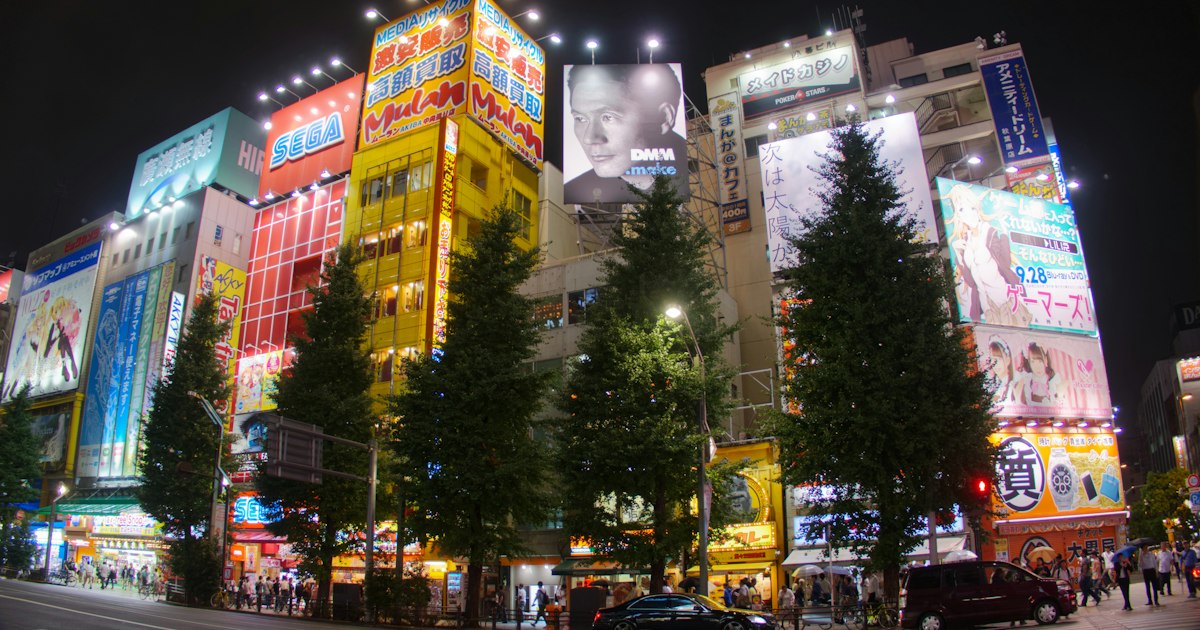
Tokyo’s Akihabara (take the JR Yamanote or Sobu line to Akihabara Station, or the Hibiya/Ginza subway lines) is still the single densest concentration of game retailers in Japan. For new releases, Yodobashi Camera’s Akiba branch and the nearby Sofmap stores carry current Switch and PS5 titles at standard retail pricing — expect roughly ¥5,000–7,480 for a new Switch game and ¥7,480–9,460 for a new PS5 game. For used and retro stock, Super Potato (a few minutes’ walk from the station, upstairs in a building full of neon signage) is the best-known destination, alongside Trader and Geo branches scattered through the district. Used games at these shops typically run ¥990–3,000 depending on age and demand. Most shops open around 10:00 or 11:00 and close between 20:00 and 21:00; weekday mornings are noticeably quieter than weekend afternoons, when the main strip gets genuinely crowded. If you’re also browsing for other secondhand electronics while you’re there, it’s worth knowing the district’s specialist shops extend well beyond games — see this guide to Akihabara’s specialist gear shops for a sense of the neighborhood’s broader electronics culture.
Den Den Town: Osaka’s Equivalent, With Less Crowding
Osaka’s Nipponbashi/Den Den Town district (a short walk from Nipponbashi Station on the Sakaisuji or Sennichimae subway lines) functions as Akihabara’s quieter southern counterpart. It has a similar mix of chain electronics stores and independent used-game shops, generally with shorter queues and slightly more negotiable browsing time. Because it draws more regional Asian tourism than Akihabara, you’ll find a higher proportion of shops actively stocking Asia-region multi-language cartridges and discs, since local staff are used to fielding exactly this question. Hours mirror Akihabara — late morning opening, early evening closing — and the district is noticeably calmer on weekday afternoons than weekends.
Official Retailers and Chain Stores Worth Checking
Bic Camera and Yodobashi Camera both have large stores in most major cities (Tokyo, Osaka, Kyoto, Nagoya, Sapporo) and carry current new releases plus a modest used selection. These are reliable, fixed-price, and the easiest place to get a straight answer on tax-free paperwork at checkout, since purchases over ¥5,000 before tax at participating stores qualify for Japan’s consumption-tax exemption for visitors — bring your passport. If a clerk flags or rejects your tax-free receipt at the airport, this guide on fixing a rejected tax-free receipt walks through the recovery steps. Book Off, primarily known for secondhand books and media, also carries used games cheaply (often ¥500–2,500) but has the least reliable stock of multi-language titles since turnover depends entirely on what locals trade in.
Budget, Mid-Range, and Splurge Strategies
On a budget, stick to used games at Book Off, Geo, or Trader, and prioritize titles you’ve already confirmed (via online databases or the box itself) have an Asia multi-language release — you’ll pay ¥1,000–3,000 for games that retailed at full price a year or two ago. Mid-range shoppers should go straight to Yodobashi or Bic Camera for new releases where staff can confirm language support on the spot. If you’re after something rare — a limited print run, a collector’s edition, or an out-of-print multi-language cartridge — Super Potato and specialist Den Den Town shops are worth the splurge; prices for genuinely scarce titles can run ¥8,000–20,000+, and these shops are more likely to have display cases of exactly this kind of inventory.
Common Mistakes to Avoid
The most frequent error is buying a Japan-domestic game assuming the Switch or PS5’s region-free hardware guarantees English support — it doesn’t. The second is buying DLC or season passes on a different regional storefront than the base game, which frequently fails silently or won’t appear in-game. Third, shoppers sometimes mistake a Japan-only re-release for the original multi-language Asia print because the cover art is identical; always check the catalog number or ask staff rather than relying on box art alone. Finally, if you’re combining this errand with a broader Tokyo or Osaka itinerary, build in buffer time — both Akihabara and Den Den Town reward slow browsing, and using a transit app that handles complex routing well, as discussed in this comparison of Japanese transit apps, makes hopping between shop clusters far less time-consuming than it looks on a map.