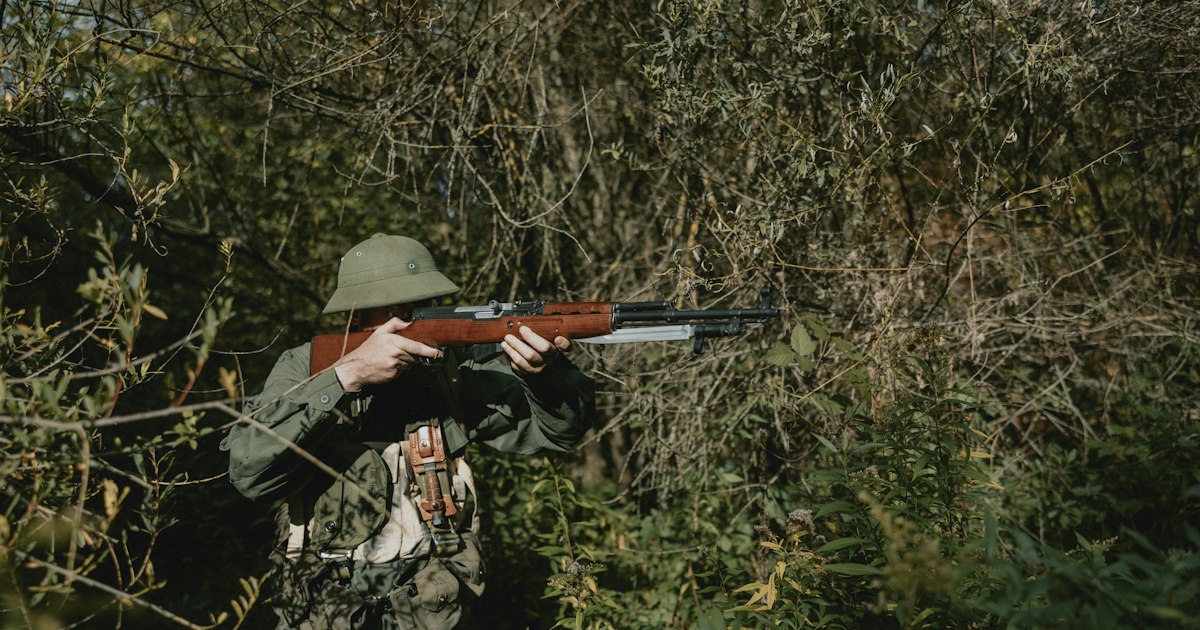
Photo by Taiwangun on Unsplash
Airsoft — known locally as sabage (survival game) — is one of Japan’s most under-the-radar hobbies for visitors who want something more active than a museum day. The country that gave the world Tokyo Marui, the manufacturer most serious airsoft players still measure their gear against, has hundreds of dedicated fields ranging from muddy forest battlegrounds to indoor arenas lit up like a laser-tag arcade. Most are far more tourist-friendly than you’d expect: no license, no club membership, and often no gear of your own required.
What Is Sabage, and Is It Legal for Visitors?
Japan regulates airsoft guns by muzzle energy rather than appearance. Under the voluntary industry standard followed by manufacturers and fields alike, replicas sold and used domestically are capped at 0.98 joules of muzzle energy — low enough to fall outside the legal definition of a firearm, which is why you can walk into a shop and buy one with no permit. That same rule is why you shouldn’t bring an airsoft gun from home: anything stronger than the Japanese limit, or anything customs judges as too realistic, risks being seized on arrival. The easy workaround is to simply rent at the field — everyone does, including most Japanese players.
Age limits vary by field. Full-power rifles and gas blowback pistols are usually restricted to players 18 and over, while lower-powered “junior class” guns are often open to kids from around 10, always under adult supervision. Check the specific field’s rules before you book, since a few operators set the minimum age higher for walk-in foreign guests without reservations.
Where to Find a Field
Fields fall into three broad categories. Outdoor forest or quarry fields are the classic sabage experience — sprawling, wooded, and often built around old military-surplus vehicles or bunker sets; most of these sit in Chiba, Saitama, Ibaraki, or the hills of Yamanashi, an hour to ninety minutes outside central Tokyo. Urban indoor arenas, common in areas like Akihabara and Shin-Okubo, trade scenery for convenience — no weather, no mud, and games that run in short, high-intensity rounds. Then there are the mega-complex operators with multiple themed fields on one site (CQB mazes, open “jungle” zones, sniper ranges), which tend to run the most English-accommodating booking systems since they see steady walk-in tourist traffic on weekends.
If you’re road-tripping rather than basing yourself in Tokyo, several rural fields sit near highway rest stops and are easy to combine with a longer itinerary — the same logic covered in our guide to renting a campervan or RV in Japan applies well here, since a field day pairs naturally with a night at a michi-no-eki en route to the mountains.
What a Day Actually Costs
Budget roughly ¥4,000–¥7,000 for a full beginner package at most fields: field admission, a rental gun, a full-face mask or goggles, and a starter bag of BBs are usually bundled together. From there, expect add-ons: extra biodegradable BBs (required at outdoor fields to avoid environmental fines) typically run ¥1,000–¥1,500 per 2,000 rounds, spare magazines rent for around ¥500 each, and lockers are another ¥300–¥500. A casual half-day player can realistically get out the door for ¥5,000; someone who wants to burn through ammo in every match can easily spend ¥10,000–¥12,000.
On the splurge end, some fields offer private “VIP” reservations — exclusive use of a themed zone with a guide-translator for a group, often ¥20,000–¥40,000 total for a few hours, which is worth it if you’re traveling with non-Japanese-speaking friends and want to skip the briefing-in-Japanese-only problem entirely. Many rural and indoor fields are cash-only or cash-preferred, and ATMs are scarce once you’re out past the station, so bring enough yen for the whole day.
Getting There
Urban indoor arenas are the easiest: most sit within a 5–10 minute walk of a JR or subway station, so no car is needed. Outdoor fields are the opposite — many only run a free shuttle bus from the nearest station on weekends and holidays, with no public transport option on weekdays. If you’re driving, Google Maps or Japan’s Navitime app handle field addresses fine, but double-check the field’s own homepage for the shuttle pickup point and time, since it’s often a specific exit or convenience store rather than the main station entrance. Reserve the shuttle slot in advance where possible — popular fields fill the morning bus first.
Best Season and Timing
Spring (March–May) and autumn (October–November) are the sweet spot: comfortable temperatures under a mask and tactical vest, and outdoor fields are dry rather than churned to mud. Summer is brutally humid, and running around in full gear risks real heat exhaustion — if you play July–August, pick an early morning slot or an air-conditioned indoor arena instead. Winter is workable and often less crowded, but rural fields can be muddy-to-frozen depending on recent weather, and some close entirely during the rainy season in June. Weekday bookings, where available, are quieter and sometimes discounted versus the weekend crowds of regular hobbyists.
Common Mistakes First-Timers Make
- Assuming you can bring your own replica. Don’t pack an airsoft gun in your luggage — rent locally instead.
- Skipping the mask fit-check. Full-face protection is mandatory at essentially every field; a loose rental mask that slips during a sprint is the single most common injury cause. Ask staff to adjust the strap before the first round.
- Wearing sandals or shorts. Closed shoes and long sleeves/pants are required at outdoor fields — BBs sting, and the terrain is uneven. Rental vests are available but rarely rental pants or shoes.
- Not bringing cash. Many fields, especially rural ones, don’t take cards.
- Booking blind without checking English support. Call or email ahead; a surprising number of fields will reply in English if asked directly, even if their website is Japanese-only.
- Underestimating BB consumption. A single starter bag rarely lasts more than two or three games — buy a second bag before you start rather than running out mid-match.
Taking the Hobby Home
If a day on the field turns into a genuine interest, Japan is also one of the best places in the world to shop for the gear itself. Secondhand otaku and hobby chains occasionally stock retired Tokyo Marui models, military surplus gear, and display replicas alongside their usual figures and manga — Mandarake’s larger stores are worth a browse if you want a display piece or collectible rather than something to pack in checked luggage, since functional airsoft guns generally can’t be exported back through most countries’ customs without a permit. A patch, cap, or tactical pouch from the field’s own shop makes a much simpler souvenir than the gun itself.
Whether you spend half a day at an urban arena in Akihabara or a full afternoon storming a forest bunker in Chiba, sabage is a rare chance to do something genuinely active and social on a Japan trip — and one that most visitors never even realize is on the table.