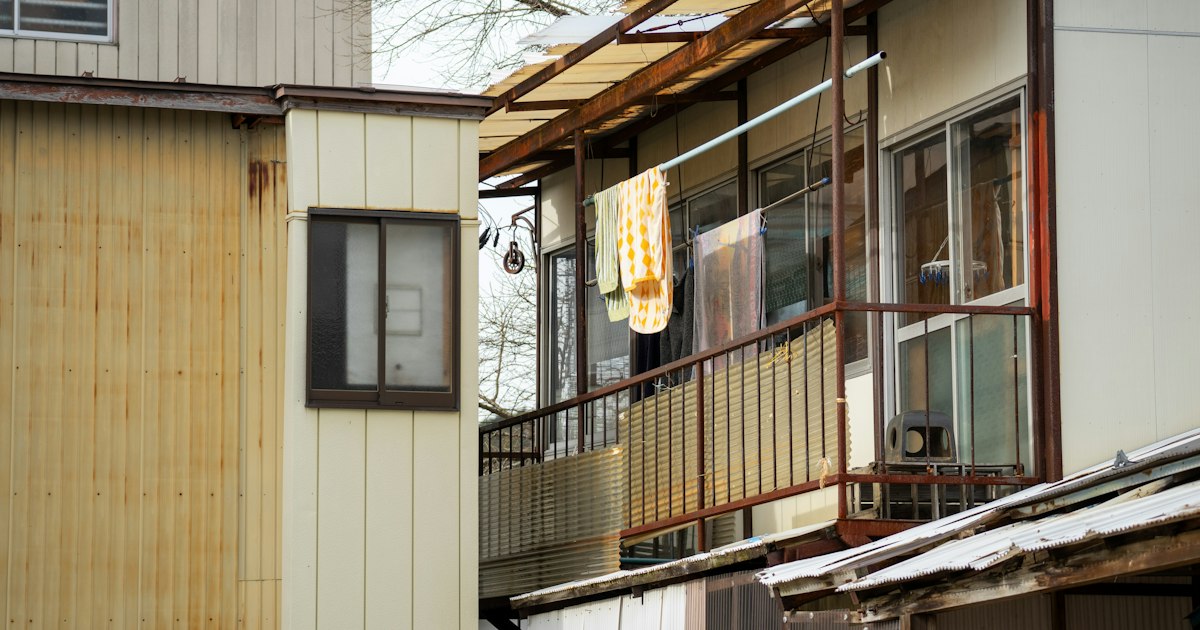
Photo by Jong Hyuk Lee on Unsplash
Open the balcony door of almost any Japanese apartment and you’ll see it: a pair of metal poles, a cantilevered bracket bolted to the wall, and a row of t-shirts snapping in the wind. Clothes dryers are common in Western homes but still a minority appliance in Japan, which surprises a lot of visitors who book a monthly apartment rental or long-stay Airbnb expecting a machine that does both wash and dry. This guide explains why line-drying is the default here, how the pole-and-rack system actually works, and what to buy if you’re setting up a short-term household yourself.
Why Japan never fully adopted the clothes dryer
A few practical reasons stack up. Japanese housing is small, and a dedicated dryer takes floor space that most apartments simply don’t have — washing machines are almost always installed outdoors on a balcony or in a tiny utility alcove, not in a closet with a stacked dryer unit. Electricity pricing and circuit capacity also play a role: most residential outlets are wired for 100V/15A, and a full-size electric dryer draws enough power that it’s awkward to run alongside other appliances without tripping a breaker. Gas dryers exist and are popular in some regions (Hokkaido and other cold, humid areas where outdoor drying isn’t practical in winter), but installing one means running a gas line, which landlords rarely bother with for rental units.
There’s also a cultural and practical preference: sun-dried laundry is considered fresher-smelling and gentler on fabric, and electricity costs for running a dryer for every load add up fast. Combined washer-dryer units exist and are increasingly common in newer apartments and business hotels, but they use a condensation or heat-pump drying cycle that’s slow (often 3-4 hours) and not very powerful compared to a vented Western dryer — fine for a few items, frustrating for a full family load.
How the outdoor pole system works
Japanese balconies come pre-fitted with two L-shaped brackets (sao-kake, サオ受け) bolted to the wall or railing, spaced roughly 1.5-2 meters apart. You buy a telescoping aluminum pole (monohoshi-zao, 物干し竿) separately and rest it across the brackets — it’s not fixed in place, which is why typhoon season matters (see below). Hangers and a pinch-style multi-peg hanger (pants hanger, pinch hangers for socks and underwear) hang directly off the pole. Many renters also use a freestanding two-tier drying rack (a stand called a monohoshi-dai) on the balcony floor or indoors for delicates, towels, or on rainy days.
If you’re renting an apartment without a balcony pole already installed, or your short-term rental lacks a rack, here’s where to buy:
- Budget (¥500-1,500): Daiso, Seria, or Can Do (the big 100-yen-ish shops) sell small folding indoor racks, pinch hangers, and short poles for under ¥1,500.
- Mid-range (¥2,000-5,000): Nitori and Kohnan Home Center carry telescoping aluminum poles (adjustable roughly 1.6m-3m), rust-resistant stainless versions, and sturdier folding floor racks with 20+ pegs.
- Splurge (¥6,000-15,000): Nitori and Kainz sell retractable ceiling-mounted drying systems (pulley-operated, foldable arms) that tuck away when not in use — popular in newer condos with limited balcony space.
If you’re outfitting a whole short-term household rather than just laundry gear — pots, an electric kettle, bedding — it’s worth a single trip to a large home center like Nitori, Kohnan, or Cainz rather than piecing things together at convenience stores. If you also need an outdoor-leaning or camping-style folding rack, Decathlon Japan occasionally stocks compact collapsible drying racks in its camping section, useful if you’re staying somewhere without a balcony at all.
Best season and timing for line-drying
Japan’s climate makes outdoor drying genuinely seasonal, not just a lifestyle choice:
- Spring (March-May) and autumn (October-November): Ideal — low humidity, consistent sun, laundry dries in a few hours.
- Tsuyu, the rainy season (early June to mid-July, varies by region): The hardest stretch. Humidity routinely sits above 70%, and clothes can take two full days to dry outside, developing a musty smell if left too long. This is when a dehumidifier, an indoor rack near a window, or the dryer cycle on a combo washer-dryer earns its keep.
- Summer (July-August): Hot and sunny but extremely humid and intensely hot — check a fresh weather forecast before planning a big wash, and see our guide to extreme heat warnings (necchusho keikai) if you’re also trying to time outdoor errands around the hottest hours.
- Winter (December-February): Cold but dry air actually works well for line-drying in most of Honshu and further south; Hokkaido and Tohoku are the exception, where freezing temperatures mean indoor drying or a gas dryer is standard.
Many Japanese households simply check the daily weather forecast’s “laundry index” (sentaku shisu), broadcast on NHK and most weather apps, before deciding whether to hang wash outside.
Common mistakes renters and visitors make
- Leaving laundry out during a typhoon or storm warning. Those poles rest loosely in their brackets — a strong gust can knock the whole pole, laundry and all, off the balcony and onto the street below, or worse, into a neighbor’s space. Bring everything in if there’s a typhoon advisory.
- Drying after dark. It’s a minor faux pas in many buildings — nighttime humidity means clothes won’t actually dry and may pick up moisture again, and visible laundry at night reads as slightly careless to Japanese neighbors.
- Hanging laundry where it’s visible from the street on the ground floor, or over a shared corridor rail in an apartment building — check your lease or building rules (kanrikisoku), since some complexes restrict visible drying for aesthetic reasons.
- Assuming a “washer-dryer” combo dries like a vented machine. If the listing says 洗濯乾燥機 (sentaku kansoki), budget real time — a full dry cycle is often 3+ hours and clothes may come out only semi-dry, needing a short finish on the rack.
- Forgetting detergent and pole are sold separately from the apartment. Furnished short-term rentals usually provide a washing machine but not always a pole, rack, or hangers — check the listing photos or ask the host before arrival, or plan a quick stop at a 100-yen shop on day one.
Where to buy on short notice
If you’ve just moved into a share house, monthly mansion, or long-stay Airbnb and discovered there’s no drying equipment at all, convenience is more important than price. Daiso and Seria locations are extremely common near train stations and can supply a basic indoor rack and hangers within minutes. For anything sturdier — a real telescoping pole or a proper floor-standing rack — a nearby Nitori, Kohnan Home Center, or Cainz is worth the extra trip; most are reachable by local train or bus from central residential neighborhoods and stock everything needed to fully kit out a kitchen and laundry setup in one visit, similar to how you’d handle other apartment basics like an induction cooktop if your rental uses one instead of gas.
For travelers rather than long-term renters, note that most hotels and business hotels either have on-site coin laundry (dryer included, usually ¥100-300 per 30 minutes) or a laundry service — you generally won’t need to buy drying equipment unless you’re in a rental apartment for a week or more.