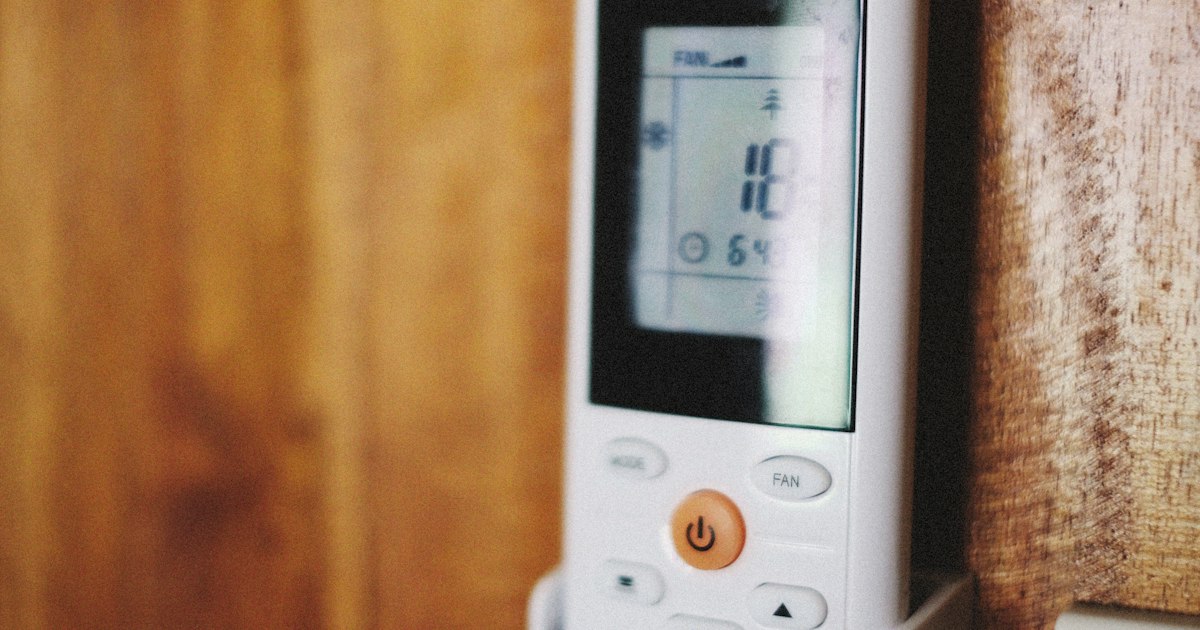
Photo by Alexey Demidov on Unsplash
You’ve just checked into a machiya rental in Kyoto or an apartment-style hotel in Osaka, it’s July, the room is a sauna, and the air conditioner remote on the wall table has twelve buttons covered in kanji and absolutely nothing that says “cool” or “on.” This happens to almost every visitor at least once. Japanese wall-mounted split-unit air conditioners (the standard setup in nearly all apartments, rental houses, and many small hotels and ryokan) run on remotes that were designed for Japanese residents, not tourists, and the layout varies by brand — Daikin, Panasonic, Mitsubishi Electric, Fujitsu General, and Hitachi all do it slightly differently. Here’s how to actually get warm or cold air out of one without calling your host at midnight.
Why the Remote Looks So Intimidating
Most Japanese AC remotes pack heating, cooling, dehumidifying, fan-only, and sometimes air-purifying modes into one device, plus a timer, a swing/louver control, and an eco mode — all labeled in kanji with small icons that are easy to miss if you’re not looking for them. Unlike the simple “cool/heat/off” dials common in North American window units, these are full climate-control systems, which is actually good news once you know the four or five buttons that matter. The rest you can safely ignore.
The Kanji You Actually Need to Recognize
You don’t need to read Japanese — you need to recognize about six strings of characters:
- 運転 (unten) — “operation,” usually paired with 停止 (teishi, “stop”). This is your on/off button, often a single button toggling both, sometimes two separate ones.
- 冷房 (reibou) — cooling mode. Usually marked with a snowflake icon.
- 暖房 (danbou) — heating mode. Usually a sun icon.
- 除湿 or ドライ (joshitsu / “dry”) — dehumidify mode. Good for humid Tokyo summer nights when you want to pull moisture out without blasting cold air.
- 送風 (soufuu) — fan only, no heating or cooling.
- 温度 (ondo) — temperature, next to up/down arrows (▲▼) to adjust the target degrees, shown in Celsius.
Many remotes have a single mode button you press repeatedly to cycle through cooling → heating → dry → fan, with a small icon changing on the tiny LCD screen each time, rather than individual buttons for each mode. If you see one button labeled 運転切換 (unten kirikae, “operation switch”) or just a button with a mode icon and no kanji, that’s it.
Setting It Up in Under a Minute
Once you’ve found the on/off and mode buttons, the actual sequence is simple: press 運転 to turn it on, tap the mode button until the snowflake (cooling) or sun (heating) icon appears on the display, then use the ▲▼ arrows to set your target temperature — 26–28°C is a normal cooling setting in summer, 20–22°C for winter heating. Point the remote at the receiver on the indoor unit (usually a small window on the front panel) and wait a few seconds; you’ll hear a soft beep and see a light blink to confirm it received the signal. If nothing happens, check that the unit itself has power at the wall or breaker — some rentals cut power to appliances between guests.
Common Mistakes That Leave You Sweating or Freezing
The single biggest mistake is setting the mode to 送風 (fan only) by accident while cycling through options — it moves air around but does nothing to the temperature, so people think the unit is “broken.” Another is leaving the unit on 除湿 (dry) expecting cooling; it will lower humidity but barely touch the temperature, which is fine on a mild, sticky evening but useless during an August heatwave. In winter, guests sometimes forget that Japanese heat pump systems take a few minutes to warm up and may blow cool air initially while the outdoor unit gets going — give it five to ten minutes before concluding it isn’t working. Also watch the timer buttons (タイマー, often with “ON”/”OFF” printed in English): it’s easy to accidentally set a shutoff timer for 1–2 hours without noticing, and you’ll wake up at 3am wondering why the room went silent and warm again.
If you’re traveling in the muggiest months, pairing good remote know-how with the cooling gear Japanese convenience stores and drugstores sell for summer streets makes the transition between outdoor heat and indoor AC much less of a shock to your system.
When the Remote Isn’t the Problem
Some rentals, especially minpaku booked through Airbnb-style platforms, use smart remote adapters (Nature Remo, SwitchBot, or similar) that let the host control the AC from an app. If the physical remote on the wall doesn’t seem to do anything, check your booking’s house manual or messages — the host may have locked the unit to a schedule, or you may need to control it entirely through a link they send you. This is also common in serviced apartments where the AC is tied to a building-wide system. If you genuinely can’t get a response from either the remote or an app after confirming the breaker is on, message your host; don’t assume the unit is faulty, since a surprising number of “broken AC” complaints turn out to be a drained remote battery (it takes two AAA batteries) or a receiver blocked by curtains.
A Few Extra Tips Worth Knowing
If the remote’s small LCD screen has gone blank or dim, that’s almost always a battery issue, not a unit fault — most convenience stores sell AAA batteries for a few hundred yen. Google Translate’s camera mode works well for reading unfamiliar kanji live off the remote if you’re genuinely stuck; just hold your phone over the buttons and it’ll overlay English. Some remotes also have a sticker or QR code applied by the host or property manager with English instructions — check the back of the remote and the wall near the unit before assuming there’s none. And one quirk worth knowing: many Japanese units default to an energy-saving “eco” icon that limits how far the temperature can be pushed in cooling mode; if the room won’t get cooler than 28°C no matter what you set, look for an eco/省エネ button and turn it off.
Getting comfortable with the AC remote is a small thing, but it matters more than it seems on a hot Tokyo night or a freezing morning in a rural minshuku. Combined with other small comfort fixes — like sorting out what to pack for thin-walled hotel rooms — a few minutes decoding the remote on arrival sets you up for a much better night’s sleep for the rest of the trip. And if you end up liking the gadget-heavy, button-dense design of Japanese home appliances, it’s worth browsing other practical Japanese home goods, like a Japanese drip kettle for pour-over coffee at home, before you leave.