Photo by Florencia Gonzalez Bazzano on Unsplash
If you’ve booked an apartment-style stay or a long-term share house in Japan, you’ve probably already met the washing machine that comes with it — usually wedged into a closet-sized “veranda” space just off the kitchen, shorter than your carry-on suitcase, and topped with a lid instead of a glass door. It looks nothing like the machine at home, the buttons are all in Japanese, and there’s no dryer in sight. None of this means it’s broken or old-fashioned. Japanese washing machines are built this way on purpose, for reasons tied to how housing, water, and electricity actually work here. Once you understand the logic, running one takes about five minutes to learn.
Why Japanese Washing Machines Are So Small
Most standalone rental units and older apartment buildings run on a 100V household circuit with a fairly low amp allowance per outlet. A large-capacity machine simply can’t draw enough power on a standard Japanese plug without tripping the breaker, so manufacturers settled on compact motors and drums decades ago and stuck with the format. Capacity is usually listed in kilograms of dry laundry rather than liters — typical rental-unit machines hold 5–7kg, enough for about one adult’s worth of clothes for two or three days, not a family-sized load. Space is the other factor: these machines live outdoors on a balcony or in a slim indoor alcove called a “bōsui pan” (a plastic drainage tray the machine sits in), and that footprint was fixed by the building’s plumbing long before the appliance was chosen. If you’re renting for a month or more and the in-unit machine feels too small for your household, it’s worth knowing that many short-term renters also end up buying secondhand appliances to supplement what’s provided — the same secondhand logic covered in this guide to buying a used kotatsu or space heater applies to small appliances generally: check the plug shape, the manufacture year sticker, and ask about a return window before handing over cash.
Top-Loading vs Front-Loading: What You’ll Actually Find
Top-loading machines dominate the rental and budget market in Japan — brands like Panasonic, Toshiba, Hitachi, and the budget label Haier/AQUA are common. They’re cheaper to manufacture, easier to repair, and don’t need a door seal that degrades over years of humid balcony weather. Front-loading drum machines exist and are marketed as premium, energy-efficient options (often with a built-in heat-pump dryer function), but they cost two to four times as much and are far less common in furnished rentals. If your unit has a front-loader, treat it as a nicer-than-average placement — it likely also has a working dryer cycle, which most top-loaders don’t.
How to Actually Run One
The control panel is almost always a single dial or a row of buttons with kanji labels, but the logic is consistent across brands:
- 電源 (dengen) — power button, usually the only English-adjacent symbol (a circle with a line through it).
- コース / 洗濯 (kōsu / sentaku) — course/cycle selector. The default course (標準, hyōjun, “standard”) is almost always fine; don’t experiment with the others unless you can read them.
- 水位 (suii) — water level, usually automatic based on load weight sensed by the drum.
- スタート/一時停止 (sutāto) — start/pause, typically a large green or blue button.
Open the lid, load clothes loosely (overpacking is the single biggest reason machines stop mid-cycle with an error beep), close the lid, press power, leave the course on standard, and press start. A full cycle — wash, rinse, spin — usually takes 40–60 minutes. There’s no need to add water manually; the machine draws from a cold-water tap behind it that should already be connected and turned on. If nothing happens when you press start, check that small tap first — tenants (and sometimes cleaning staff) turn it off between guests.
Detergent, Softener, and the Net Bag Rule
Japanese detergent is sold as liquid (液体, ekitai) far more often than powder, in bottles with a built-in dosing cap — one capful per standard load, poured directly into the drum before or during fill, not into a separate tray on most compact machines (though some have a small tray for softener, marked 柔軟剤, jūnanzai). A bottle of everyday detergent like Attack or Arial runs roughly ¥400–¥700 at any supermarket or drugstore. Mesh laundry net bags (洗濯ネット) are genuinely non-optional here, not a nice-to-have — Japanese machines agitate more aggressively than many Western ones relative to their size, and bra underwires, delicate knitwear, and anything with a zipper will snag or get twisted without one. A set of three nets costs about ¥300–¥500 at Daiso, Seria, or any 100-yen shop.
Common Mistakes Renters Make
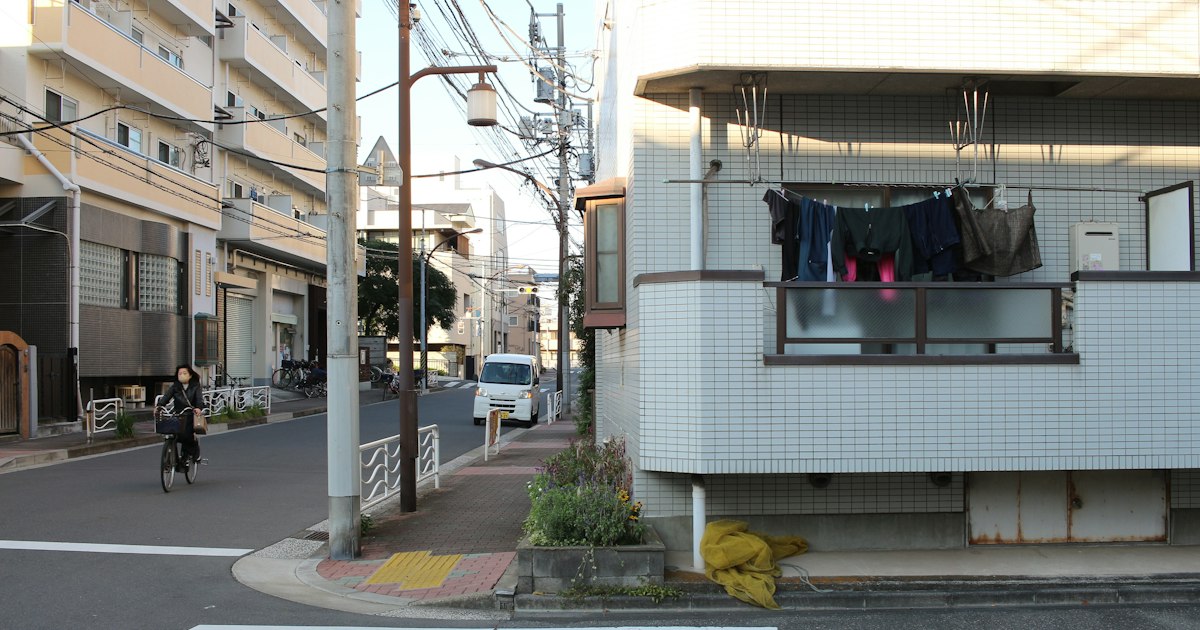
The most frequent complaint from first-time renters is “it doesn’t dry anything” — because it isn’t supposed to. The spin cycle wrings clothes hard, but actual drying happens on a balcony rack (物干し, monohoshi) or an indoor pole, not inside the machine. This makes timing matter: June through mid-July is the rainy season (梅雨, tsuyu) across most of Honshu, when indoor drying with a dehumidifier or the apartment’s built-in 24-hour ventilation fan is far more reliable than hanging clothes outside. Winter, by contrast, is one of the best drying seasons — low humidity and strong sun, even though the air is cold. Other common missteps: running the machine late at night in a thin-walled apartment building (check house rules — some buildings restrict laundry hours to roughly 8am–9pm out of courtesy to neighbors); forgetting that the drain hose empties into that plastic floor tray and can overflow if it’s cracked or blocked with lint; and assuming “standard” and “quick wash” courses use the same amount of water — quick courses use less water and rinse less thoroughly, which matters if you’re washing anything you’ll wear against skin.
Coin Laundries as a Backup
If your in-unit machine is broken, too small for a big load (bedding, for example), or you just want a dryer, coin laundries (コインランドリー) are everywhere, even in small towns, and most run 24 hours with no staff on site. A standard wash costs roughly ¥300–¥500 depending on machine size, and large commercial dryers run about ¥100 per 10–20 minutes — a full dry usually takes ¥300–¥500 in coins. Bring exact change or a prepaid IC-compatible machine; few accept credit cards. This is also the fastest fix if you’re trying to get bedding or towels properly dry before checking out of a short-term rental, since hang-drying a duvet cover on a small balcony rack can take two full days in humid weather.
Buying or Upgrading for a Longer Stay
For stays under a few months, live with what’s provided — buying an appliance rarely pays off. For stays of six months or longer, a new budget top-loader (5–6kg, Haier or AQUA brand) runs about ¥25,000–¥35,000 from Yamada Denki, Bic Camera, or Nojima, often with free delivery and old-unit disposal bundled in if you ask. Mid-range (7–9kg, Panasonic or Toshiba, quieter motor, better rinse) lands around ¥50,000–¥80,000. A splurge front-loader with a heat-pump dryer function starts around ¥150,000 and up — worth it only if you’re staying a year or more and genuinely can’t access outdoor drying space. Secondhand appliance shops (リサイクルショップ) near university neighborhoods sell lightly used units for ¥8,000–¥15,000, often with a short warranty; just confirm the drain hose and power cord are included, since sellers sometimes strip those for parts.