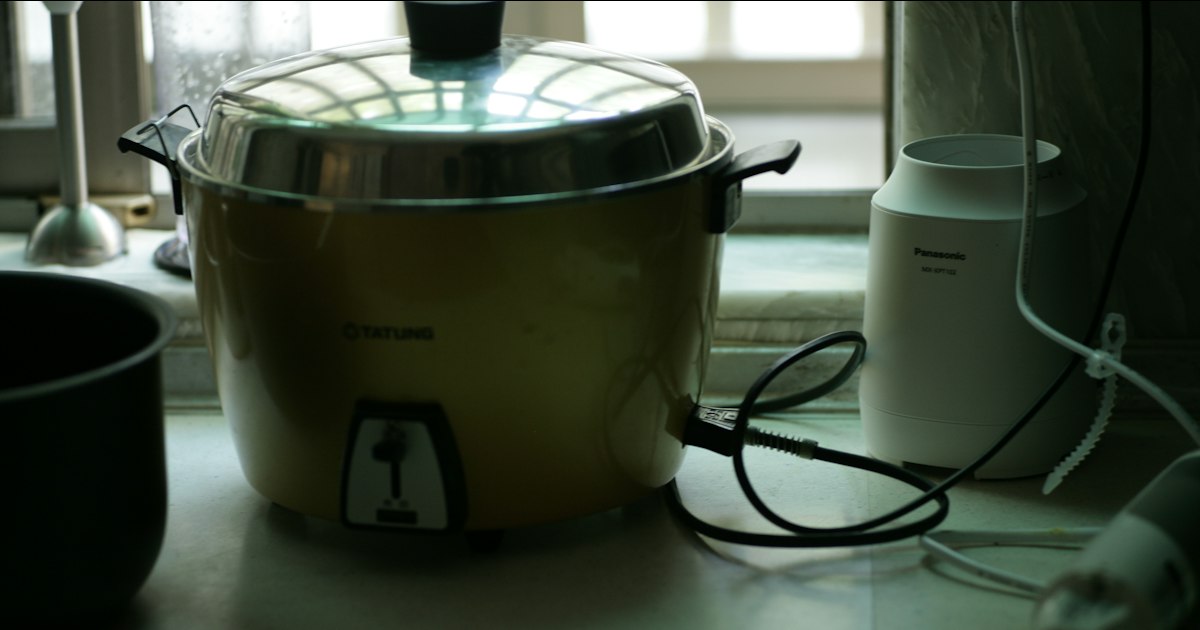
If you’re staying in Japan for more than a week or two — a share house in Osaka, a weekly mansion near a hospital, a dorm room during a language program — plain white rice from a convenience store gets old and expensive fast. A mini rice cooker sized for a single room solves that, and Japan happens to make the best tiny ones in the world. Here’s how to pick one, where to buy it, and the rules nobody mentions until you’ve already plugged one in.
What counts as a “mini” rice cooker
Japanese rice cookers are measured in go (合), a unit equal to about 180ml of uncooked rice, roughly one adult portion once cooked. For a single person in one room, you want a 1-go or 1.5-go cooker, sometimes labeled “0.5–1.5合” on the box. These are genuinely small — about the footprint of a large mug, 15–18cm tall — and cook enough rice for one or two meals. Anything labeled 3合 and up is meant for a small family and starts to feel bulky on a hotel desk or dorm shelf.
There are two basic types worth knowing:
- Direct-heat single cookers — a simple heating plate under a removable pot, no fuzzy-logic brain. Cheapest, lightest, and the most common “mini” format.
- Micom (microcomputer) mini cookers — scaled-down versions of standard household cookers, with a timer, keep-warm function, and sometimes a porridge or reheat setting. Better rice, higher price.
Where to buy one
Electronics megastores are the easiest option because staff can show you the actual size and you can compare three or four models side by side. Bic Camera, Yodobashi Camera, and Edion all stock compact rice cookers, usually in the small appliances section near the toasters and electric kettles. Yodobashi’s flagship stores (Akihabara, Shinjuku, Umeda) tend to have the widest selection of 1-go models specifically because so many students and short-term workers buy them.
Don Quijote (“Donki”) is the budget option and worth checking first if you’re on a tight timeline — most branches carry at least one no-frills 1-go cooker for under ¥2,000, shelved with other single-person kitchen goods. It’s the same kind of practical, cheap-but-useful shopping hunt as picking up gunte work gloves — low cost, genuinely handy, easy to find in almost any neighborhood store.
If you’d rather not carry it home from a store, Amazon.co.jp and Rakuten both ship small appliances same- or next-day in most cities, and you can filter by capacity (容量) to stay under 1.5合. This is the better route if you’ve already landed and are settling into a share house with no time to shop in person.
Realistic prices: budget, mid-range, splurge
- Budget (¥1,500–3,000): Basic direct-heat 1-go cookers from brands like Koizumi or house brands at Donki. No timer, one-button cook/keep-warm switch. Fine for plain rice, not great for anything delicate.
- Mid-range (¥4,000–8,000): Compact micom cookers from Tiger, Zojirushi, or Iris Ohyama in the 1–1.5合 range. These give noticeably better texture and often include a timer and a porridge setting — useful if you’re ever under the weather, similarly to how travelers stock up on netsusama cooling sheets for the same reason.
- Splurge (¥10,000+): Small-capacity versions of Zojirushi’s pressure or induction-heating (IH) lines. Overkill for a single room unless you’re staying six months or more and care a lot about rice quality.
Check hotel and dorm rules before you plug anything in
This is the step most first-time buyers skip. Many Japanese hotels, weekly mansions, and dorms restrict or ban cooking appliances in guest rooms — not because of the electricity, but because of fire codes and smoke detectors tied to a building-wide alarm system. Business hotels are usually the strictest; serviced apartments and share houses are usually fine, especially if there’s already a shared or in-room kitchenette. A few things to confirm with the front desk or landlord before buying:
- Whether cooking appliances are allowed in-room at all (ask specifically about rice cookers, not just “cooking” — some places distinguish a rice cooker from a hot plate).
- Whether there’s a shared kitchen you’re expected to use instead.
- If the room has only one outlet behind the TV or desk, confirm it isn’t on a shared circuit with the AC — mini cookers draw 300–500W, which is rarely an issue, but older buildings sometimes trip breakers when multiple devices run at once.
If the property genuinely bans cooking appliances, a mini cooker becomes dead weight, so this is worth a message before you buy rather than after.
Voltage, plugs, and taking one home
Within Japan, voltage is a non-issue: the entire country runs on 100V, and every rice cooker sold here is built for that, with a standard two-pin plug (Type A) that matches Japanese outlets everywhere. The complication comes if you plan to bring the cooker home. Most countries outside Japan, the US, and a few others run on 220–240V, and a 100V-only appliance plugged into that without a step-down transformer will burn out almost immediately — this isn’t a slow-degradation risk, it fails the first time you use it. Before buying one as a souvenir or long-term investment, check your home country’s voltage and budget for a transformer if needed, or look specifically for export/dual-voltage models sold in electronics store tourist-tax-free sections (Bic Camera and Yodobashi both have these, usually on a separate floor from the regular appliance section).
If you’re flying home with one in checked or carry-on luggage, note that mini rice cookers are light (usually under 1.5kg) but bulky for their weight, so they eat into carry-on space fast — worth knowing if you’re already tight on an LCC’s sizing gate, the same kind of allowance crunch covered in oversized carry-on enforcement on domestic LCCs.
Common mistakes
- Buying before checking room rules. Covered above, but it’s the single most common regret — people buy, then find out cooking isn’t allowed.
- Sizing for a family instead of one person. A 3合 cooker looks only slightly bigger in a photo but takes up real desk space and cooks far more rice than one person eats in a sitting.
- Skipping the rinse step. Japanese short-grain rice needs a quick rinse to wash off surface starch before cooking; skip it and even a good cooker produces gummy rice.
- Not checking the keep-warm power draw. Cheap direct-heat models often keep-warm by cycling the full heating element on and off, which is noisier and less efficient than a micom cooker — fine for a night, annoying over weeks.
Timing-wise, there’s no real seasonal angle here — unlike many Japan purchases, rice cookers sell steadily year-round, though stock of ultra-compact models is often best right before April and September, when student move-ins spike in the big cities and stores restock single-size kitchen goods accordingly.