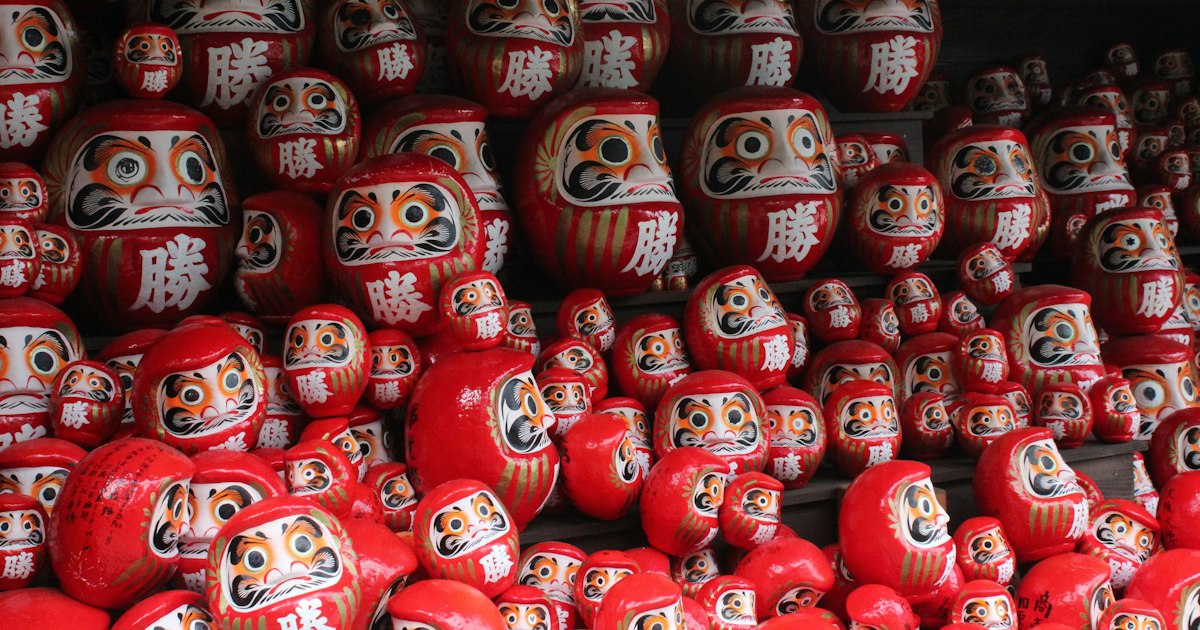
Photo by Issy Doherty on Unsplash
Round, red, and staring at you with two blank white eyes, the daruma doll is one of Japan’s most recognizable talismans — and one of the easiest souvenirs to actually use rather than just display. Modeled after Bodhidharma, the monk credited with founding Zen Buddhism, a daruma is a hollow, bottom-weighted figure that always rights itself when knocked over, a physical reminder of the proverb “nana korobi ya oki” — fall down seven times, get up eight. Here’s how the goal-setting ritual works, where daruma dolls are actually made, and where to buy one that isn’t just mass-produced plastic.
What Is a Daruma Doll, Really?
Traditional daruma are made of papier-mâché over a mold, hand-painted, and left hollow so a weight in the base makes them self-righting (the same okiagari-koboshi mechanism used in some children’s toys). The classic color is red, associated with good fortune and warding off illness, but you’ll now find gold for wealth, white for love or purity, and yellow for study luck, among others. Most are sold with completely blank eyes — the blankness is the point, not a manufacturing defect.
Daruma sit somewhere between souvenir and folk craft, similar in spirit to the hand-turned kokeshi dolls of Tohoku — both are regional crafts tied to a specific production town, both make honest, packable souvenirs, and both reward buying from the source rather than an airport gift shop.
How to Use a Daruma: The Two-Eye Goal Ritual
The ritual is simple and is exactly why daruma make better souvenirs than most: when you set a goal — passing an exam, starting a business, running a race — you pick up a black pen or included ink and fill in one eye, traditionally the left one as you look at the doll. The daruma then sits somewhere visible, one-eyed and watching, as a daily nudge. When the goal is achieved, you paint in the second eye to “complete” it. Politicians famously do this on election night; small business owners do it when a shop opens; students do it before entrance exams.
Traditionally, a daruma is kept for one year and then returned — many people bring their year-old daruma back to the temple or shrine where they bought it (or any temple that accepts them) for a ceremonial burning called daruma kuyo, usually held around New Year, and a fresh daruma is purchased to start the next cycle. This overlaps with Japan’s broader New Year renewal customs, in the same spirit as the seasonal purification rituals covered in our guide to Setsubun, Japan’s bean-throwing festival.
Takasaki: The Daruma Capital of Japan
If you want the real thing, go to Takasaki in Gunma Prefecture, which produces the large majority of Japan’s daruma dolls and has done so since the late 1700s. The city’s version, known as Takasaki Daruma, has a distinctive face with bushy eyebrows shaped like a crane and a mustache shaped like a turtle — both symbols of longevity.
Takasaki is easy to reach: it’s about 50 minutes from Tokyo Station on the Joetsu Shinkansen. The spiritual home of the local industry is Shorinzan Daruma-ji, a temple a short taxi ride (roughly 10 minutes) or a longer bus ride from Takasaki Station; temple grounds are free to enter and generally open from early morning to early evening daily. Several workshops around the city also sell daruma directly and, at some, you can watch or even try the hand-painting process yourself.
The big event is the Takasaki Daruma Ichi (Daruma Market), held every year on January 6th and 7th at Shorinzan Daruma-ji, drawing hundreds of stalls and hundreds of thousands of visitors who come to buy the year’s new daruma and burn the old one. If your trip lines up with early January, it’s genuinely worth the detour — it’s one of the largest daruma markets in the country and far more atmospheric than buying one off a souvenir shelf.
Where Else to Buy a Daruma Doll
You don’t need to go to Gunma to get one, though quality and authenticity vary a lot by where you look:
- Budget (¥500–¥1,500):
- Mid-range (¥2,000–¥6,000): medium daruma (15–20cm) from craft shops, department store New Year fairs (held in December and January), or directly from Takasaki workshops. These are properly hand-painted and a better gift.
- Splurge (¥10,000+): large daruma (30cm or taller), often bought by shopkeepers and companies for a New Year display, available from specialty daruma shops in Takasaki or by special order.
small daruma (roughly 6–10cm) are sold at temple and shrine gift counters nationwide, at Asakusa’s Nakamise shopping street in Tokyo, and at general souvenir shops and even some Don Quijote branches. Fine for a desk-sized keepsake, though quality is often mass-produced.
Outside Gunma, another well-known daruma destination is Katsuo-ji in Minoh, on the outskirts of Osaka (admission is a modest fee, around ¥400), a mountainside temple famous for “victory daruma” bought by athletes, students, and business owners — the approach to the main hall is lined with thousands of orange-red daruma left behind by past visitors, which makes for a striking photo stop even if you don’t buy one.
Choosing the Right Size and Color
Size matters mostly for where you’ll display it and how you’ll get it home. A palm-sized daruma fits in a suitcase without a second thought; anything over 20cm is bulky, and the traditional papier-mâché construction, while surprisingly sturdy, isn’t crush-proof in checked luggage. If you’ve bought a large one, or several as gifts, it’s worth reading our guide to shipping souvenirs home from Japan to compare post office and courier options rather than risk it in a suitcase.
On color: red is the safe, traditional default and works for any general goal. If you’re buying as a gift for someone with a specific ambition, gold (wealth or business success), white (romance or a clean start), or yellow (academic success) are all readily available at craft shops and make the gift feel more personal.
Common Mistakes to Avoid
A few things trip up first-time buyers. Don’t paint both eyes in at the same time — the entire point is that one eye stays blank until the goal is actually achieved; painting both immediately turns it into a plain ornament rather than a working talisman. Don’t assume every daruma you see is from Takasaki — cheaper souvenir-shop versions are often generic imports, so if authenticity matters to you, look for a maker’s mark or buy from a temple shop or Gunma-based retailer. And don’t expect every daruma seller to speak English or have online stock lists — Takasaki’s craft workshops are small, family-run operations, so if you have a specific size or color in mind, going in person or asking your hotel to call ahead works better than trying to order remotely.
When Your Wish Comes True (or Doesn’t)
You’re not obligated to return your daruma to Japan every year. Many visitors simply bring theirs home, paint the second eye whenever the goal is met, and keep it as a memento afterward — there’s no rule against that. If you happen to be back in Japan around New Year with an old daruma in hand, most temples that sell them (Shorinzan Daruma-ji included) will accept old ones for the ceremonial burning even if it wasn’t purchased there, so it’s fine to bring it along rather than store it indefinitely. Either way, it’s a rare souvenir that actually asks something of you after you’ve left the shop — which is exactly why it’s worth buying one on purpose rather than picking one up as an afterthought.