Photo by Dr. C.K. Huang on Unsplash
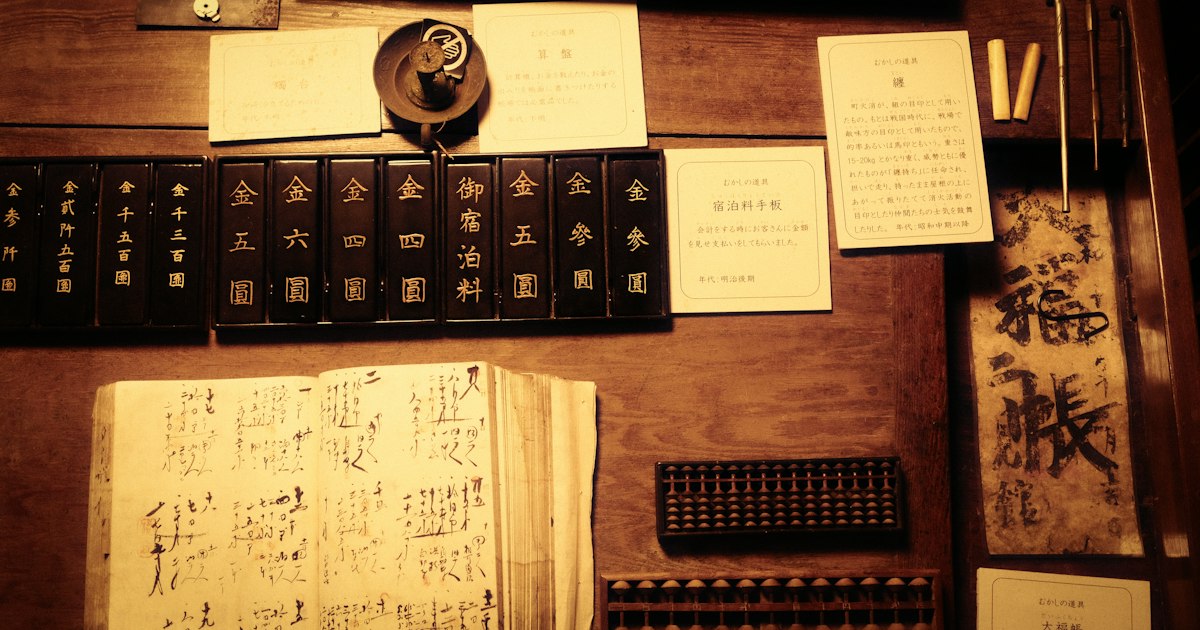
Long after the omiyage snacks are gone and the folding fan has been relegated to a drawer, a soroban sitting on a shelf still does something: it’s a working tool, a piece of design history, and — if you actually use the workbooks that come with it — a genuinely useful way to teach a kid (or yourself) to do arithmetic faster than a calculator. Japan’s soroban (abacus) culture runs deep, from after-school juku that drill flash anzan mental calculation to century-old workshops that still hand-carve the beads. Here’s how to buy a kit that’s worth bringing home instead of a toy-aisle gimmick.
What’s actually in a soroban training kit
A proper starter set has three parts, and it’s worth knowing what each one does before you buy:
- The soroban itself — usually a 23-rod (23-keta) board for children’s instruction, or 13/17-rod for casual adult use. Beads are typically wood-grain resin on budget models, real wood (kaya, sakura) on craft versions.
- Workbooks (soroban drill / renshuu-chou) — graded exercise books, often published by Kumon, Shuchiin, or regional soroban associations, moving from single-digit addition to multi-digit multiplication and division entirely by bead manipulation.
- Flashcards (flash anzan cards) — number cards flipped rapidly to train mental visualization of the abacus (“anzan”), the skill behind those viral videos of Japanese kids solving fifteen-digit sums in their heads without touching a bead.
Buy all three together and you have a self-contained curriculum, not just a souvenir that gets admired once and forgotten.
Where to buy: stationery chains and bookstores
You don’t need a specialty shop to get started — Japan’s big stationery and bookstore chains stock soroban gear as standard inventory, not a novelty section.
- Tokyu Hands and Loft — both carry entry-level sorobans (roughly ¥1,000–¥3,000 for a 23-rod plastic-bead model) in their stationery or educational-toy floors. Branches in Shibuya, Shinjuku, and Umeda are reliably stocked.
- Itoya (Ginza) — the flagship Ginza store has a strong traditional-stationery section and occasionally carries nicer wood-bead sorobans alongside its calligraphy and paper goods, worth a look if you’re already shopping Ginza.
- Kinokuniya and Maruzen — the education/reference floors of these bookstore chains are where the workbooks live. A graded Kumon-style soroban drill book runs about ¥600–¥1,200; flash anzan card sets are typically ¥800–¥2,000 depending on the number of cards and digit range.
- Daiso — for a true budget option, 100-yen shops sometimes stock simplified toy sorobans (¥100–¥500) aimed at toddlers learning to count rather than real calculation; fine as a cheap add-on gift, not as the main kit.
If you’re combining this errand with a day of nicer shopping, Futako-Tamagawa has a quieter mix of boutiques and a Tokyu department store where stationery floors are less crowded than central Tokyo.
The real deal: traditional-craft sorobans
If you want something closer to a collector’s piece than a classroom tool, Japan has two regions officially recognized for hand-made soroban as a traditional craft (dento kogei):
- Unshu soroban (雲州算盤) from Yasugi, Shimane Prefecture — known for precision bead-shaving and use of local persimmon and plum wood. Hand-made Unshu sorobans typically start around ¥5,000 for a basic model and climb well past ¥20,000 for larger, finely finished boards with rosewood frames.
- Banshu soroban (播州算盤) from Ono, Hyogo Prefecture — the historically larger production center, with workshops that still offer factory visits by appointment. Prices sit in a similar range, from a few thousand yen for simple models to tens of thousands for lacquered, decorative pieces.
Both regions are a detour from the standard tourist route, so unless soroban craftsmanship is the point of the trip, most visitors are better off buying a well-made (not hand-carved) soroban in Tokyo or Osaka and saving the workshop visit for a dedicated craft-focused itinerary. If niche artisan shopping already appeals to you, the same impulse that leads people to hunt down suiseki viewing stones applies well here — it’s a small, specific collector’s market, and worth planning around rather than squeezing into a single afternoon.
Budget, mid-range, and splurge picks
- Budget (~¥1,500–¥3,000 total): Daiso toy soroban or Tokyu Hands 23-rod plastic model, one Kumon-style workbook, one basic flashcard set. Enough for a child to start learning.
- Mid-range (~¥4,000–¥8,000): A nicer 23-rod soroban with wood-grain beads from Itoya or a specialty stationer, two or three graded workbooks covering addition through division, a full flash anzan card deck.
- Splurge (¥10,000+): An Unshu or Banshu hand-made soroban purchased directly from a regional workshop or its online storefront, paired with workbooks as a teaching companion rather than the main attraction.
Common mistakes to avoid
- Buying a soroban with the wrong rod count for the workbooks. Children’s curricula are built around 23-rod boards; buying a compact 13-rod travel model and a kids’ workbook set is a mismatch.
- Skipping the workbooks entirely. A soroban without graded drills is just a decorative object — the workbooks are what actually teach the bead techniques (and most are only in Japanese, so a model with furigana or an English supplementary guide, where available, is easier for non-readers).
- Assuming any “abacus” is a soroban. Chinese suanpan and Russian schety use different bead counts and column arrangements; if you want authentic Japanese technique, confirm it’s labeled soroban (算盤/そろばん), not a generic import.
- Buying fragile lacquered models for a child who’ll actually use them daily. Save the decorative craft pieces for display and get a sturdy resin-bead board for real practice.
Timing, packing, and getting it home
There’s no real seasonal rush for this purchase — stock is steady year-round, though late March and early April (start of the Japanese school year) is when workbook selections are freshest in bookstores, since publishers release new editions then. A soroban packs flat and is light, so it travels fine in a carry-on; the main risk is loose beads on well-worn secondhand boards, which is one more reason to buy new. If your kit purchase is part of a bigger shopping haul that’s making your suitcase unmanageable, Japan’s takuhai courier network makes it easy to send bulky buys ahead — see our guide to hotel-to-hotel luggage forwarding and same-day cutoff times for how to route a box of books and a soroban to your next hotel or straight to the airport.
For a souvenir that costs less than a dinner out and comes with a built-in reason to keep using it after the trip ends, a soroban kit is hard to beat — buy it at the stationery store on your way to the station and you’ve already found something most souvenir shops won’t offer twice.