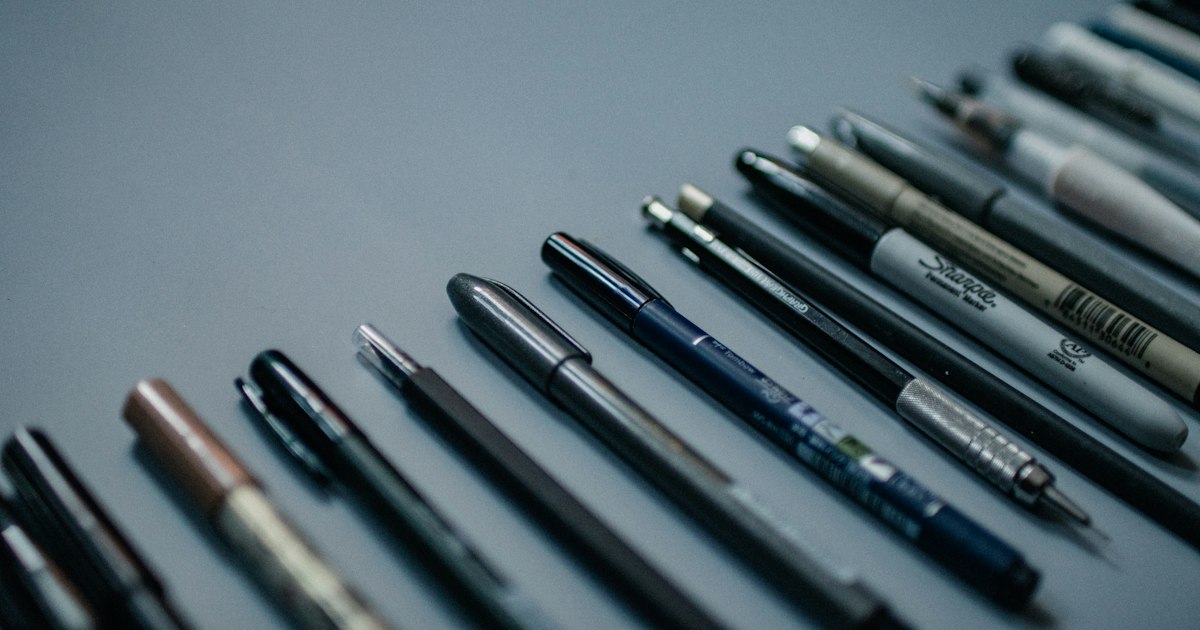
Photo by Kelly Sikkema on Unsplash
Walk into any Japanese office, cram school, or train-commute reading nook and you’ll see the same pen in nearly every hand: a Pilot FriXion, cap color-coded, cap end fitted with a rubbery nub that looks almost like an eraser. That’s because it is one. FriXion pens write like a ballpoint but erase like a pencil, and in a country that runs on handwritten memos, multi-colored study notes, and planner culture, that single trick turned Pilot into a household name and spawned an entire genre of erasable stationery. If you’re the kind of traveler who always ends up browsing a stationery floor somewhere, here’s what’s actually worth buying, what it costs, and the one mistake that ruins the whole pen.
How FriXion Ink Actually Works (and Its One Weakness)
FriXion ink is thermosensitive — it’s engineered to turn transparent when heated past roughly 60°C (140°F), which is exactly what the friction from the rubber tip on the cap generates when you rub it over the line. The ink doesn’t vanish into the page like a solvent eraser; it’s still there, just decolorized. That’s why a FriXion-written document left in a hot car dashboard in August, or a notebook page pressed against a heating pack, can fade on its own without you touching it. The flip side is also true: if erased text gets cold enough (below about -10°C to -20°C, like inside a freezer), the ink can reappear, because the color change is a reversible chemical reaction, not a permanent one. Japanese office workers learn this quickly — nobody signs anything official with a FriXion, and nobody leaves a FriXion-filled memo pad on a car seat in summer.
Where to Buy Them in Japan (and What They Actually Cost)
You genuinely don’t need to hunt. FriXion pens are sold at convenience stores (7-Eleven, Lawson, FamilyMart), 100-yen shops, supermarkets, and every stationery floor in the country. Rough budget-to-splurge pricing:
- Budget: Single FriXion Ball, 0.5mm, at a convenience store or Daiso — around 150–220 JPY.
- Mid-range: FriXion Ball 3 or FriXion Ball 4 multi-color pens (three or four retractable erasable colors in one barrel) — around 400–600 JPY. The FriXion Light erasable highlighter runs about 150–200 JPY each and is genuinely useful for marking up guidebooks or language-study texts without the ink bleeding through.
- Splurge: Limited-edition barrel designs (Sanrio, Studio Ghibli, Disney, sports-team collabs) or the metal-bodied FriXion Ball Knock Zone pens — 800–2,000 JPY, often sold only at specific chains or during seasonal campaigns.
For the best selection under one roof, head to a dedicated stationery store rather than a convenience store. Itoya in Ginza (the flagship “G. Itoya” building, a short walk from Ginza Station, generally open 10:00–20:00) stocks nearly every FriXion variant across several floors along with international exclusives you won’t find in your home country. Sekaido near Shinjuku Station and the stationery floors of Loft or Hands branches (Shibuya, Shinjuku, Ikebukuro) are reliable backups with similarly long hours. If you’re paying by card, it’s worth knowing which cards skip the foreign transaction fee before you start stacking up 500-yen pens — see our guide to no-foreign-transaction-fee credit cards for a Japan trip. Many smaller stationery shops are cash-preferred, so keep yen on hand; a 7-Bank ATM inside any 7-Eleven is the easiest way to withdraw more — details in our 7-Bank ATM guide.
Beyond the Basic Ball: What’s Worth Seeking Out
Once you’re in a stationery store, a few FriXion siblings are worth the extra look:
- FriXion Colors — a 24-color set of felt-tip-style erasable markers, popular for the color-coded note-taking style Japanese students are famous for.
- FriXion Ball Slim (0.38mm) — the fine tip favored for writing small, dense Japanese text in a planner or techo (pocket diary).
- FriXion Stamp — erasable stamp pens shaped like cute characters, aimed at kids but genuinely satisfying for planner decoration.
- Erasable correction tape alternatives — some shops stock FriXion-branded sticky notes and highlighter sets as pre-boxed gift sets, which lead nicely into the next point.
Best Time to Shop: Back-to-School Season and New Year
Stationery stores stock the deepest selection and run seasonal promotions twice a year. The weeks before the Japanese school year starts in early April bring new colorways and school-supply bundles, and late August (before the second semester) does the same on a smaller scale. December into early January is the other sweet spot — stationery shops lean into New Year planner and nengajo season, and FriXion sets show up in gift displays alongside other seasonal gift traditions; if you’re curious about that gifting culture more broadly, our pieces on nengajo New Year postcards and Oseibo and Ochugen gift-giving seasons cover the etiquette. A boxed FriXion multi-pen set in nice packaging is a genuinely well-received, inexpensive souvenir for coworkers back home — it reads as thoughtful without being extravagant.
Common Mistakes Tourists Make
The biggest one is treating FriXion ink as permanent. Don’t use it for anything that needs to survive heat or that has legal weight — immigration forms, postal declarations, contracts. Airport baggage left in a hot hold or a car trunk in summer is enough to fade it. Second mistake: buying only the 0.5mm black ball and missing the multi-color and highlighter versions, which are arguably the more distinctive souvenir since erasable highlighters aren’t widely available outside Japan. Third: assuming every convenience-store FriXion is identical to what you’ll find at Itoya or Loft — the specialty stores carry refills, rare tip sizes, and collaboration designs that convenience stores simply don’t stock, so if you only have time for one stop, make it the stationery floor, not the konbini rack.
Packing Them for the Trip Home
FriXion pens fly fine in carry-on or checked luggage — there’s no liquid-restriction issue since they’re not classified as liquid ink in the way fountain pens can be. The only real packing consideration is heat: don’t leave a bag with FriXion pens in a hot car during a layover, and if you’re also bringing back collectibles from a convention like Comiket, pack the pens away from anything that traps heat in transit, like electronics left in direct sun. Beyond that, they’re about as low-maintenance a souvenir as Japan offers — cheap, light, useful every single day, and a genuine conversation starter the first time a colleague back home tries to erase one and can’t quite believe it worked.