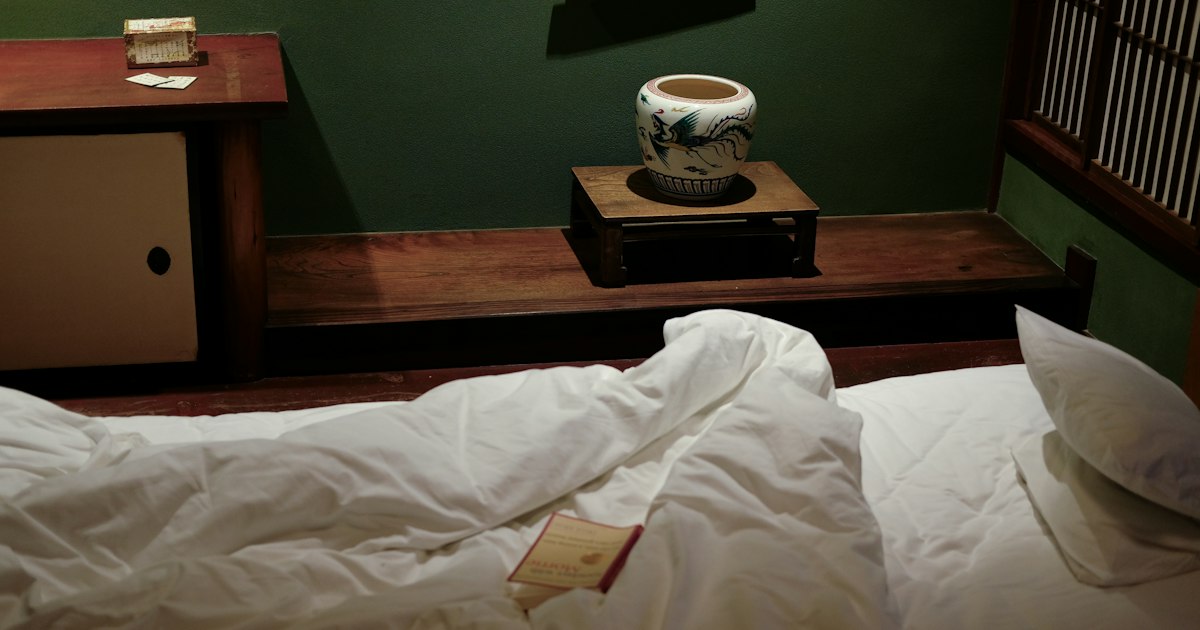
If you’ve booked a winter apartment stay in Japan and noticed the bedroom has no central heating, you’re not imagining it. Most Japanese homes and short-term rentals rely on individual room units—air conditioners that double as heaters, kerosene stoves, or kotatsu—rather than whole-house heating. Once the sun goes down in December or January, that gap shows up fast, especially in bedrooms, where turning on an air conditioner all night feels wasteful and dries out the air. The local fix is denki mofu (電気毛布), the electric blanket, and its cousin the denki shikimono or “under-futon heating pad,” a thin heated mat you place beneath your futon or mattress sheet. Both are cheap, sold everywhere, and worth understanding before your first cold night.
Electric Blanket vs. Under-Futon Heating Pad: What’s the Difference
A denki mofu is a flat, quilted blanket with a heating wire woven through it, used as an extra layer over or under your regular bedding—most people put it directly against their skin, under a normal duvet, rather than on top. A denki shikimono (also sold as “hot carpet” or “電気敷毛布,” denki shiki mofu) goes under the futon or mattress pad and warms from below, which matters in Japan because traditional futon bedding sits directly on tatami or flooring and loses heat downward fast. Many households use both together in the depths of winter: the under-layer keeps the sleeping surface from feeling like a cold slab, and the over-blanket traps warmth around the body. If you only buy one, the under-futon pad usually makes the bigger difference for comfort, since cold rising from the floor is the main complaint in uninsulated Japanese apartments.
Where to Buy One
You don’t need to hunt for a specialty shop. Nitori (Japan’s equivalent of IKEA) carries the widest range of denki mofu and denki shikimono, with stores in most mid-size cities and often open 10:00–20:00 or later. Don Quijote, the discount chain found near major stations, stocks compact single-size versions that pack down well if you’re buying one for a short stay and want to resell or discard it before leaving. Electronics megastores—Yamada Denki, Bic Camera, Yodobashi Camera—carry mid-range and premium brands like Panasonic, Sanyo (now under Haier), and Toshiba, usually with English-language price tags during winter and staff familiar with tourist questions about plug voltage (all are built for Japan’s standard 100V outlets, so no adapter is needed). Amazon Japan and Rakuten also sell them with next-day delivery in most cities, which is often the easiest route if you’ve just arrived and don’t want to carry a bulky box back from a store.
What to Expect to Pay
Budget: a single-size, no-frills denki mofu from Don Quijote or a Nitori basic line runs roughly ¥1,500–¥2,500. These usually have a simple two- or three-setting dial and no auto-shutoff timer, so treat them as a short-stay disposable purchase rather than a long-term investment.
Mid-range: most travelers end up here. A washable denki mofu with multiple heat levels and a built-in timer (so it turns itself off after 1–3 hours or overnight) from Nitori or a department store costs around ¥3,000–¥6,000. Under-futon heating pads in this tier, sized for a single futon, run about ¥3,500–¥7,000.
Splurge: name-brand models (Panasonic, Sanyo/Haier) with dual-zone temperature control, moisture sensors, and fully machine-washable fabric sit in the ¥8,000–¥15,000 range, often as a double-size set covering both a blanket and a fitted under-pad. Unless you’re staying for several months, this tier is rarely necessary.
Best Time to Buy
Selection peaks from late September through October, when stores first roll out winter goods and shelves are fullest. By November and December you’ll still find plenty of stock, though popular sizes can sell out at smaller branches during cold snaps. From late January, many retailers start clearance sales—sometimes 30–40% off—to clear stock before spring, which is a good window if your trip runs into February and you don’t mind slightly reduced selection. After early March, most stores pull electric bedding off the floor entirely and you’ll need to special-order or shop online.
Common Mistakes Renters Make
- Leaving it on all night on full power. Most denki mofu are designed to be set low and left on, or run on a timer, not blasted on high for eight hours. Overheating is the top cause of both discomfort (waking up sweating) and, rarely, equipment faults. Check the dial for a timer function and use it.
- Folding or bunching it while powered on. The heating wire inside can be damaged by sharp folds under weight, especially on cheaper models without reinforced wiring. Lay it flat.
- Assuming it’s machine washable without checking. Many budget models (especially under-futon pads) are not washable at all, or require the heating controller to be unplugged and removed first. Look for “丸洗い可” (fully washable) on the packaging if hygiene matters for a multi-week stay.
- Buying before checking your rental’s bedding setup. If your apartment uses a Western-style bed with a mattress, you want a fitted under-pad sized for that mattress, not a futon-shaped one—sizes are listed in centimeters on the box (e.g., 80×140cm for single futon, 100×140cm for a single bed).
Receipts, Returns, and Moving Out
Keep your receipt until you’ve used the item at least once—Japanese electronics and homeware returns are strict about unopened condition, and a faulty heating element is hard to prove after the fact without the original paperwork. If you do lose a convenience-store or department-store receipt and the unit stops working, the practical options are covered in this guide to same-day electronics returns without a receipt. When your stay ends, don’t just leave the blanket behind or toss it in a regular trash bag—electric bedding with a wired heating element is almost always sorted as a small appliance or “moeru gomi with metal parts” depending on the municipality, and some wards require it to go out on a specific collection day. If you’re in a longer-term furnished rental, this is the kind of question your building’s neighborhood association can clarify; see what foreign renters are expected to do for gomi sorting and the chonaikai for how that typically works.
One More Thing New Renters Often Miss
If you’re settling into a rental for the winter season rather than a hotel, an electric blanket purchase often coincides with other first-week admin: setting up utilities, registering with the local ward office, and occasionally answering the door to an NHK fee collector. That last one surprises a lot of first-time renters, and this explainer on the NHK reception fee is worth a quick read so you know what you’re being asked to pay for before you commit to anything at the door. A warm, functioning denki mofu is a small comfort, but it’s exactly the kind of practical detail that makes a winter stay in Japan feel manageable rather than a string of cold surprises.