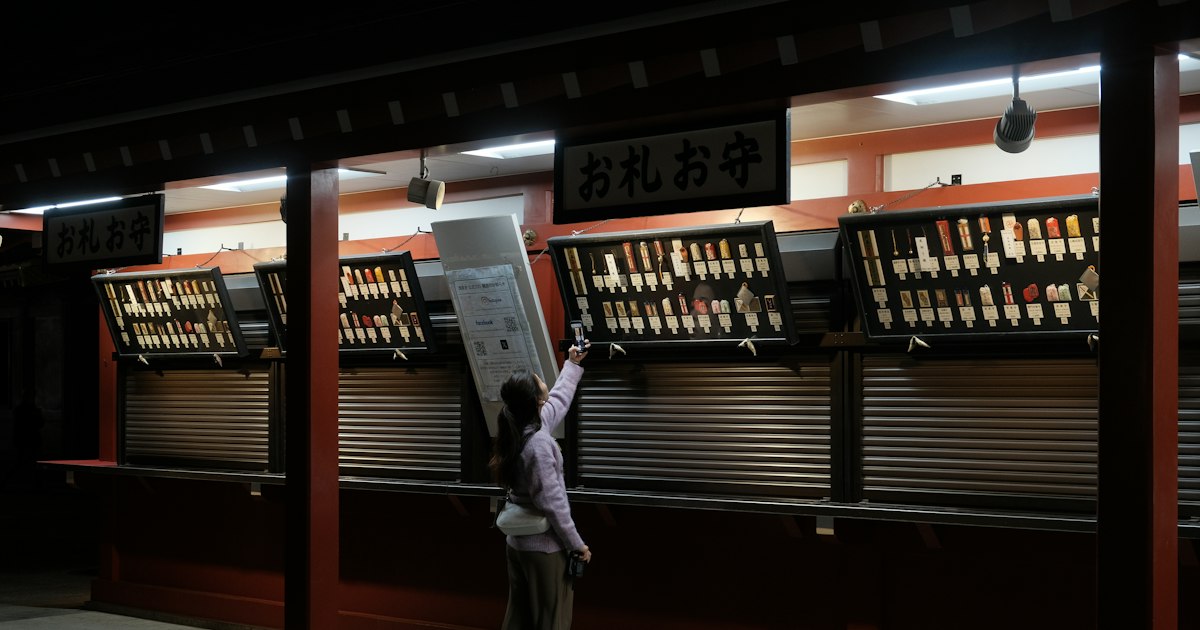
Photo by Nicholas Ng on Unsplash
You bought a lacquered sake cup, a cloth omamori, or a carved wooden charm from the small shop tucked beside the main hall, and once you got back to your hotel you noticed a crack, a loose seam, or a broken clasp. Before you assume you can just march back and demand your money, it helps to know that shrine gift shops operate very differently from a department store counter — and that the fix you’re likely to get is an exchange, not a refund. Here’s what’s realistic, what Japanese law actually says, and how to handle it without wasting a day of your trip.
Why Shrine Shops Don’t Work Like Retail Stores
The small shop (jushamusho or shamusho, often just called the juyosho) selling omamori, ema boards, incense, and souvenirs at a shrine is usually staffed by shrine administrative staff or miko, not trained retail employees. Many of these shops have no cash register system beyond a drawer and a price list, no formal returns desk, and no corporate return policy to point to. “No refunds, no exchanges” (ご返品・ご交換はお受けできません) is the default assumption at most shrines, and it’s often posted in small print near the till or simply understood as custom rather than written anywhere.
This matters because when you ask for a refund, you’re not invoking a store policy — you’re asking an individual staff member to make a judgment call, often in a language you don’t share. Framing your request as a defect issue rather than a change-of-mind issue gets you much further.
What Japanese Consumer Law Actually Entitles You To
Japan’s Civil Code (revised in 2020) does give buyers a real right here: if goods don’t conform to the sales contract — meaning they’re genuinely defective, not just unwanted — the buyer can request repair, replacement, a price reduction, or in some cases cancellation of the sale. This applies to shrine shops as much as any other retailer, because it’s a general contract-law protection, not a consumer-only statute with carve-outs for religious vendors.
The practical catch is enforcement. Small shrine shops rarely have supply chains that make “repair” meaningful, and a price reduction negotiation is awkward through a language barrier for an item that may have cost ¥800. In practice, your legal right translates into one realistic outcome: a same-item exchange if stock allows, done on goodwill rather than a formal claims process.
The Realistic Playbook: Exchange, Not Refund
If you discover the defect while still at the shrine or nearby:
- Go back the same day if at all possible. Shrine shops typically keep shorter hours than the shrine grounds themselves — commonly 9:00am to 4:00 or 5:00pm — even when the gate and approach stay open from dawn to dusk. Don’t assume the shop will still be staffed if you return in the evening.
- Bring the receipt. Most shrine shops do issue a small printed receipt (reshīto) even for a ¥500 charm. Without it, staff have no way to confirm where or when you bought it, and a verbal claim alone rarely moves anyone.
- Keep all original packaging, tags, and the cloth pouch. Omamori and similar items often come bagged or boxed; returning something that looks used or incomplete makes “manufacturing defect” a harder sell.
- Ask for the person who handles the shop, not just whoever is at the counter. At larger shrines (Meiji Jingu, Fushimi Inari Taisha, Itsukushima Shrine), the shamusho often has a slightly more senior staff member who can authorize an exchange; a miko staffing a side table may genuinely have no authority to do anything.
- Expect exchange for the identical item, not cash back. If that exact item is out of stock, some shops will offer a different item of equal value instead of a refund — treat that as a reasonable outcome rather than pushing for cash.
Special Case: Omamori and Other Sacred Items
Omamori, ofuda, and similar amulets sit in a different category from ordinary merchandise because they’re treated as having been blessed or imbued with protective power — they aren’t “products” in the usual sense once purchased. This is why you’ll almost never get a refund on an omamori, even a defective one, framed as a commercial transaction. What you can do instead is return it to a shrine (ideally, but not necessarily, the one you bought it from) for ritual disposal — this is the same process locals use when an omamori reaches the end of its typical one-year lifespan. Most shrines have a dedicated collection box (often near the entrance or shamusho) for old charms, and burn them in a purification ritual, commonly around New Year’s. If your omamori is actually faulty — a torn cord or split seam — a shrine attendant may still swap it for a fresh one as a courtesy, but ask gently and don’t expect it as a right.
Higher-Value Souvenirs: A Different Calculation
Larger shrines with substantial craft shops sometimes sell pricier items — lacquerware boxes, ceramics, or even items like samue-style workwear sold as temple-adjacent loungewear. On a ¥5,000–¥15,000 purchase, it’s worth the extra effort to push for a proper exchange or refund, since the civil-code protection has real teeth once the amount gets significant enough to matter to the shop financially. If you bought something large and fragile — a folding screen or framed artwork from a shrine’s craft annex — and it arrived damaged after being shipped, read up on crating and shipping services for oversized art before you decide whether re-shipping a replacement is even worth the cost versus accepting a partial refund.
If You’ve Already Left Japan
For anything under roughly ¥3,000, it’s rarely worth pursuing a refund by mail once you’ve departed — postage back to Japan plus the shrine’s limited ability to process overseas refunds usually costs more than the item. For something more valuable, email the shrine’s office (most major shrines list a shamusho contact on their website) with photos of the defect, your receipt, and dates. Response times vary widely and a refund by international bank transfer or furikomi is uncommon, so manage expectations.
One thing worth checking before you leave: if you used your shrine-shop receipt as part of a larger tax-free bundle at a department store or airport, a return after departure doesn’t retroactively fix anything, but if a tax-free purchase elsewhere gets questioned at the counter, it helps to know how to resolve a rejected tax-free receipt at departure so you’re not blindsided twice in one trip.
Common Mistakes to Avoid
- Assuming “faulty” and “I don’t like it” get the same response. They don’t — a clear manufacturing defect is a different conversation than buyer’s remorse, and conflating them in your explanation weakens your case.
- Leaving the shrine before checking your purchase. Open the bag and inspect the item at the counter if you can; it’s far easier to resolve on the spot than to come back later.
- Throwing away the receipt. Even a tiny slip of paper is your only proof of purchase at most shrine shops.
- Expecting English-language signage or staff. Have a translation app ready, and keep your explanation simple: show the defect, point to the receipt, and ask “koukan dekimasu ka?” (交換できますか — “can I exchange this?”).
Shrine gift shops run on a different logic than retail chains — closer to a small family business than a store with a policy binder. Go in with modest expectations, a receipt in hand, and a request framed around the defect rather than a refund, and you’ll get the best outcome realistically available.