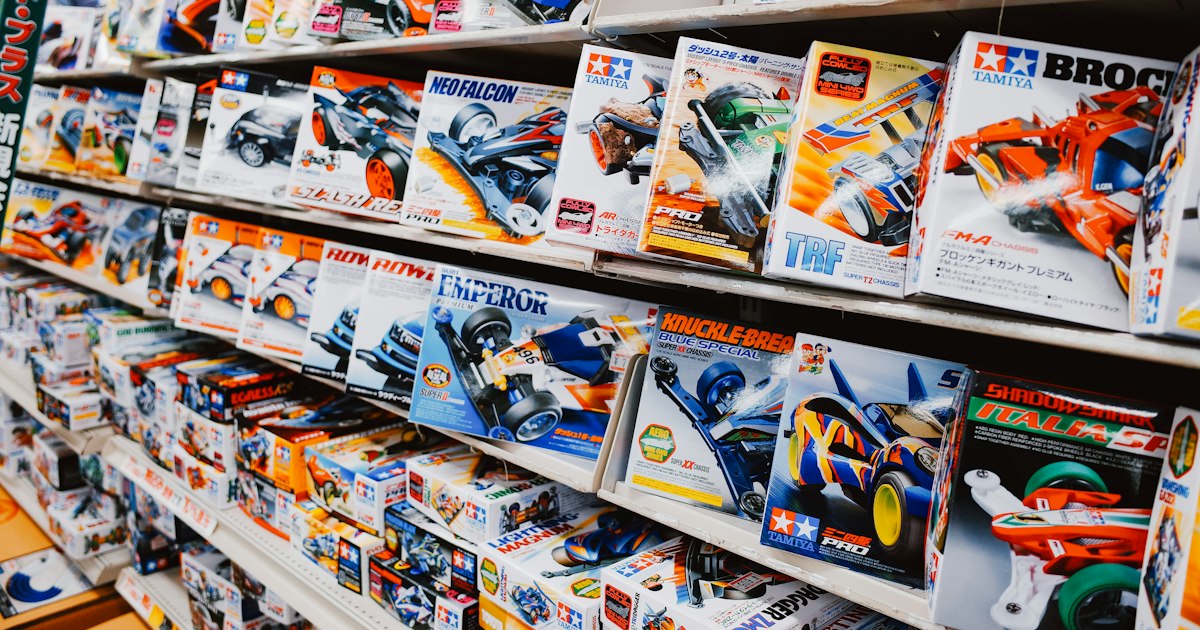
Ask most foreign visitors about Japanese plastic models and they’ll say “Gunpla.” But long before Gundam, there was Tamiya — the Shizuoka-based manufacturer that effectively built Japan’s scale-model hobby from the ground up in the 1950s and still makes some of the most respected tank, car, ship, and aircraft kits in the world. If you’re even mildly curious about model-making, a stop at a Tamiya specialty shop or hobby district is one of the most rewarding, least-touristy souvenir hunts you can do in Japan — and unlike Gunpla, which is everywhere, genuinely good Tamiya selections are concentrated in a handful of places worth planning around.
Why Tamiya Is Different From Gunpla
Gunpla (Gundam plastic models) are snap-fit, pre-colored, and designed for quick, satisfying builds with minimal tools. Tamiya’s core lineup — 1/35 military vehicles, 1/24 and 1/12 racing cars, 1/700 ships, 1/48 aircraft — is traditionally glue-and-paint, aimed at builders who want to weather a tank hull or polish a Formula 1 body to a mirror finish. Prices reflect that: a basic 1/35 tank kit runs roughly ¥2,500–¥4,500, a detailed 1/24 car kit ¥3,500–¥6,000, and premium items like the 1/12 big-scale motorcycle or supercar kits can hit ¥15,000–¥30,000. Tamiya also makes its own acrylic and enamel paints, cement, and tools, so a full first-time purchase (kit + paint + brushes + cement) easily lands at ¥6,000–¥10,000 even for a modest project.
Tokyo’s Best Hobby Shop Districts
You don’t need to leave Tokyo to find excellent Tamiya selections. Akihabara has several multi-floor hobby shops with dedicated Tamiya sections alongside Gunpla and figures; Yodobashi Camera’s Akihabara flagship also carries a surprisingly deep model kit floor with tax-free purchasing for tourists on the spot. For a more hobbyist-focused, less crowded experience, Jinbocho and parts of Shinjuku have smaller specialty shops run by lifelong modelers who can talk you through scale choices and paint compatibility — useful if your Japanese is limited, since staff are used to pointing at boxes and nodding. Most shops open around 10:00 or 11:00 and close between 19:00 and 20:30; Sundays and holidays are busiest, so weekday mornings are calmer if you want unhurried browsing time.
The Pilgrimage: Tamiya’s Hometown of Shizuoka
For anyone genuinely into the hobby, Shizuoka City is the real destination. Tamiya’s headquarters and factory are here, and the city hosts the Shizuoka Hobby Show every May, an enormous trade event where Tamiya and other Japanese manufacturers (Hasegawa, Aoshima, Bandai) unveil new releases a full year ahead of general retail. The show is partly trade-only but opens to the general public on its final two days, with tickets around ¥1,500–¥2,000 at the door. It’s a niche, specialist event rather than a mainstream attraction, so treat it as a bonus if your trip already lines up with early-to-mid May rather than a reason to restructure your whole itinerary. Shizuoka is about 1 hour from Tokyo by Shinkansen (Kodama or Hikari, roughly ¥6,000–¥7,500 one-way), making it an easy day trip. If you’re combining it with other Shizuoka attractions, this pairs naturally with a visit to the region’s famous green tea plantations, since both are reachable from the same Shinkansen stop.
Common Mistakes First-Time Buyers Make
The single biggest mistake is buying a glue-and-paint kit without checking the skill level printed on the box — Tamiya rates kits 1 through 4 (or marks them “Beginner”), and a Level 3+ 1/35 tank with etched-metal parts is a frustrating first build. Second: forgetting that Tamiya’s plastic cement and spray paints count as flammable/hazardous goods under airline rules, meaning you generally cannot pack them in checked or carry-on luggage on international flights — buy the kit in Japan and source paint and cement at home, or budget time to use them before you fly. If you’re unsure about limits on other items you’re bringing home, it’s worth checking general rules like those covered in the guide on excess baggage fees on ANA & JAL, since oversized completed model displays can also add up in weight and bulk. Third mistake: assuming all shops have everything — niche subjects (older military vehicles, discontinued racing liveries) sell out and don’t always get reprinted quickly, so if you see a kit you want, there’s little downside to buying it on sight rather than “coming back later.”
Budget, Mid-Range, and Splurge Picks
On a budget (¥1,500–¥3,000), Tamiya’s 1/48 military miniature series and smaller 1/32 WWII aircraft are quick, satisfying builds that don’t demand much paint or tooling, and make genuinely good lightweight souvenirs. Mid-range (¥3,500–¥6,500) is where most of the famous kits sit — the 1/35 Panzer and Sherman lines, 1/24 road cars like the Toyota Supra or Mazda RX-7, and 1/700 waterline warships. For a splurge, Tamiya’s 1/12 big-scale motorcycles (Honda, Ducati, Kawasaki replicas) and the 1/12 Lamborghini and Ferrari kits run ¥15,000–¥30,000+ and are aimed at serious builders producing display-quality results; these also make a far more memorable gift than anything mass-market. Whichever tier you go for, pick up a cheap pair of nippers (sprue cutters, ¥500–¥1,500) locally — cutting parts off the sprue with scissors or a knife is how most beginners damage their first kit.
Packing and Shipping Kits Home
Unbuilt kits in their boxes are compact, flat, and sturdy — they travel well in a suitcase and rarely raise customs issues since they’re toys, not weapons replicas (note: some countries restrict realistic military vehicle kits, so check your home country’s import rules if buying several). If you’re flying out via Haneda and want a last-minute pickup, it’s worth checking what’s actually available at Haneda Airport Terminal 3 before counting on it — airport souvenir shops skew toward Gunpla and character goods rather than Tamiya’s scale-model lineup, so buying in Akihabara or Shizuoka ahead of your flight is the safer bet. For larger hauls, Japanese post offices and convenience stores offer reasonably priced international surface mail (EMS is faster but pricier), which is often more practical than trying to fit ten tank kits into a carry-on.
Tamiya’s hobby culture rewards a bit of planning more than spontaneity — know your skill level, buy cement and paint locally if you’re building in Japan, and treat Shizuoka as a worthwhile detour rather than a detour-worthy obsession unless you’re already deep into the hobby. Either way, a Tamiya kit tucked into your luggage is a souvenir that keeps giving you something to do long after the trip ends.