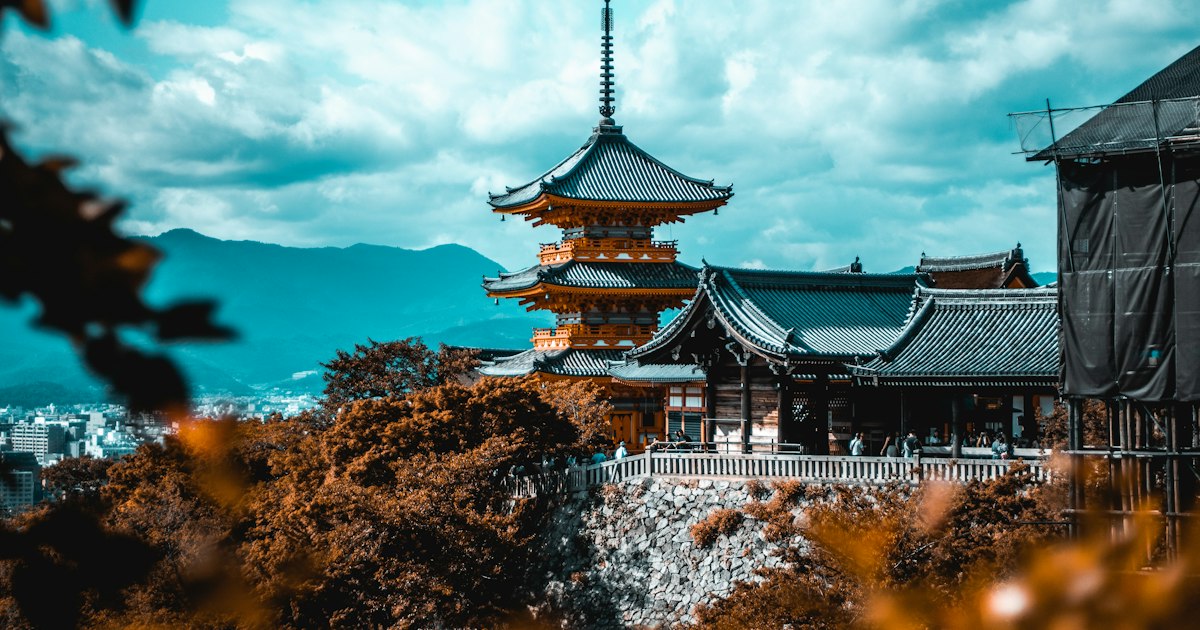
Photo by Cosmin Georgian on Unsplash
Perched on wooden stilts above a forested hillside in eastern Kyoto, Kiyomizu-dera is one of the few sights in Japan that lives up to every photo you’ve seen of it — and also one of the most crowded. Its famous main hall juts out over the slope on a lattice of timber beams assembled without a single nail, a feat of joinery that has survived fires, wars, and over a thousand years of visitors. Getting the most out of it is less about what to see and more about when and how you arrive.
A Temple Built Without a Single Nail
Kiyomizu-dera (“pure water temple”) was founded in 778, though the structures standing today date mostly from a 1633 rebuilding ordered by the shogun Tokugawa Iemitsu after a fire. The main hall’s stage (butai) extends 13 meters above the hillside, held up entirely by interlocking cypress beams and joinery — no nails or metal fasteners. It’s the same tradition of wood joinery you’ll find in Edo-period furniture making; if the construction method interests you, it’s worth reading about Edo Sashimono, Tokyo’s nail-less wood joinery furniture craft, which uses the same basic principle at a much smaller scale. Kiyomizu-dera is a UNESCO World Heritage Site as part of the Historic Monuments of Ancient Kyoto, and it belongs to the Kitahosso sect of Buddhism rather than the Zen schools more commonly associated with Kyoto.
Getting There from Kyoto Station
There’s no train station at the temple itself, which is part of why it feels more rewarding than some drive-up sights. From Kyoto Station, take city bus 100 or 206 to the Gojo-zaka or Kiyomizu-michi stop (about 15-20 minutes, 230 yen flat fare), then walk uphill for 10-15 minutes through the approach streets. Alternatively, Keihan Railway’s Kiyomizu-Gojo Station is about a 20-25 minute walk away, mostly uphill — fine if you don’t mind the climb, slower if you’re short on time. Taxis from Kyoto Station run roughly 1,500-2,000 yen depending on traffic. Whichever route you take, the last stretch is on foot and uphill, so wear real shoes, not sandals.
Opening Hours, Admission, and Night Illuminations
The temple grounds open at 6:00 am and close at 18:00 most of the year, with closing pushed to 18:30 during the summer peak in July and August. Admission to the main hall and inner grounds is 400 yen for adults and 200 yen for elementary and middle school students; the outer grounds, including the famous view of the stage from below, are free to enter. There is no advance booking — you simply pay at the gate.
During three special windows — roughly late March to early April for cherry blossoms, mid-August for the Obon season, and mid-November to early December for autumn leaves — the temple holds night illuminations with separate admission (also 400 yen) and extended hours until around 21:30 (last entry 21:00). These are genuinely beautiful, with the pagoda and stage lit against the dark hillside, but they draw their own dedicated crowds, so don’t expect a quiet evening even after dark.
The Otowa Waterfall and Jishu Shrine
Below the main stage, the Otowa Waterfall splits into three separate streams, and visitors queue to drink from one using long-handled cups provided at the site. Tradition holds each stream grants a different benefit — longevity, academic success, or a good love life — but drinking from all three is considered greedy and said to cancel the effect, so pick one. The queue moves quickly, usually under 10 minutes even when busy.
Within the temple complex, Jishu Shrine is dedicated to the deity of love and matchmaking. Its main draw is a pair of “love stones” set about 18 meters apart; walking between them with your eyes closed is said to predict success in romance. It’s a quick, low-effort stop if you’re already walking past.
When to Go to Avoid the Crowds
Kiyomizu-dera is consistently one of the most visited sites in Kyoto, and the approach streets can feel like a parade by mid-morning. The single most effective trick is arriving right at the 6:00 am opening — tour groups and most independent travelers don’t show up until 9:00 or later, so the first hour or two gives you the stage and the main hall nearly to yourself. Weekday mornings are noticeably calmer than weekends.
Seasonally, avoid the peak cherry blossom week (typically late March into early April) and the peak autumn foliage window (mid to late November) unless you specifically want the scenery and are willing to share it with thousands of other people. Golden Week (late April to early May) and the Obon holiday in mid-August are also packed, since they’re major domestic travel periods — timing worth keeping in mind if you’re also tracking other seasonal Japanese traditions like Hana Matsuri, the Buddha’s birthday festival, which falls on April 8 at Buddhist temples nationwide and overlaps with the start of the spring crowd season. Late June and early September, between the rainy season and the worst heat, are the quietest stretches of the year if your travel dates are flexible.
Common Mistakes First-Time Visitors Make
The most common mistake is treating Kiyomizu-dera as a quick midday stop between other Kyoto sights. Arriving at noon on a Saturday during foliage season means shuffling through the main hall in a slow-moving crowd rather than actually seeing it. A second mistake is skipping the walk back down a different way — most visitors retrace the same approach street, missing the quieter Kiyomizu-zaka back lanes with smaller shops and fewer people.
A third mistake, especially for visitors who’ve rented kimono for the day (a popular activity in this neighborhood, with rental shops clustered around the approach streets), is underestimating how long the uphill walk and stone steps take in traditional dress and sandals; budget extra time and consider the hidden layers that make kimono comfortable for walking, covered in Juban and Hadajuban, the hidden underlayers every kimono needs. Finally, don’t assume you can easily get a taxi right outside the main gate during peak hours — the street is narrow and often closed to vehicle pickup, so plan to walk back down to the bus stop.
Nearby: Sannen-zaka and Ninen-zaka Shopping Streets
The two preserved streets leading up to the temple, Sannen-zaka (“three-year slope”) and Ninen-zaka (“two-year slope”), are worth building extra time around rather than rushing through. They’re lined with traditional wooden machiya buildings now housing shops selling Kiyomizu-yaki pottery, pickles, matcha sweets, and small crafts — good for souvenir browsing before or after the temple visit. Prices here run a little higher than department store basements, so if you’re after specific regional snacks or crafts, it’s worth comparison shopping rather than buying the first thing you see.
If you’re basing yourself in Kyoto for a few nights to see Kiyomizu-dera alongside other Higashiyama-area sights, many budget and mid-range properties near Kyoto Station now use unstaffed check-in; it’s worth knowing how these work before you arrive, covered in Self Check-In Hotels in Japan. Pair an early temple visit with a slow afternoon in the surrounding lanes, and Kiyomizu-dera goes from a crowded checkbox stop to one of the better mornings you’ll spend in Kyoto.