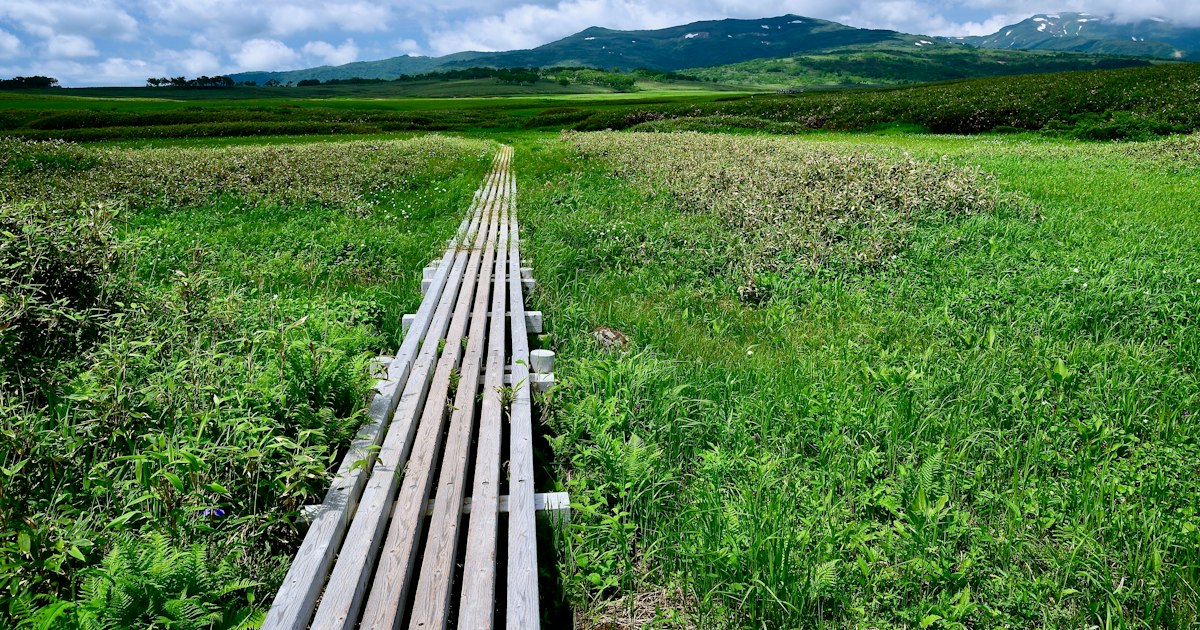
Most visitors picture Japan’s nature as cedar forests or volcanic peaks, but Oze is something stranger and quieter: a high-altitude marsh plateau where wooden boardwalks stretch for kilometers across open wetland, ringed by mountains and, in late spring, dotted with white skunk-cabbage flowers. It’s one of the least “touristy” nature experiences within striking distance of Tokyo, and that’s exactly the appeal — but it also means the logistics (no cars inside the park, limited transport windows, a short usable season) trip up a lot of first-time visitors. Here’s what you actually need to know.
What Makes Oze Worth the Trip
Oze National Park sits at the border of Gunma, Fukushima, Niigata, and Tochigi prefectures, centered on two main wetland areas: Ozegahara, a vast marsh plateau at roughly 1,400 meters elevation, and Ozenuma, a mountain lake and surrounding marsh a bit further east. Both are crossed by mokudo (木道) — narrow wooden boardwalks built specifically so hikers never step directly on the peat and sphagnum moss underneath. The marsh has been protected since the early 20th century, and the boardwalks themselves are part of the story: without them, the wetland’s unique plant communities wouldn’t have survived decades of hiking traffic.
It’s not a park you drive through or glimpse from a car window. You park (or bus in) at the edge, then walk — flat, easy walking on the boardwalks themselves, though getting to the boardwalk often involves a forested uphill or downhill stretch first.
Getting There: The Hatomachi Pass Route from Tokyo
The most common approach for Tokyo-based travelers is via Hatomachi Pass (鳩待峠) on the Gunma side, which has the shortest walk-in to the marsh — about 1 to 1.5 hours one-way to reach Ozegahara, on a gentle downhill trail.
The catch: private cars are banned from driving all the way to Hatomachi Pass during the park’s busy season (Golden Week through late October on weekends/holidays, and daily during peak summer). Instead, you drive or bus to the Tozawa (戸倉) parking area and transfer to a shuttle bus for the last stretch up to the pass. The shuttle runs frequently in season, with a fare of roughly ¥1,000 one-way (around ¥1,900-2,000 round-trip). Parking at Tozawa costs around ¥1,000 per day.
By public transport, the typical route is JR to Numata Station (via the Joetsu Shinkansen to Jomo-Kogen, then a local bus, or JR Joetsu Line to Numata), then a bus to Tozawa and the shuttle onward. In peak season, direct overnight or early-morning highway buses also run from Shinjuku in Tokyo straight to the Oze entry points — these are worth checking specifically for mizubasho season and summer weekends, since they cut out a lot of transfer time.
Alternative Approaches: Fukushima and Numata Sides
If you’re coming from the Tohoku direction, the Fukushima-side entrances — Oshimizu or the Ozeguchi trailhead near Hinoemata village — put you closer to Ozenuma and the eastern marsh, with access via the Aizu rail network and local buses rather than the Tokyo route. These approaches tend to have fewer crowds than Hatomachi Pass but longer walk-in times. Numayama Pass is another Fukushima-side option used mainly by hikers continuing on to Mount Hiuchigatake. None of these routes are quick — budget a full day for Oze regardless of which entrance you use, and treat it as an overnight trip if you want to see both Ozegahara and Ozenuma without rushing.
Best Time to Visit
Oze is only accessible roughly mid-May through late October; the access roads close under snow outside that window, and the park essentially shuts down.
- Late May–early June: Mizubasho (skunk cabbage, Lysichiton camtschatcensis) blooms across the wet meadows — white hooded flowers that made the marsh famous through the folk song “Natsu no Omoide” (Memories of Summer). This is the signature Oze image and the busiest period on weekends.
- July–August: Nikko kisuge (day lilies) and other alpine flowers bloom; warm, green, and the longest daylight hours for a day hike, but also the most crowded and the most humid.
- Late September–early October: Kusamomiji — the marsh grasses turning gold, red, and brown — is a quieter, equally striking alternative to flower season, with cooler hiking weather.
Weekday visits, even in peak bloom weeks, cut the crowds and shuttle-bus queues dramatically compared to weekends.
On the Boardwalk: What to Expect and Trail Etiquette
The boardwalks are mostly flat and easy underfoot, but they’re one plank wide in many sections, so traffic is genuinely one-directional in spirit even where it’s technically two-way — slower walkers should let others pass at the slightly wider passing points, and group hikers should walk single file rather than side by side. Stepping off the boardwalk onto the marsh itself is both damaging to the ecosystem and generally prohibited.
There are no trash bins anywhere in the park — pack out everything you bring in, including food wrappers and empty bottles. Toilets exist at the main huts and trailheads (some charge a small ¥100 maintenance donation), but not along the open boardwalk stretches, so plan accordingly. Bring your own water and snacks; convenience stores disappear once you’re past the trailhead towns, so it’s worth stocking up on hydration and something with a caffeine kick — the kind of retro pick-me-up bottle covered in Oronamin C & Lipovitan D: Japan’s Retro Energy Drink Culture is a genuinely common sight in hikers’ bags here — before you head up from Numata or Tozawa.
Mobile signal is patchy to nonexistent across much of the marsh. If you’re hiking solo or venturing beyond the main boardwalk loops toward Mount Hiuchigatake or Mount Shibutsu, it’s worth knowing in advance how mountain rescue works in Japan — the guide on Emergency Services in Japan: Calling 110 and 119 as a Tourist covers how to reach help when you’re off the beaten path.
Where to Stay and Eat
There are no roads or convenience stores inside the park, so lodging options inside Oze are limited to a handful of mountain huts (yamagoya) at Ozegahara and near Ozenuma. A night with two meals typically runs around ¥9,000–12,000 per person — book well ahead for peak mizubasho weekends, as beds are limited and huts do sell out. Budget travelers often do Oze as a long day trip instead, staying the night before and after in a trailhead town like Numata, Hinoemata, or Tozawa, where guesthouses and simple ryokan run closer to ¥6,000–10,000 per night.
For a splurge, several ryokan in the Fukushima-side villages near Hinoemata pair a soak in a mountain onsen with regional mountain-vegetable cooking — and some pour doburoku, the cloudy, unfiltered homemade-style sake that’s traditionally brewed in these remote mountain communities; see Doburoku: Japan’s Rustic Unfiltered Sake and Where to Try It for where that tradition is strongest. It’s a fitting way to end a day spent walking across one of Japan’s strangest and most beautiful landscapes.
Common Mistakes to Avoid
- Driving straight to Hatomachi Pass without checking the car restriction dates. During controlled periods you’ll be turned back to the Tozawa parking lot regardless, so check the current season’s regulation-traffic calendar before you leave.
- Underestimating the walk-in time. The marsh itself is flat, but reaching it from any entrance involves real elevation change on forest trail — wear proper hiking shoes, not sandals or sneakers.
- Visiting outside the open season. Roads physically close for winter; there’s no way to improvise a visit from roughly late October to mid-May.
- Not budgeting enough daylight. The last shuttle buses back from Hatomachi Pass run on a fixed schedule — missing it means an unplanned night with no easy way out.
- Forgetting cash. Shuttle buses, hut toilets, and some parking lots are cash-only or cash-preferred, and there are no ATMs past the trailhead towns.