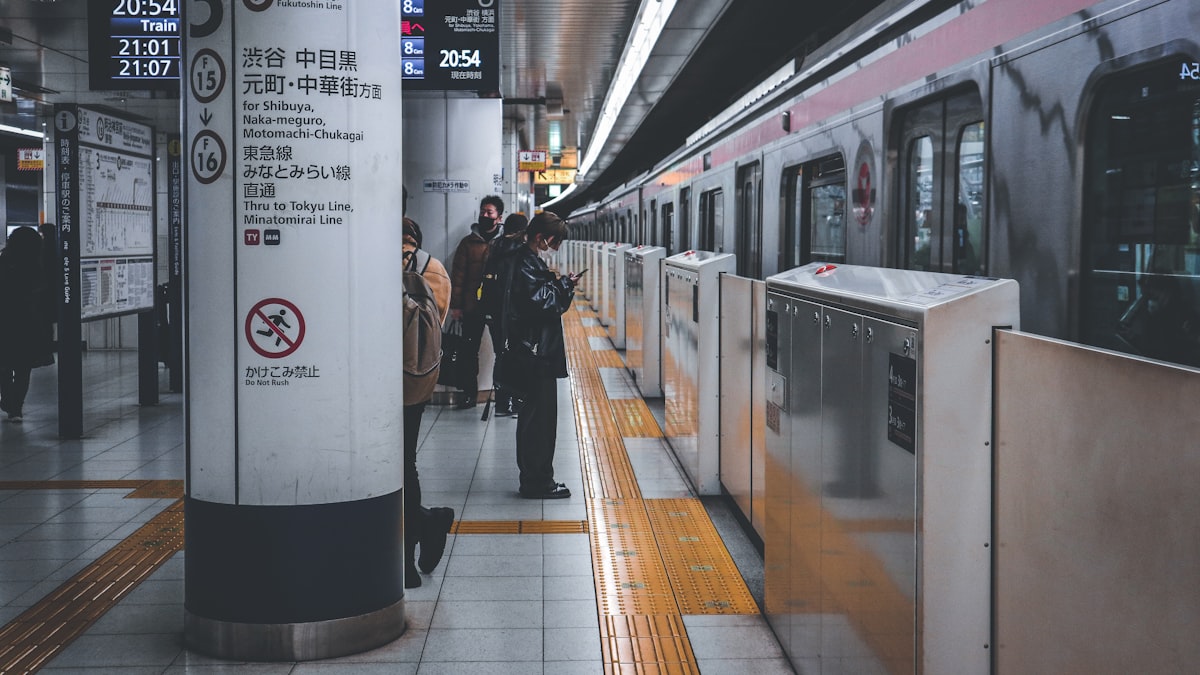
Tokyo’s transport looks intimidating but is actually one of the easiest and most reliable systems in the world once you know the basics. Here’s how to get around the city with confidence.
Start with an IC card
Get a Suica or Pasmo (or use a mobile version) — tap in and out of any train, subway, or bus, and pay at konbini too. It removes all the ticket-buying hassle. See our IC card guide.
Trains & subways
- JR Yamanote Line — the green loop connecting major hubs (Tokyo, Shinjuku, Shibuya, Ueno). Your backbone.
- Tokyo Metro & Toei subways — dense coverage for everywhere in between.
- Use a maps app for the fastest route and platform/exit info — see our trains guide.
Key survival tips
- Note your exit name/number, not just the station — big stations have dozens of exits.
- Avoid rush hour (roughly 7:30–9:30am, 5:30–7:30pm) if you can — trains get packed.
- Stand on the correct side of escalators (left in Tokyo) and let passengers off first.
- Keep quiet on trains and avoid phone calls.
Other options
- Taxis — clean and reliable but pricey; doors open automatically (no tipping — see tipping).
- Walking — neighborhoods are dense and rewarding on foot.
- Buses — useful in some areas; tap your IC card.
Do you need the JR Pass in Tokyo?
Usually no — a nationwide JR Pass rarely pays off for city-only travel; just use your IC card. Pair this with our Tokyo guide and 3-day itinerary.
What a day of Tokyo transport costs
- Most single subway/train rides within central Tokyo run JPY 170-320 depending on distance; a full day of sightseeing with several transfers typically totals JPY 1,000-1,500 on your IC card.
- Tokyo Metro and Toei day passes (around JPY 800-900 combined) can pay off on a day with 5+ rides, but for most first-timers tapping an IC card per ride ends up simpler and similarly priced.
- Taxis start around JPY 500-700 for the first kilometer or so and climb quickly — fine for a short late-night hop with luggage, expensive for anything cross-town.
Common mistakes to avoid
- Confusing similarly named stations — Tokyo has several stations with near-identical names in different areas; always check the line name and a couple of stops in each direction on your map app, not just the station name.
- Standing on the wrong side of the platform — some lines share platforms for both directions; check the electronic board or ask, since boarding the wrong direction is an easy early mistake.
- Trying to time a rush-hour ride with heavy luggage from the airport — route large-suitcase travel around 7:30-9:30am and 5:30-7:30pm if you can, or use the Narita Express/Skyliner and its luggage racks instead of a packed commuter line.
Getting oriented fast
If you only remember one thing, remember the Yamanote Line loop — nearly every major area worth visiting on a first trip (Tokyo, Ueno, Ikebukuro, Shinjuku, Shibuya) sits directly on it or a short transfer away. Pair this guide with our 3-day Tokyo itinerary to see how the areas connect in practice.
Accessibility & traveling with luggage or a stroller
Most central Tokyo stations have step-free elevator routes, though they are not always the most obvious path from the ticket gate — station staff will point you to the right elevator if you ask. Rush hour with a stroller or large suitcase is genuinely difficult; if you must travel with bulky luggage during the day, the Narita Express, Skyliner, or a taxi are more comfortable choices than a packed Yamanote Line car. See our accessible Japan guide for more on navigating with mobility needs.
Apps and tools that actually help
Google Maps handles Tokyo train routing well, including live platform and exit numbers, and works offline once cached if your eSIM connection drops underground. The Japan Official Travel App and each subway operator’s own app add fare and first/last train details that Google Maps sometimes lacks. Set your home country’s transit card off before you land so your phone doesn’t try to use it by mistake at the ticket gates.