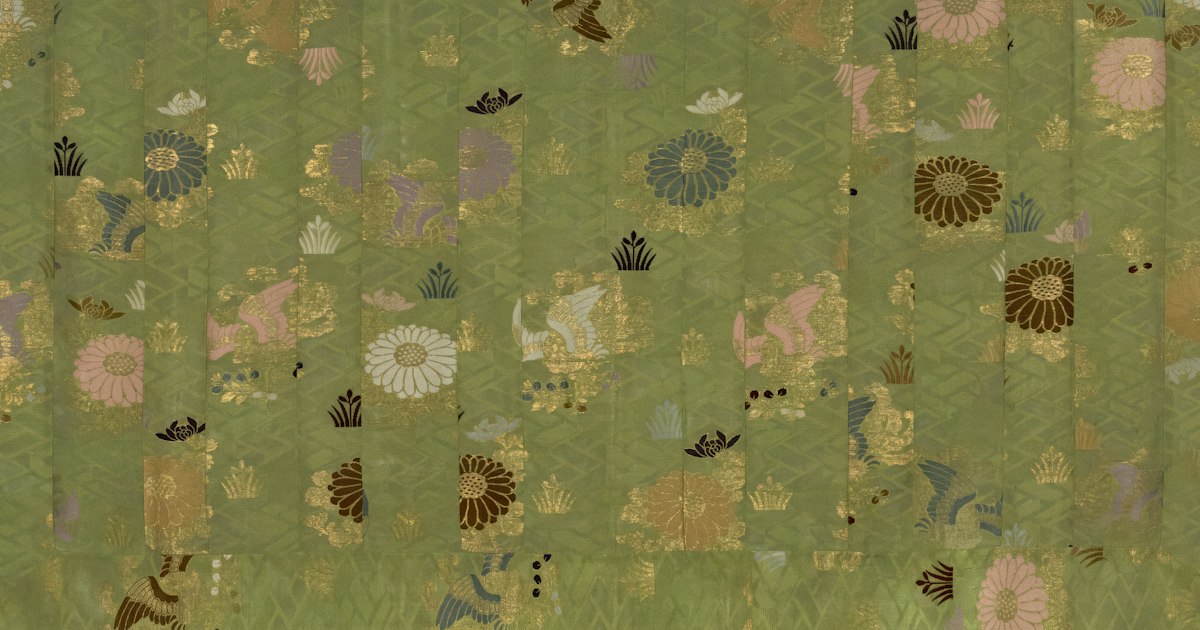
Photo by Art Institute of Chicago on Unsplash
From three feet away, a bolt of Edo Komon fabric looks like a single flat color — indigo, slate gray, deep brown. Step closer and that solid color dissolves into thousands of tiny repeating shapes: dots, checks, arrows, pine needles, stacked only millimeters apart. That optical trick is the whole point of Edo Komon, a stencil-dyeing craft that developed in Tokyo (then Edo) and still survives in a handful of workshops in the city today. It’s one of the more rewarding things to shop for if you want a textile souvenir that isn’t mass-produced, and this guide covers how it’s made, where to see it happening, and what you’ll actually pay.
What Is Edo Komon, Exactly?
Edo Komon (江戸小紋) is a dyeing technique, not a single pattern. A carved paper stencil called a katagami is laid over plain silk, and rice-paste resist is spread through its tiny cutouts before the fabric is dyed. Where the paste sat, the dye can’t reach, so when it’s washed out afterward, the original fabric color shows through in a dense, uniform pattern. The name was only formally adopted in 1955, to distinguish Tokyo’s version from Kyoto’s similar Kyo-komon, after dye master lineages lobbied for recognition of what had been a distinct regional craft for over a century. The best-known practitioner, Komiya Kiyoshi, was designated a Living National Treasure for Edo Komon dyeing in 1978, and his family’s workshop lineage is still cited as the benchmark for the craft.
A Pattern Born from Samurai Restraint
The patterns themselves exist because of sumptuary laws. During the Edo period, samurai were required to wear formal kamishimo for attending Edo Castle, but shogunate rules discouraged visibly flashy clothing. Domains got around this by commissioning dye patterns so fine they read as a solid color at a distance — satisfying the letter of the restriction while quietly broadcasting status and clan identity up close. Patterns like same-komon (a scattering of tiny dots resembling shark skin) became associated with specific domains, and some are still called “sadame-komon,” meaning patterns reserved for particular families. That history of visual modesty hiding real craftsmanship is why Edo Komon still feels distinctly different from the bolder, larger-scale prints you’ll see on yukata or festival happi coats.
How the Dyeing Actually Happens
A single katagami stencil only covers a small repeat unit, often just a few centimeters, so a craftsman has to lift and realign it hundreds of times down the length of a kimono bolt — roughly 12 meters — lining up the pattern edge by edge with no visible seam. Any millimeter of misalignment shows immediately once the paste is dyed. After the paste-resist application, the fabric is steamed to fix the dye, then washed to remove the paste and reveal the pattern. Older katagami stencils were made from layered mulberry paper hardened with persimmon tannin; many of the katagami still used today are decades or even a century old, carved by specialist artisans in a separate trade from the dyers themselves.
Where to See It Made: Nakai and Ochiai, Shinjuku
Tokyo’s historic dyeing district sits along the old Myoshoji River in the Nakai and Ochiai neighborhoods of Shinjuku-ku — the clean running water here was essential for rinsing paste and dye out of long fabric bolts, and several dye workshops have operated in the area for generations. The most visitor-accessible is Futaba-en (染の里 二葉苑), which also runs the small Tokyo Dyeing Story Museum on-site. You can watch dyeing in progress, browse finished Edo Komon textiles and small goods, and in many cases book a hands-on session dyeing your own tenugui or furoshiki cloth, typically priced in the ¥3,000–¥6,000 range depending on the item. It’s a short walk from Nakai Station on the Seibu Shinjuku Line (also reachable via the Toei Oedo Line) or from Ochiai Station on the Tokyo Metro Tozai Line. Hours and experience-session availability vary by day, so it’s worth confirming ahead rather than showing up unannounced — dyeing demonstrations are sometimes paused for private workshop work.
If you’re interested in the silk side of the craft rather than the dyeing itself, the Tomioka Silk Mill in Gunma makes a good companion day trip — it’s the UNESCO-listed site that shows how the raw silk feeding Japan’s textile trade was actually produced.
Where to Buy Edo Komon in Tokyo
For finished kimono and obi, Ginza is the easiest starting point. Specialist kimono retailers in the Ginza Chuo-dori area, such as Ginza Motoji, stock Edo Komon alongside other traditional textiles and can explain the difference between hand-dyed and machine-printed pieces — a distinction that matters enormously for both price and authenticity. If you’re already spending an afternoon in Ginza for fashion shopping, it’s easy to pair this with a stop at Dover Street Market Ginza on the same trip.
For smaller, easier-to-pack souvenirs — pouches, coin purses, handkerchiefs, and tenugui printed or dyed with Edo Komon-style patterns — Japan Traditional Crafts Aoyama Square in Minato-ku is a reliable one-stop option, since it curates certified traditional crafts from across the country, usually open daily from late morning into early evening. If you’d rather hunt for genuine secondhand or vintage Edo Komon kimono at a fraction of new prices, the antique and vintage shops around Nishi-Ogikubo occasionally turn up older dyed textiles worth checking, though stock is unpredictable since it’s not a kimono-specific street.
Budget, Mid-Range, and Splurge: What You’ll Actually Pay
Price ranges in this craft are wide, and the gap usually comes down to hand-dyeing versus printing. On the budget end, small Edo Komon-patterned goods — tenugui, coin pouches, fabric coasters — generally run ¥1,500 to ¥5,000, and make genuinely practical, packable souvenirs. Mid-range buyers looking at machine-printed Edo Komon-style yardage or ready-made items like haori jackets should expect somewhere in the ¥30,000–¥100,000 range. True hand-dyed Edo Komon kimono fabric, cut by a recognized workshop using real katagami stencils, is a splurge purchase: bolts commonly start around ¥150,000–¥300,000 and can run well past ¥500,000 for work by senior craftsmen, before tailoring costs are even added. If a “hand-dyed Edo Komon” kimono is priced like a department-store yukata, it almost certainly isn’t what it claims to be.
Common Mistakes to Avoid
- Judging the pattern up close only. Edo Komon is designed to be viewed from a few steps away. Always check how a piece reads at a natural conversation distance before deciding whether the pattern works for you.
- Confusing print with dye. Printed imitations are common and far cheaper, but the paste-resist edges on genuine hand-dyed Edo Komon have a very slightly soft, irregular quality under magnification that printing can’t fully replicate. Ask directly whether a piece is “型染め” (katazome, stencil-dyed) or printed.
- Visiting during peak kimono-rental tourist seasons expecting workshop time. Spring (cherry blossom season) and autumn weekends are busiest for kimono-related tourism citywide, and small dye workshops with limited staff may have less availability for demonstrations or hands-on sessions then. Weekday visits in off-peak months are easier to book.
- Skipping care instructions. Hand-dyed silk Edo Komon generally needs specialist kimono cleaning (araihari), not home washing or standard dry cleaning — ask the shop for care guidance at the time of purchase.
Edo Komon rewards close attention in a way few souvenirs do — it’s a craft literally built around the idea that the real detail only reveals itself once you stop and look twice. Whether you come home with a ¥2,000 tenugui or a kimono bolt costing many times that, buying directly from a workshop or a specialist shop rather than a generic souvenir store is the surest way to know you’re getting the real thing.