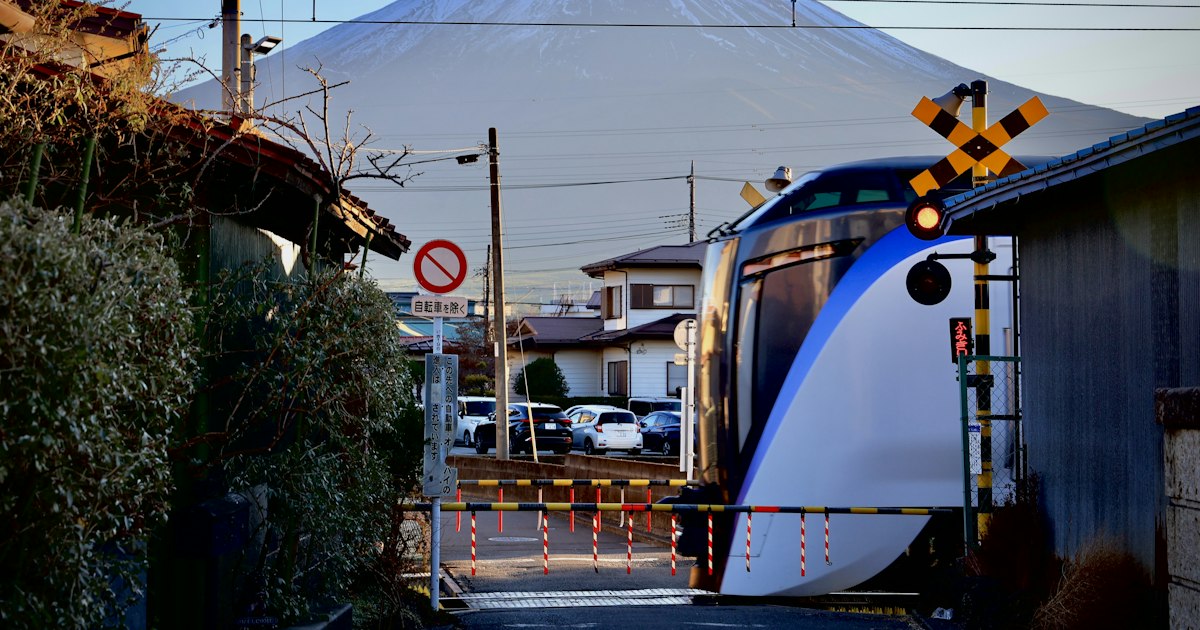
Photo by Jiachen Lin on Unsplash
If you want to see Mt. Fuji without renting a car or joining a bus tour, the easiest route from central Tokyo is a single train: the Fuji Excursion (富士回遊), a reserved-seat limited express that runs directly from Shinjuku to Kawaguchiko in the Fuji Five Lakes region. No transfers, no station-dragging luggage between platforms — you sit down in Tokyo and get off at the lake. Here’s how the train actually works, what it costs, and the booking mistakes that catch first-timers.
What Is the Fuji Excursion Train?
The Fuji Excursion is jointly operated by JR East and Fujikyu Railway. It starts as a normal JR limited express out of Shinjuku Station, runs down the Chuo Line to Otsuki, and then — without you having to change trains — continues onto the private Fujikyu Railway line into the mountains, terminating at Kawaguchiko Station. The whole trip takes roughly 1 hour 55 minutes to 2 hours, and there are typically only a handful of departures each way per day (around four round trips), so this isn’t a hop-on-whenever service like the Yamanote Line — check the timetable before you plan your day.
All seats are reserved. There’s no non-reserved car, so you need a seat assignment before boarding, not just a ticket.
Tickets, Fares, and Which Pass Actually Covers It
This is where most visitors trip up. The train crosses two different companies’ tracks — JR East (Shinjuku to Otsuki) and Fujikyu Railway (Otsuki to Kawaguchiko) — and your fare is really two fares stitched together.
- Standard one-way fare, Shinjuku to Kawaguchiko: around ¥4,130 for a reserved seat, covering base fare plus limited express charge for the full route.
- Japan Rail Pass (nationwide): covers the JR East portion (Shinjuku–Otsuki) but not the Fujikyu Railway leg, so you’ll still pay a supplementary fare for the Otsuki–Kawaguchiko section plus the reserved seat charge.
- JR East Tokyo Wide Pass (around ¥10,180 for 3 consecutive days): this is the one locals and repeat visitors actually use for this trip, because it covers the entire Fujikyu Railway line as well as JR East’s greater Tokyo network. With this pass you only pay the limited express reserved-seat surcharge (around ¥1,300) rather than the full fare — and the pass itself pays for itself quickly if you’re also using it for day trips elsewhere in the region.
Reserve seats online through JR East’s train reservation site up to about a month in advance, or at any JR East “Midori no Madoguchi” ticket counter or ticket machine. Seats sell out on weekends and holidays, especially during cherry blossom season (early-mid April) and autumn foliage (late October to mid-November) — don’t assume you can just walk up and board.
Riding the Route: Shinjuku to Kawaguchiko
Board at Shinjuku Station — check the departure board for the specific limited express platform, since it’s separate from the regular Chuo Line commuter platforms. The train glides out through western Tokyo and Tachikawa before climbing into the hills past Otsuki, where the Fujikyu Railway track begins and the scenery shifts from suburban sprawl to forested mountainside. On clear days, Mt. Fuji starts appearing on the right-hand side of the train in the final 30–40 minutes, so grab a right-side window seat if the mountain is the whole point of the trip.
The second-to-last stop, Mt. Fuji Station (formerly Fujiyoshida), is also worth knowing about: it’s the jumping-off point for the Chureito Pagoda viewpoint, a roughly 10–15 minute uphill walk and stairs climb for the classic pagoda-with-Fuji-in-the-background photo. Many visitors accidentally stay on to the final stop, Kawaguchiko, and miss this — know which station you want before you board.
Best Time to Go for Mt. Fuji Views
Mt. Fuji is notoriously shy in summer, when haze and clouds hide it most afternoons — if you’re visiting July through September, aim for early morning. Winter (December through February) gives the clearest, most reliable views, with crisp air and snow-capped peak, though it’s cold for lakeside walking. Spring brings the Fuji Shibazakura Festival (pink moss phlox fields near Lake Motosuko, typically mid-April to late May) with Fuji as a backdrop, and autumn (late October to mid-November) brings the Momiji Corridor near Lake Kawaguchiko, where red maple trees line the lakeside path. Both of these seasonal windows are also when trains and buses are busiest, so book your Fuji Excursion seat and any hotel well ahead.
Getting Around the Fuji Five Lakes Once You Arrive
Kawaguchiko Station is the regional hub, with a tourist information counter right at the exit. From there, the Fujikyu “Retro Bus” network loops around the lake and out to attractions like Oshino Hakkai (a small village built around eight spring-fed ponds, about 25 minutes by bus) and the Kachi Kachi Ropeway. A one- or two-day bus pass is usually the most economical way to see multiple spots without waiting on timed buses one by one.
If you’d rather cycle the flat lakeside path at your own pace, rental shops (including electric bikes) cluster near Kawaguchiko Station. If you’re not used to Japan’s cycling rules, it’s worth knowing the helmet requirements that apply to rental bikes here — see our guide to Japan’s bicycle helmet law for tourists before you grab a bike.
Common Mistakes to Avoid
- Assuming the Japan Rail Pass covers the whole fare. It only covers the JR East section to Otsuki — you’ll still owe the Fujikyu portion at the gate or on board.
- Confusing the Fuji Excursion with the Fujisan View Express. The latter is a separate, retro-styled sightseeing train that runs only within the Fujikyu Railway network (not from Tokyo) and charges its own extra fee — a nice add-on once you’re already in the area, but not a substitute for the Shinjuku–Kawaguchiko train.
- Not reserving ahead on weekends. Because every seat is reserved and departures are limited, a sold-out train means waiting hours for the next one, not just standing.
- Overshooting your stop. If Chureito Pagoda is on your list, get off at Mt. Fuji Station, one stop before the Kawaguchiko terminus.
Budget, Mid-Range, and Splurge Options
- Budget: The Keio/Fujikyu highway bus from Busta Shinjuku to Kawaguchiko costs around ¥1,800–2,200 one way and takes about 1 hour 45 minutes without traffic — slower and less comfortable than the train, and more exposed to weekend traffic jams, but notably cheaper if you’re not using a pass.
- Mid-range: The standard Fuji Excursion reserved seat (around ¥4,130 one way) is the sweet spot for most travelers — direct, scenic, comfortable, and no transfers with luggage.
- Splurge / best value for a multi-day trip: Buy the JR East Tokyo Wide Pass if you’re also planning other day trips from Tokyo during your stay (Nikko, Kamakura, or further-flung spots). It covers the Fujikyu Railway fare entirely and unlocks unlimited rides elsewhere on JR East’s greater Tokyo network for three days, dropping your Fuji Excursion cost down to just the seat reservation fee.
However you book it, the Fuji Excursion remains the simplest way to turn “day trip to Mt. Fuji” from a logistics project into a single reserved seat and a two-hour ride with the mountain filling your window.