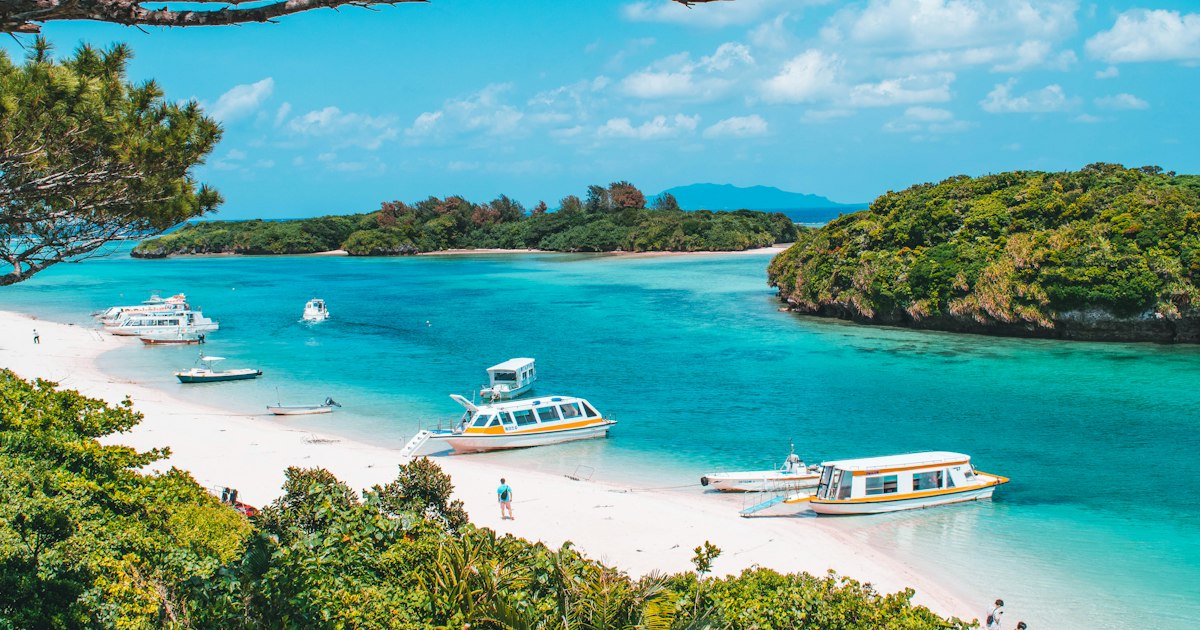
Most visitors who make it as far as Ishigaki already feel like they’ve reached the edge of Japan. But keep going another 50 kilometers south by boat and you hit Hateruma Island (波照間島), the southernmost point in Japan that anyone actually lives on. It’s a flat, low-rise island of sugarcane fields, one small village, a beach that regularly gets ranked among Japan’s best, and a stargazing tower built specifically because the Southern Cross is visible from here and almost nowhere else in the country. It takes real effort to get to — rough water, a ferry that cancels often, and almost no infrastructure once you arrive — which is exactly why it still feels undeveloped.
Why Hateruma, Specifically
Japan’s true southernmost territory is Okinotorishima, a tiny uninhabited reef far south in the Pacific administered by Tokyo. Hateruma is the southernmost point anyone permanently lives on, with a population of around 500 people spread across one compact village. That distinction — plus a genuinely striking coastline — is why Japanese travelers add it to Yaeyama itineraries that also include Ishigaki, Iriomote, and Taketomi. If you’ve already read about Taketomi Island’s car-free village, Hateruma is the more remote, less crowded cousin — fewer red-tiled roofs, more open horizon.
Getting There: Ishigaki to Hateruma by Ferry
You cannot fly to Hateruma. The only way in is by boat from Ishigaki’s ferry terminal (石垣港離島ターミナル), run by two operators, Anei Kanko and Yaeyama Kanko Ferry. The crossing takes roughly 60 to 100 minutes depending on sea conditions — it’s open ocean for part of the route, and it’s noticeably rougher than the short hops to Taketomi or Kohama. Expect around ¥3,600 one-way and ¥6,900–7,500 round-trip for adults; always check the current timetable and fare on the operator’s site before you go, since schedules shift seasonally and both companies run only a handful of sailings a day (often 2–4 round trips).
This route cancels more often than any other in the Yaeyama Islands, especially from November through March when winter swells pick up. If you’re on a tight schedule, build in a buffer day, book your return sailing as early in the day as your itinerary allows, and call the terminal or check the operator’s site the morning of travel rather than assuming your booked boat will run. Seasickness medication is worth having on hand even if you don’t normally need it elsewhere in Japan.
Getting Around Once You’re There
There are no taxis to speak of and public transport is minimal, so rent wheels the moment you step off the boat — rental counters cluster right at the harbor. A scooter runs roughly ¥2,500–3,500 for a full day and is the easiest way to cover the island’s loop road; a bicycle is cheaper (around ¥1,000–1,500/day) but Hateruma is bigger than it looks on a map, with real distance between the harbor, the village, and the southernmost point. There are no convenience stores and only limited ATM access, so bring cash from Ishigaki — card acceptance on the island is inconsistent at best.
What to See and Do
The Southernmost Point of Japan Monument (日本最南端の碑) sits on the cliffs at Takanazaki, a windswept, treeless stretch of coast where you can genuinely feel how far south you’ve traveled — it’s a short scooter ride from the harbor and free to visit anytime. Nishihama Beach (ニシ浜), near the port, is the island’s postcard shot: pale sand and startlingly clear turquoise water, good for swimming and snorkeling when conditions are calm.
After dark, head to the Hateruma Star Observation Tower (星空観測タワー). With almost no artificial light on the island, this is one of the only places in Japan where you can see the Southern Cross low on the horizon, along with far more of the Milky Way than is visible from any mainland city. Entrance runs a few hundred yen; the tower is sometimes closed on nights with heavy cloud or a full moon washing out the sky, so check ahead rather than assuming it’s open. If you’re building out a Japan trip around stargazing and remote-point chasing, it pairs oddly well with a visit to Cape Soya at the opposite, northernmost end of the country — the two make a fun bookend if your trip spans that much ground.
For shopping, the island’s one real claim to fame is Awanami (泡波), the awamori made by Hateruma Shuzo, the distillery in the village. Production is small and it rarely leaves the island in any quantity — it’s one of the hardest-to-buy spirits in Japan, and bottles are sometimes rationed to one per customer at local shops. If you see it for sale, buy it there; you likely won’t see it again once you leave.
Best Time to Visit
April through June offers the calmest seas, clear skies, and comfortable temperatures — the easiest window for both the ferry crossing and beach time. July through September is hot and humid with real typhoon risk, which can strand you on either end of the crossing for days. October through March brings the most ferry cancellations due to winter swells, but it’s also dry season with strong stargazing conditions on the nights the boat does run. If stargazing is your main goal, accept the cancellation risk and build slack into your schedule; if you just want sun and swimming, aim for late spring.
Day Trip or Overnight?
A day trip from Ishigaki is technically possible — take an early sailing out and a late-afternoon one back — but it leaves only a few hours on the island once you factor in the crossing, and it rules out stargazing entirely. Accommodation is limited to a handful of small minshuku and guesthouses in the village, typically ¥5,000–8,000 per night including two meals, since there’s nowhere else to eat. Book ahead; rooms are few and fill up fast around Japanese holiday periods. Staying overnight is really the only way to see the island properly and catch the night sky, and it’s worth combining with time in Ishigaki or Iriomote — the latter is also where many visitors book guided mangrove kayaking tours if you want to add an active day to the same Yaeyama trip.
Common Mistakes to Avoid
- Not confirming the ferry the morning of travel. Cancellations happen with little warning, especially outside summer. Call the terminal or check online before heading to the dock.
- Booking only a same-day round trip with no buffer. If the afternoon boat is cancelled, you’re stuck overnight whether you planned for it or not — pack as if that might happen.
- Assuming there’s a convenience store or reliable card payment. There isn’t. Bring enough cash from Ishigaki for your whole stay.
- Trying to walk the island. It’s larger than first glance suggests; rent a scooter or bike at the harbor rather than discovering this the hard way.
- Skipping the night sky because you’re only doing a day trip. The stargazing tower is Hateruma’s single most distinctive attraction and it’s only worth it if you stay past sunset.
Hateruma rewards exactly the kind of traveler who’s willing to deal with an unreliable boat schedule and zero conbini for the payoff of empty beaches, a sky full of stars you can’t see anywhere else in Japan, and the quiet bragging rights of having stood at the southernmost inhabited edge of the country.