Photo by Life.Time.Values on Unsplash
Nankinmachi is Kobe’s answer to Yokohama’s and Nagasaki’s Chinatowns, but it’s smaller, cheaper to graze through, and sits almost exactly between Sannomiya Station and the harbor — which makes it one of the easiest “extra” stops to slot into a Kobe day without derailing your plans. You can eat your way through the whole district in under an hour, or stretch it into a longer walk down to the water. Here’s how to do it without wasting time or money.
Getting There From Sannomiya or the Harbor
Nankinmachi sits between Kobe’s two main downtown stations, Sannomiya and Motomachi, so you’ll almost never go out of your way to reach it.
- From Sannomiya Station (JR, Hankyu, Hanshin, or the subway): walk south through the Motomachi covered shopping arcade for about 7–8 minutes.
- From Motomachi Station (JR, Hanshin, or the subway): it’s a 2–3 minute walk south of the station — the closer option if you’re coming from Osaka on the Hanshin or JR line.
- From the harbor (Meriken Park / Kobe Harborland): it’s a flat, pleasant 15–20 minute walk north, passing through the Kyu-Kyoryuchi (Old Foreign Settlement) district, where Kobe’s 19th-century trading-house architecture now houses boutiques and cafés. It’s a nice contrast to walk from European-style stone buildings straight into red-and-gold Chinese gates.
Because of this geography, the easiest way to use Nankinmachi is as a midpoint: start at Sannomiya, eat your way through Nankinmachi, then keep walking south to the harbor for the view and call it a loop.
What to Eat First: The Street-Food Crawl
The main draw of Nankinmachi isn’t sit-down dining — it’s the dense cluster of walk-up counters selling steamed buns, skewers, and small Chinese-style snacks along the main street and the side alleys branching off the central square.
Butaman (pork buns) are the signature item. The most famous shop, Roushouki, has been making a stripped-down version since the early 20th century — thin-skinned, just pork and onion inside, sold a few pieces at a time for a few hundred yen. It regularly sells out and closes for the day once it does, so if you want to try it, go before midday rather than after lunch. Most other stalls sell a more generously sized, sauce-dipped version of the same bun, usually in the ¥150–¥400 per piece range.
Beyond buns, look for:
- Chinchin / goma dango — fried sesame balls with sweet bean paste, a good ¥150–¥300 snack.
- Tenshinhan — a crab-omelette rice bowl, usually only at the sit-down restaurants rather than the stalls.
- Kobe beef skewers or nikuman — a handful of stalls lean on local pride and sell wagyu-beef versions of standard street snacks for ¥800–¥1,500. These are the closest thing to a “splurge” bite in the district and worth doing once rather than filling up on.
Budget-wise, ¥1,000–¥1,500 in cash is enough to sample four or five different stalls and leave full. That’s the appeal of doing Nankinmachi as a crawl rather than sitting down at one restaurant: you get variety for less money and less time.
If You Want to Sit Down: Mid-Range and Splurge Options
The streets ringing the square also have proper restaurants if you’d rather eat a full meal. Set lunches at mid-range Chinese restaurants here typically run ¥1,200–¥2,500 and include a main, rice, and soup. A few higher-end spots serve fukahire (shark fin soup) and other banquet-style dishes, where a meal can run ¥3,000–¥8,000 per person — these are worth it only if you specifically want that style of Chinese banquet cooking rather than street food, since the quality-to-price ratio is much better at the stalls for everyday eating.
One practical note: sit-down restaurants in Nankinmachi get genuinely busy at lunch on weekends, with queues forming outside the more photogenic storefronts. If you want a table rather than a bun in hand, aim for an early lunch around 11:30, or shift to a late lunch after 1:30pm.
The Square, the Gates, and the Walk South
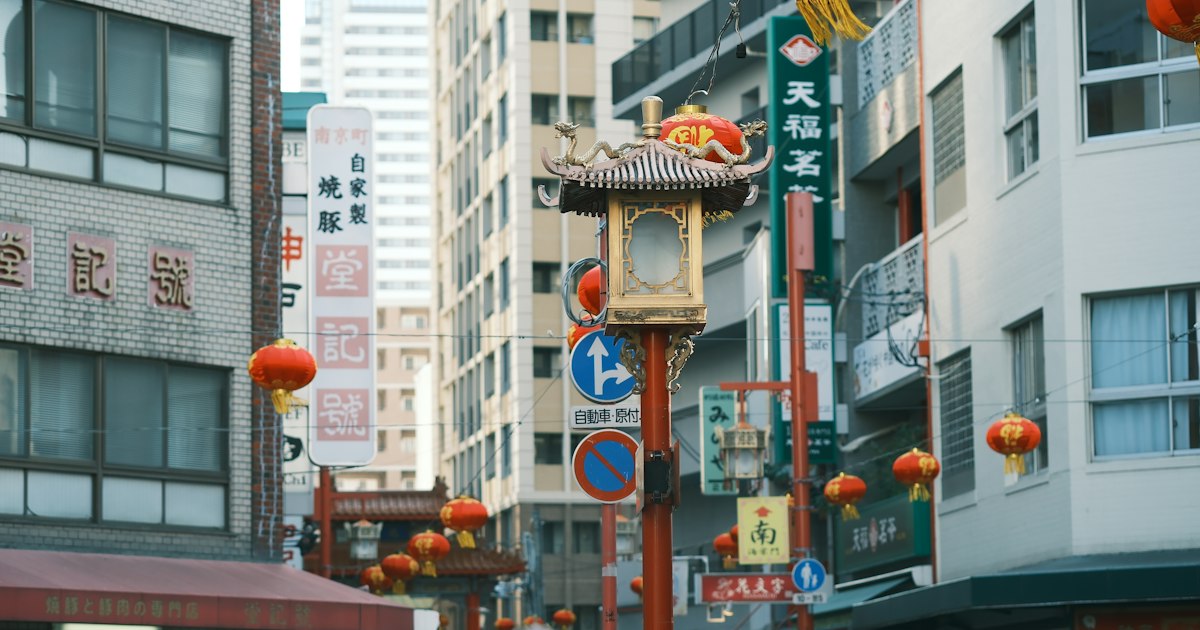
At the center of the district is Nankinmachi Square, a small open plaza ringed by red lanterns and flanked by ornate Chinese-style gates at either end — it’s the obvious photo spot and also where festival events are staged. The whole walkable area is compact: a single main street plus the square and a couple of side lanes, so don’t plan on spending more than 45–60 minutes here unless you’re eating slowly at a restaurant.
Once you’ve eaten, continue south toward the water rather than backtracking to the station. The walk takes you past the old foreign settlement’s brick buildings, then opens up at Meriken Park, home to the red Kobe Port Tower and the Kobe Maritime Museum, and continues into Kobe Harborland, a shopping-and-waterfront complex with a Ferris wheel and evening illuminations. It’s an easy way to turn a 45-minute food stop into a half-day out.
Best Time to Go
Nankinmachi is at its most crowded on weekend afternoons and during its biggest annual event, the Nankinmachi Spring Festival, usually held over a weekend in mid-March, with lion and dragon dances in the square. It’s fun to see once, but expect dense crowds and longer stall lines if you’re there that weekend.
For a calmer visit, go on a weekday around 11am, right as stalls are opening and before the lunch rush. Kobe’s harbor-facing location also means it’s worth checking the forecast if you’re visiting in late summer — see our guide to typhoon season in Japan if your trip falls between August and October, since a direct hit can shut down outdoor stalls for the day. Spring (March–April) and autumn (October–November) are the most comfortable seasons for standing around eating outdoors.
Paying and Common Mistakes
Most of the small stalls are cash-only or accept only one or two payment apps, which catches a lot of visitors off guard after getting used to card payments elsewhere in Kobe. Many now take PayPay — our guide to QR code payments in Japan covers how to set it up as a tourist — but it’s still worth carrying ¥2,000–¥3,000 in small bills and coins specifically for this crawl. If you’re low on cash, there are Japan Post Bank ATMs around Sannomiya and Motomachi Stations that reliably accept foreign cards; see our breakdown of how foreign cards work at Japan Post Bank ATMs before you go.
The other common mistake is treating Nankinmachi like a destination in itself worth a half-day. It’s genuinely small — one main street and a square — so the best use of it is exactly what this guide describes: a focused 45-minute to one-hour food stop wedged between Sannomiya and the harbor, not a standalone outing. Go hungry, bring cash, and keep walking south when you’re done.