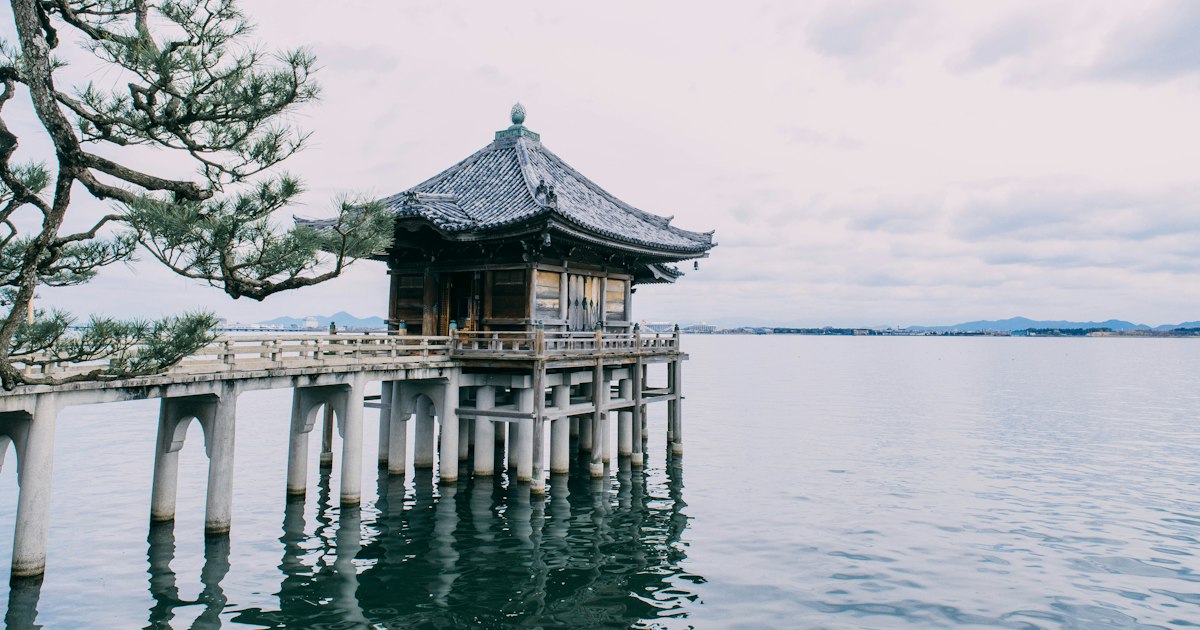
Photo by Wu Hsien Yu on Unsplash
Most visitors glimpse Lake Biwa for about ninety seconds, through a shinkansen window somewhere between Kyoto and Maibara, and never think about it again. That’s a shame, because Japan’s largest lake — big enough to have its own weather, its own fishing culture, and a 200-kilometer shoreline — starts practically at Kyoto’s back door. You can be standing on a national-treasure castle keep or riding a canal boat through a 400-year-old merchant town less than an hour after leaving Kyoto Station, and be back in time for dinner in Pontocho. Shiga Prefecture, which wraps almost entirely around the lake, is one of the easiest “second day” additions to a Kyoto itinerary and one of the least crowded with foreign tourists.
Why Lake Biwa Is Kyoto’s Easiest Big Day Trip
Lake Biwa covers about one-sixth of Shiga Prefecture and supplies drinking water to much of the Kyoto-Osaka region, which is part of why the area feels so well connected by rail. The lake is roughly 235 km around, so “doing Lake Biwa” in a day doesn’t mean circling it — it means picking one or two towns along the southern or western shore and going deep rather than wide. Unlike Nara or Arashiyama, you won’t be shuffling through crowds; even on a weekend, Hikone Castle or the Omi-Hachiman canals feel unhurried. The trade-off is that sights are spread out, so decide on a theme (castle town, canal town, sacred island, cycling) before you leave Kyoto rather than trying to improvise on the day.
Getting There From Kyoto
Everything in this guide runs off the JR Biwako Line, which is simply the Kyoto–Maibara stretch of the Tokaido Line, plus its northward extension, the JR Kosei Line, which hugs the lake’s west shore up toward Nagahama. From Kyoto Station:
- Otsu (south tip of the lake): about 10 minutes, roughly ¥240 — the closest and easiest stop, good for a lakeside cruise or a quick look at the water.
- Hikone (castle town): 45–55 minutes on a shinkaisoku (special rapid) train, around ¥1,200.
- Omi-Hachiman (merchant/canal town): about 40–45 minutes on the shinkaisoku, around ¥990.
- Omi-Imazu / Omi-Takashima (north shore, boats to Chikubushima, Shirahige Shrine): 50–70 minutes via the Kosei Line.
An IC card (ICOCA/Suica) works on every train and bus in this guide, and increasingly at shop registers too, though smaller lakeside restaurants and souvenir stalls in places like Omi-Hachiman still sometimes prefer cash or a QR code app — if you’re relying on your phone for payment, it’s worth skimming our guide to using PayPay and Rakuten Pay as a tourist before you go, since signal and setup are easier to sort out in Kyoto than in a small rural town.
Hikone Castle: The Must-See Highlight
Hikone Castle is the headline attraction on the lake, and for good reason — it’s one of only twelve Japanese castles with a keep that survives in its original Edo-period wood (not a postwar concrete rebuild), and one of just five castle keeps nationwide designated a National Treasure, alongside Himeji, Matsumoto, Matsue, and Inuyama. The compact hilltop keep is steep and low-ceilinged inside, which is part of the appeal — it still feels like a functioning fortress rather than a museum piece. Admission runs around ¥800 for the castle alone, with a combination ticket covering Genkyu-en, the Edo-period garden at the base of the hill, for a bit more. The castle grounds are typically open from around 8:30am to 5pm (last entry 4:30pm), and the moat is still patrolled by a small fleet of boats you can ride for a different angle on the walls. Hikone’s old town, just outside the castle moat, has a handful of Omi-beef restaurants worth timing your visit around — Shiga is one of the lesser-known producers of wagyu-grade beef, alongside Kobe and Matsusaka.
Omi-Hachiman’s Canal Boats and Merchant Streets
Omi-Hachiman was built in the 1580s as a planned merchant town, and the Omi merchants who trained here went on to found businesses that still exist today (Takashimaya and Itochu both trace roots back to Omi trading families). The draw now is the Hachiman-bori, a willow-lined canal that once carried cargo boats to and from the lake, now plied by small sightseeing boats (roughly ¥1,000–1,500 for a 30–35 minute ride) past white-walled storehouses and samurai-era residences. It’s a quieter, smaller-scale cousin of Kurashiki or Omihachiman’s own castle-town neighbors, and far less visited than Kyoto’s canal-adjacent streets. Climb (or take the ropeway up) Hachiman-yama for a wide view over the old town and the lake beyond — it’s a good 20–30 minute add-on if you’ve got the legs for it.
Shirahige Shrine, Chikubushima, and the North Shore
If you have more than half a day, the north shore has two sights found almost nowhere else in Japan. Shirahige Shrine, near Omi-Takashima station, is one of Japan’s oldest Shinto shrines and is known for a vermillion torii gate standing out in the lake itself — it’s often described as a smaller, quieter version of Miyajima’s floating gate, and unlike Miyajima it’s free to visit any time, though the best photos are from the road above rather than the shrine grounds. Chikubushima, a small sacred island near the lake’s north end, is reachable by sightseeing boat from Imazu port or Nagahama (round trip roughly ¥3,000–4,000, about 25–40 minutes each way) and holds Hogon-ji Temple, part of the Saigoku Kannon pilgrimage route, plus a shrine built partly over the water. Boats run a limited number of departures per day and don’t operate in rough weather, so check the return time before you commit — getting stuck on the island overnight is a real (if rare) possibility.
Best Season, Food to Try, and Common Mistakes
Spring (late March–early April) is the standout season: the Kaizu-Osaki stretch on the northwest shore has roughly 800 cherry trees forming a tunnel along the lakeside road, and it’s far less congested than Kyoto’s cherry blossom spots. Early autumn is pleasant for cycling the lake’s flatter southern sections, but late summer brings the same humidity and typhoon risk as the rest of central Japan — if you’re planning a visit between August and October, it’s worth checking our rundown of typhoon season timing, since boat services to Chikubushima are the first thing to get cancelled when weather turns. On the food side, don’t leave without trying funazushi, a pungently fermented crucian-carp sushi that predates the vinegared sushi most visitors know — it’s an acquired taste but a genuine piece of culinary history, served in small portions at Omi-Hachiman and Otsu restaurants.
The most common mistake is treating Lake Biwa as a single destination rather than several separate towns strung along two different rail lines — trying to combine, say, Hikone and the north-shore boats in one day usually means over an hour of extra train time eaten into sightseeing. Pick a southern-shore day (Otsu, Omi-Hachiman) or a day centered further north (Hikone, Chikubushima) rather than both. Budget travelers can see a lot for well under ¥3,000 in train fares and entry fees; a splurge day adds a canal boat ride, the castle-and-garden combo ticket, and an Omi-beef lunch for closer to ¥8,000–10,000 per person. Either way, book your return train loosely rather than tightly — boats and ropeways here run on their own schedules, and missing the last direct train back to Kyoto from the north shore means a longer, less convenient transfer.