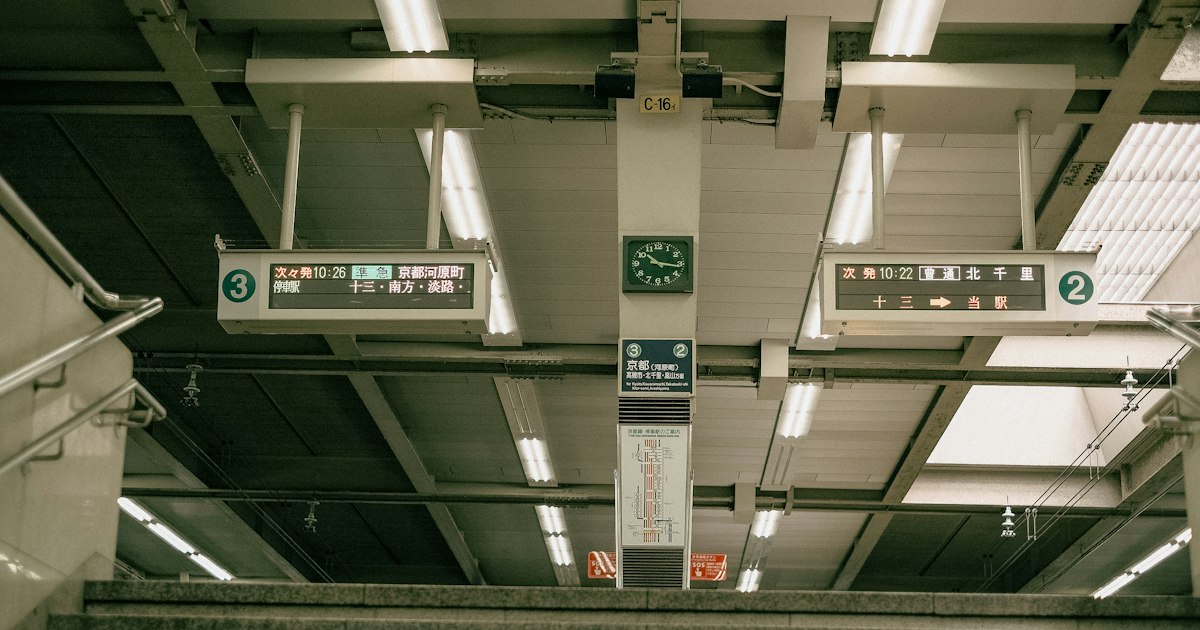
Ask a first-time visitor to Kansai how to get around and they’ll almost always say “JR.” That’s fair — the JR Kansai Area Pass is heavily marketed and the Japan Rail Pass dominates pre-trip research. But JR doesn’t actually own most of the useful routes between Osaka, Kyoto, Kobe, and Nara. Three private railways — Hankyu, Hanshin, and Kintetsu — quietly run faster, cheaper, and more frequent trains on exactly the routes tourists need, and almost nobody plans around them. Here’s what each one is for, what it costs, and where the mistakes happen.
Why these three railways matter to visitors
Hankyu, Hanshin, and Kintetsu are regional private operators, not JR subsidiaries, which means JR passes (including the Japan Rail Pass and the JR Kansai Area Pass) are not valid on any of them. That single fact trips up more tourists than anything else in this article — people buy a JR pass assuming it covers “the trains,” tap in at a Hankyu gate, and get rejected or charged in full.
The upside of stepping outside the JR network is real. Hankyu and Hanshin both connect Osaka and Kobe faster and cheaper than JR’s rapid service in most cases, and Kintetsu is the only direct rail link between Osaka/Kyoto and Nara that doesn’t require a transfer. If your itinerary includes Kobe, Nara, or the Umeda/Namba shopping districts, you’ll be using these lines whether you plan for them or not.
Hankyu: Osaka–Kyoto–Kobe, and the best people-watching in the city
Hankyu’s main value is its triangle route linking Osaka (Umeda Station), Kyoto (Kawaramachi/Arashiyama), and Kobe (Sannomiya/Kobe-Sannomiya). The Kyoto Line’s limited express runs Umeda to Kawaramachi in about 43 minutes for ¥410 — noticeably cheaper than the JR equivalent and with plush maroon seating that regulars will tell you beats the Shinkansen for comfort on a short hop.
Trains run every few minutes during the day from roughly 5:00 AM to midnight, so there’s rarely a reason to check a timetable in advance. The one planning note worth remembering: the Hankyu Kyoto Line terminates at Kawaramachi, which is on the east side of the Kamo River near Gion, not at Kyoto Station — useful if you’re headed into the old city, less useful if you need the Shinkansen or JR lines, where you’d want JR or the subway instead.
Hankyu Umeda Station itself is worth ten minutes even if you’re not boarding a train — the elevated concourse has a cathedral-like roof and is directly connected to the Hankyu department store, a good stop if you’re building out a Kansai shopping day.
Hanshin: the budget route into Kobe, and Koshien for baseball fans
Hanshin runs a near-parallel route to Hankyu between Osaka (Umeda) and Kobe (Sannomiya), but hugs the coast and tends to be the cheapest option on this corridor — around ¥330 one-way on the limited express, roughly 30 minutes. If budget is the deciding factor between Osaka and Kobe, Hanshin wins.
Hanshin’s other claim to fame is Koshien Stadium, home of the Hanshin Tigers and Japan’s most famous high-school baseball tournament. Koshien Station sits directly on the Hanshin main line between Osaka and Kobe, about 15 minutes from Umeda. If you’re in Kansai during the professional season (late March to October) or the national high-school tournaments (early April and mid-August), a Hanshin Tigers game is one of the most atmospheric sporting experiences in Japan, and tickets are easy to buy same-day at the stadium gate for ¥2,000–¥6,000 depending on seating.
Kintetsu: your only direct line to Nara
This is the one tourists most need and least know about. Kintetsu’s Nara Line runs direct from Osaka Namba Station to Kintetsu-Nara Station in about 35 minutes on the rapid express, for ¥680. There is no direct JR equivalent from Namba — JR requires a transfer at Tennoji or Osaka Station, adding time and a line change for roughly the same price. If you’re day-tripping to see Nara’s deer park and Todai-ji, boarding at Namba on Kintetsu instead of hunting for a JR route will save you a genuine transfer headache.
Kintetsu also runs the direct line from Kyoto to Nara (Kintetsu Kyoto Line, about 45 minutes, ¥760) and, further afield, the long-distance limited expresses to Ise-Shima and the approach routes toward the Kii Peninsula. If Nara is on your itinerary at all — and it should be, even as a half-day add-on to Kyoto or Osaka — Kintetsu is the line to search for, not JR.
One practical note: Kintetsu’s limited express trains (marked “L/E” or with a distinct livery) require a separate seat reservation ticket on top of the base fare, typically an extra ¥520–¥1,000 depending on distance. The rapid express and regular express trains on the same Nara route don’t need this and are only a few minutes slower — for a short Namba–Nara hop, skip the limited express surcharge entirely.
IC cards make all three lines a non-issue
You don’t need to buy separate tickets or learn each railway’s fare chart. ICOCA, Suica, PASMO, and other nationwide IC cards work identically across Hankyu, Hanshin, Kintetsu, JR, and the Osaka Metro — tap in, tap out, and the correct fare is deducted automatically, including transfers between operators. This is the single easiest fix for the “which railway do I need” anxiety: load an IC card at any station machine and stop worrying about which company’s gate you’re walking through. The only exception is Kintetsu’s limited express seat reservation, which still needs to be bought as a paper or app ticket even if you tap your IC card for the base fare.
Common mistakes to avoid
- Assuming a JR pass covers these lines. It doesn’t, ever. Hankyu, Hanshin, and Kintetsu are entirely separate companies.
- Buying a Kintetsu limited express ticket for a short Namba–Nara hop. The rapid express is nearly as fast and needs no reservation.
- Confusing Hankyu Kawaramachi with Kyoto Station. They’re on opposite sides of the city center; check which one your hotel or destination is actually near before boarding.
- Not checking for discount day passes. Both Hankyu and Kintetsu sell their own 1-day or 2-day tourist passes (sold at major stations and some airports) that can beat paying per-ride if you’re doing multiple legs on the same line in one day — worth a quick check against your planned stops before defaulting to single tickets.
None of these three railways need advance booking or seasonal timing the way, say, a Mt. Fuji mountain hut does — they run year-round on the same frequent schedules. The only timing consideration is rush hour (roughly 7:30–9:00 AM and 5:30–7:30 PM weekdays), when Umeda, Namba, and Sannomiya platforms get genuinely crowded. If you’re traveling with luggage between Kansai Airport and the city, aim outside those windows.
The broader lesson is that Japan’s rail map isn’t one network wearing different liveries — it’s a patchwork of competing companies, and the private railways often built the more convenient route precisely because they were competing with JR for the same passengers. The same logic applies elsewhere in the country; if you’re mapping out driving instead of rail for part of your trip, it’s worth knowing the rules differ there too, as covered in this guide to Japanese traffic enforcement for foreign drivers. But for Osaka, Kobe, Kyoto, and Nara specifically, learning to glance at a map and ask “is there a Hankyu, Hanshin, or Kintetsu option here” before defaulting to JR will save you money and transfers on nearly every day of a Kansai trip.