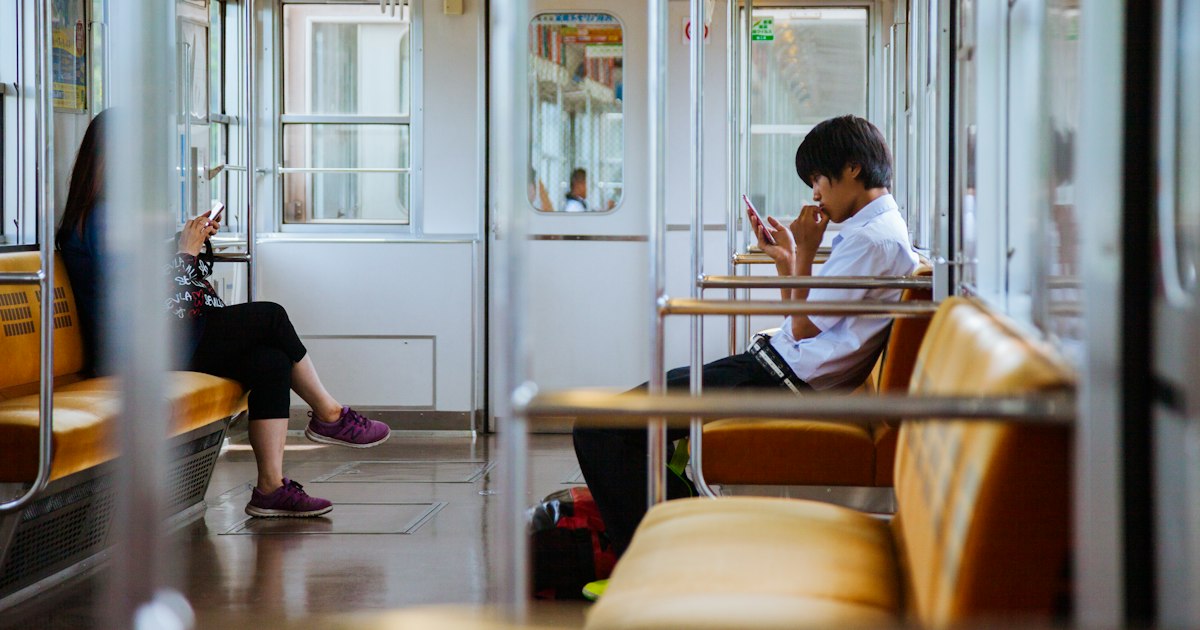
Photo by Victoriano Izquierdo on Unsplash
Nearly every train and subway car in Japan has a cluster of seats near the doors in a different color — pale yellow, pink, or green — marked with pictograms of elderly passengers, pregnant women, people with injuries, and parents holding infants. These are yuusenseki (優先席), or priority seats, and they are one of the easiest places for a well-meaning visitor to accidentally cause offense. Unlike a lot of Japanese train etiquette, which is unwritten and easy to misread, priority seat rules are actually posted in plain English and pictograms right above the seats — the problem is that most visitors never stop to read them, and the few who do often misunderstand what they say.
What priority seats are actually for
Priority seats exist for four groups, always shown as icons on or near the seat: elderly passengers, people with disabilities or injuries, pregnant women, and passengers traveling with small children or infants. They are not reserved in the sense of being empty or ticketed — anyone can sit in them when the car isn’t crowded. The expectation is that you give them up promptly, without being asked twice, if someone from one of those groups boards and the car is full. On the Yamanote, Chuo, and other Tokyo-area JR lines, priority seats are usually at both ends of each car; on Tokyo Metro and Toei Subway trains, look for seats in a noticeably different fabric color, often yellow-green or pink.
Mistake #1: Treating them as off-limits entirely
The most common overcorrection is visitors avoiding priority seats altogether, even on a nearly empty train at 11pm. This isn’t necessary and can actually look odd — standing awkwardly next to open seats signals confusion rather than courtesy. If the car is quiet and no one who obviously needs the seat is nearby, it’s fine to sit. The etiquette is situational, not absolute: it’s about yielding when needed, not about the seat being forbidden territory for able-bodied travelers.
Mistake #2: Not noticing the maternity mark
Pregnancy in Japan isn’t always visibly obvious, especially in the first and second trimesters, and a lot of visitors miss the small cue many pregnant passengers wear: a pink keychain tag called the matanity maaku (maternity mark), distributed free at city halls and JR ticket offices, usually clipped to a bag strap. It reads “お腹に赤ちゃんがいます” (there is a baby in my belly). If you spot it on someone standing near a priority seat, offering your seat — even a non-priority one — is the expected move, and a short “どうぞ” (dōzo, “please, go ahead”) with a gesture toward the seat is all you need to say.
Mistake #3: Keeping headphones loud or phones on speaker
The posted rules near priority seats in many cars also ask passengers to turn off phone ringers and avoid calls, originally out of concern for pacemaker interference from older phone models. That specific medical risk is largely outdated with modern phones, but the social norm has outlived the original reason: silence and phones on silent mode near these seats is still expected and noticed if violated. If you’re charging through a long Shinkansen or local transfer and listening to something, keep volume low enough that it doesn’t leak from your earbuds — the same low-noise expectation that governs most of a Japanese train car, priority seats or not.
Mistake #4: Assuming “no one needs it, so I’ll nap there”
Falling asleep or burying yourself in a phone in a priority seat means you won’t notice when someone who needs the seat boards, which is the actual problem — not the seat choice itself. Japanese commuters frequently sit in priority seats on crowded rush-hour trains out of simple necessity, but they tend to stay alert to who gets on at each stop. If you’re jet-lagged and likely to doze off, it’s courteous to pick a standard seat instead, precisely because you won’t be able to respond in time.
How to read the signage quickly
Above or beside priority seats you’ll typically see a small sign with four pictograms in a row (a cane-user or elderly figure, a figure with a cast or injury, a pregnant figure, and a parent-and-child figure) alongside Japanese text and often an English line reading something like “Please offer this seat to those who need it.” Some older rolling stock only has the Japanese version, but the icons are consistent nationwide, so once you recognize the row of four symbols, you’ll spot priority seating instantly on any line — JR, private railways, or subway — even without being able to read kanji.
A related courtesy: standing and escalators near train platforms
Priority seating is part of a broader pattern of small, situational courtesies on Japanese public transit that visitors often get backwards by overcorrecting or underreacting. The same logic applies to station escalators, where standing on the correct side matters more in some cities than others — our guide to escalator etiquette in Japan, including why Osaka stands on the right while everywhere else stands left, covers the regional exception that trips up a lot of travelers moving between Kansai and Tokyo. If your trip involves a lot of long-distance travel between priority-seat etiquette on commuter lines and quieter rural or seasonal travel, it’s also worth checking our guide on traveling during Obon, since trains during that week run far more crowded than usual, which raises the stakes on all of this seating etiquette considerably.
Practical takeaway for visitors
You don’t need to memorize a rulebook here. The short version: sit in priority seats freely when a car is empty or quiet, stay alert rather than asleep if you do, give up the seat promptly and without a fuss when someone from the four marked groups boards or is clearly struggling to stand, and keep phone calls and loud audio out of that zone specifically. None of this requires fluent Japanese — a small nod, a gesture to the seat, and moving promptly communicates everything necessary. Getting this right is a small thing, but it’s one of the most visible ways a visitor signals basic consideration on a system that millions of commuters rely on daily, and it costs nothing beyond a moment’s attention to who just got on the train.