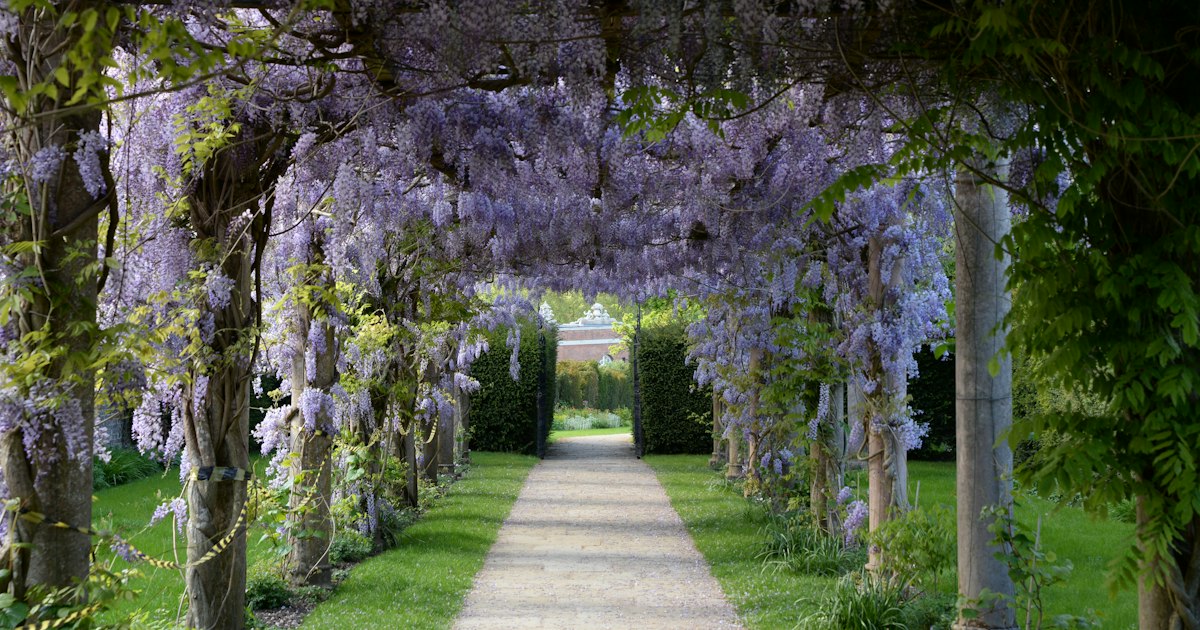
Photo by Jaroslaw Laka on Unsplash
Every April and May, two gardens on opposite ends of Japan turn purple, pink, and white under curtains of hanging wisteria — and neither one is actually named after Mount Fuji. “Fuji” (藤) just means wisteria, a coincidence that trips up a lot of first-time visitors Googling “Fuji flower park Japan.” Ashikaga Flower Park, north of Tokyo in Tochigi Prefecture, and Kawachi Fuji Garden, in Kitakyushu on the island of Kyushu, are the two most photographed wisteria sites in the country. They’re very different experiences — one is a big, easy day trip from Tokyo; the other is a small private garden that requires advance planning — so here’s what you actually need to know before you go.
Ashikaga Flower Park: The Great Wisteria
Ashikaga Flower Park (あしかがフラワーパーク) in Tochigi Prefecture is built around several enormous wisteria trees, including a single specimen often called the “Great Wisteria” that’s over 150 years old and spreads across roughly 1,000 square meters, held up on a framework of trellises so you can walk beneath its canopy. There are also white, pink, and yellow wisteria varieties, plus a long wisteria tunnel of its own, blooming in sequence from mid-April into mid-May.
The park uses a variable admission system tied to how much is actually in bloom that day — a practice worth knowing about before you arrive, because the price swings a lot. Outside of major flower seasons, adult admission can be as low as 300–900 yen. During peak wisteria season (typically the last week of April through early May), it rises to around 1,800–2,000 yen for adults, with children roughly half price. Check the park’s official site the morning of your visit — they post the day’s fee and a bloom-status report.
Regular hours run from about 9:00 to 18:00, but during wisteria season the park extends into an evening illumination, with wisteria lit up after dark until around 21:00. The night illumination is a separate highlight from the daytime visit — the lanterns and colored lighting under the wisteria canopy are genuinely different from the daytime scene, so if your schedule allows, it’s worth staying past sunset rather than treating it as an either/or choice.
Getting to Ashikaga Flower Park
This is the easy one logistically. The park has its own train station, Ashikaga Flower Park Station, on the JR Ryomo Line — it’s a roughly three-minute walk from the platform to the entrance. From central Tokyo, the typical route is a JR Shonan-Shinjuku Line or Utsunomiya Line train north to Oyama Station, then a transfer onto the JR Ryomo Line to Ashikaga Flower Park Station. Total travel time is around 1.5 to 2 hours each way, and a one-way fare runs roughly 2,000–2,500 yen depending on your starting station. Driving is also straightforward if you’re renting a car, with large on-site parking lots (a parking fee applies during flower seasons).
If you’re traveling with kids or rail enthusiasts and want to build this into a longer Saitama/Tochigi day, it’s worth knowing the route passes near Omiya, home to The Railway Museum in Saitama — easy to combine as a stop on the way up or back if you break the trip into two days.
Kawachi Fuji Garden: Kyushu’s Wisteria Tunnels
Kawachi Fuji Garden (河内藤園) in Kitakyushu, Fukuoka Prefecture, is a small, privately run garden that became internationally famous after CNN listed it among the “31 Most Beautiful Places in the World.” Its signature feature is a pair of wisteria tunnels — one about 80 meters long, one about 110 meters — where the blossoms form a dense, color-graded ceiling you walk through, along with a wisteria-covered dome area nearby.
That fame came with a catch: this is a modest, family-run garden, not a large public park, and it genuinely wasn’t built to handle the crowds the CNN feature brought. As a result, the garden now runs on a variable, bloom-condition-based admission fee similar in spirit to Ashikaga’s — generally somewhere in the 500–1,500 yen range for adults depending on how far along the flowers are, with the garden sometimes closing entirely in the days just before or after peak bloom for maintenance. During the fullest bloom window, which usually falls in the last week of April into the first few days of May, expect the higher end of that range and sizeable crowds regardless of price.
Getting to Kawachi Fuji Garden (and Why You Need to Plan Ahead)
This garden is far less convenient to reach than Ashikaga, and that’s the single biggest thing to plan around. There’s no train station nearby. The standard approach is to take the JR Kagoshima Main Line to Yahata Station, then transfer to a shuttle bus that runs only during the wisteria season — it doesn’t operate the rest of the year. The shuttle ride takes roughly 20–30 minutes, and because capacity is limited, lines for the bus can stretch into an hour or more on weekends at peak bloom. A taxi from Kokura or Yahata Station covers the same distance in a similar amount of time without the queue, but at taxi prices.
Because of the crowding problems after the CNN exposure, the garden has in recent years required advance online ticket reservations with a designated entry time slot during the busiest weeks — walk-up admission without a reservation may simply not be possible on the most popular days. Reservations open on the garden’s official website before the season starts and sell out for the best time slots, so if your trip dates are fixed, book as soon as the window opens rather than assuming you can decide on the day.
Best Timing and Common Mistakes
Both gardens bloom on roughly the same calendar — mid-to-late April through early May — but the exact peak shifts year to year by about a week depending on spring temperatures, so a fixed date on a travel itinerary booked months in advance is a gamble. A few mistakes are easy to avoid:
- Booking around Golden Week without checking crowds. Japan’s Golden Week holiday (roughly April 29–May 5) overlaps with peak wisteria at both gardens, and also happens to be when most of the country is traveling domestically. Expect the heaviest crowds, longest shuttle-bus lines at Kawachi Fuji Garden, and highest variable admission fees at both sites during this stretch.
- Assuming “Fuji” means Mount Fuji. If you’re actually trying to plan around Mount Fuji sightseeing or climbing, these wisteria gardens won’t help — for that, see Chureito Pagoda for the classic mountain photo spot, or booking a mountain hut on the Yoshida Trail if you’re climbing.
- Not checking same-day bloom reports. Both gardens post daily bloom status online because the flowers only look spectacular for a narrow window — arriving a week early or late can mean paying peak-adjacent prices for partially bare trellises.
- Underestimating Kawachi Fuji Garden’s access bottleneck. Visitors used to Japan’s excellent train network sometimes assume they can wing it; the seasonal-only shuttle bus and reservation requirement make this one of the few sights in the country where showing up without a plan can mean not getting in at all.
Budget, Mid-Range, and Splurge Options
For budget travelers, visiting Ashikaga Flower Park just before or after peak bloom keeps admission near the 300–900 yen floor while still catching some color, since the park has staggered wisteria varieties that bloom across several weeks. Mid-range visitors should budget for peak admission (around 1,800–2,000 yen at Ashikaga, up to 1,500 yen at Kawachi Fuji Garden) plus transport, and treat the evening illumination at Ashikaga as the mid-range splurge — it’s included in the same admission if you simply stay past dark. For a genuine splurge, pair a wisteria-season trip with a few nights in the region: the Tochigi/Saitama area and northern Kyushu both have good onsen towns within reach, turning a single-garden visit into a proper regional loop rather than a rushed day trip.