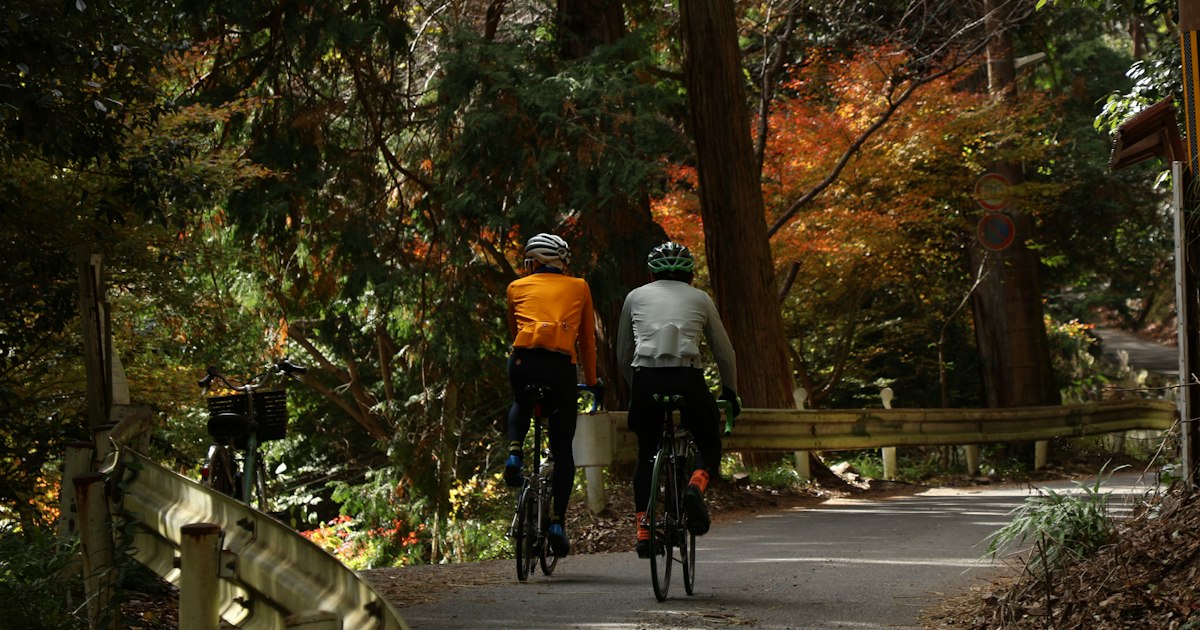
Photo by Yanhao Fang on Unsplash
City bike-share apps like Docomo Bike Share and HELLO CYCLING get most of the attention in Tokyo and Osaka guides, but the real payoff of an electric-assist bicycle in Japan is out in the countryside — on a coastal cycling road, between rice paddies, or up a hill to an onsen town you’d otherwise skip because the climb looked brutal. Rural e-bike rental is cheap, easy to book same-day, and solves the biggest problem with countryside travel: buses run twice an hour and taxis are scarce, but a bike goes exactly where you want, when you want.
What counts as an “e-bike” rental in Japan
Almost every rental shop outside the big cities is renting a denki assist jitensha (電動アシスト自転車) — a pedal-assist bicycle that boosts your pedaling up to 24 km/h and then cuts the motor. This is legally a bicycle, not a moped, so you don’t need a driver’s license or International Driving Permit to rent or ride one. Throttle-only e-bikes and e-scooters are a different legal category in Japan and are rarely offered to tourists, so if a listing just says “e-bike,” assume pedal-assist unless stated otherwise. Helmets are recommended for all cyclists under the revised road traffic rules but not legally required for adults, and most rental counters will offer one for free or a few hundred yen.
Where it’s actually worth renting one
A few regions built their rental networks specifically around e-bikes because the terrain or distances call for it:
- Shimanami Kaido (Hiroshima to Ehime, via six bridges over the Seto Inland Sea) — the most famous cycling route in Japan, roughly 70 km one-way. The Giant Store rental network has stations at Onomichi, Imabari, and the islands in between, and lets you pick up at one end and drop off at the other for a one-way fee (around ¥1,000 extra). E-assist models typically run ¥3,000–¥4,500 per day versus ¥2,000 for a standard road bike.
- Noto Peninsula and the Sado Island coast — long, flat-ish coastal roads where a standard bike is fine for fitness riders but an e-bike makes a 40–50 km day realistic for everyone else.
- Furano and Biei (Hokkaido) — the rolling flower-field hills between the two towns are gorgeous but genuinely hilly; rental shops near Biei Station rent e-bikes seasonally, roughly June through October, for about ¥3,000–¥4,000 for 4–6 hours.
- Hot spring and mountain towns — places built on a slope, like the bathhouse circuit at Shibu Onsen or the valley town around Hakone, often have a rental counter near the station precisely because walking between ryokan, baths, and sights involves steady climbs that a motor makes painless.
- Yakushima and other island destinations — e-bikes let you cover the coastal ring road sections without needing a rental car, which is useful if you’re traveling light.
Prices and what’s included
Budget around ¥2,000–¥3,000 for a half day (4–5 hours) and ¥3,000–¥5,000 for a full day at a typical countryside shop or roadside station (michi-no-eki). That price usually includes a helmet, a basic lock, and liability insurance — several prefectures (Kyoto, Osaka, Hyogo, Saitama among them) legally require cyclists to carry bicycle insurance, and rental shops build this into the fee rather than itemizing it. Splurge options exist too: some shops near popular routes rent higher-spec e-bikes with larger batteries and better suspension for ¥6,000–¥8,000 a day, aimed at riders doing 60+ km routes. On the budget end, HELLO CYCLING’s app-based e-assist bikes have spread well beyond Tokyo into regional cities and some tourist towns, charging around ¥130 per 15 minutes with a daily cap — cheaper for a short hop, but you’re limited to wherever their docking ports are, which is still thin outside major cities.
Booking and picking up your bike
Most rural shops don’t need advance reservations outside peak seasons (cherry blossom season in spring, foliage season in autumn, and Golden Week in late April/early May), but calling or booking online a day ahead guarantees availability and lets you ask about the battery range for your planned route. You’ll need a passport or ID for the rental form, and a credit card or cash deposit at some shops. If your rental starts right after arriving by train, check your IC card or ticket works cleanly through the gate before you’re standing there with a bike reservation ticking — if it doesn’t tap through, our guide on what to do when your IC card or ticket won’t open a station gate covers the fix. If you’re doing the rental as a day trip from a city hotel and don’t want to lug a suitcase around on a bike rack, see our guide to stashing luggage at the station before you head out.
Best timing and season
Spring (March–May) and autumn (October–November) are the sweet spot almost everywhere in rural Japan: comfortable temperatures, good battery efficiency, and scenery worth the ride. Midsummer (July–August) is punishing on exposed coastal and inland routes — heatstroke is a real risk, and batteries drain faster in high heat just as they do in the cold. Rainy season (mid-June to mid-July) makes many rentals a wash, literally. In snow regions like Hokkaido, Nagano, and parts of Tohoku, e-bike rental shops typically close for winter (roughly December–March), so check the shop’s seasonal hours before building a winter itinerary around one.
Common mistakes to avoid
- Underestimating the return deadline. Most shops close by 17:00–18:00 and charge a late fee or an extra day’s rate if you’re not back by closing — build in buffer time, especially on one-way routes where you still need to find the return counter.
- Assuming one-way drop-off is everywhere. It’s a feature of specific networks like Shimanami Kaido’s Giant Store system, not a default. Ask explicitly before planning a point-to-point route.
- Not checking the battery range against the route. A fully charged e-bike typically covers 40–70 km depending on assist level and terrain, but hills, headwinds, and cold weather cut that noticeably. Ask the shop which assist mode to use for your specific route.
- Riding on routes where bikes aren’t allowed. Expressways and some tunnels prohibit bicycles entirely; local shops will flag this when you ask about a route, which is reason enough to ask.
- Skipping the insurance question. If a shop’s price seems unusually low, confirm liability insurance is included — it should be, but it’s worth a direct question rather than an assumption.
Done right, a day on a rural e-bike is one of the best-value things you can book in Japan: a few thousand yen buys you a self-paced, motor-assisted route through scenery that the train and bus schedules would otherwise ration out to you in small, inconvenient doses.