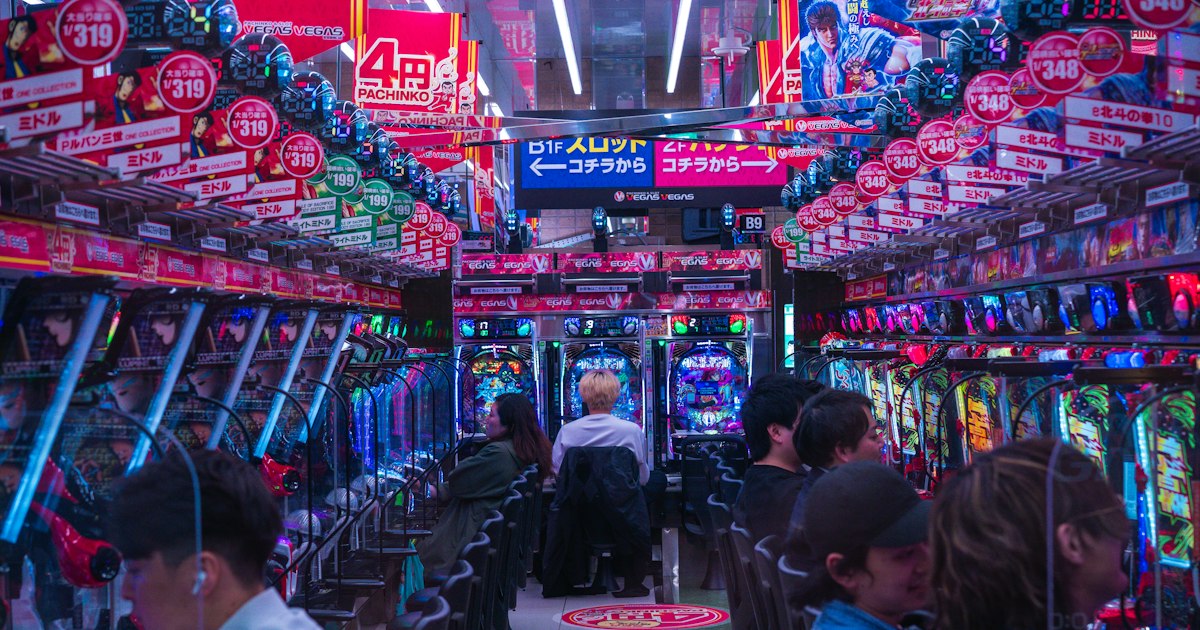
Photo by Alexandre Valdivia on Unsplash
If you’ve wandered through almost any mid-sized Japanese city and spotted a multi-story building lit up like a pachinko parlor with a bowling pin on the sign, you’ve probably found a Round1 Stadium. It’s one of Japan’s largest entertainment chains, and for visitors it solves a very specific travel problem: what to do on a rainy afternoon, a jet-lagged night, or a gap between dinner and your last train. One building gets you bowling, a full arcade floor, karaoke rooms, darts, pool tables, batting cages, and sometimes even ice skating or a gym — all under one roof, open absurdly late.
What’s Actually Inside a Round1
Round1 (ラウンドワン) locations vary in size, but a typical “Round1 Stadium” branch spans several floors and includes:
- Bowling lanes — usually 20-40+ lanes, automatic scoring, rental shoes
- Game arcade (Round1 Spo-Cha or Amusement floor) — crane games (UFO catchers), rhythm games, racing cabinets, photo booths, medal games, and claw machines stacked with anime and character merchandise
- Karaoke rooms — private rooms by the hour or “free time” block, with drink bars
- Darts and billiards — coin-operated or time-based
- Sports Cha (Spo-Cha) — larger locations add batting cages, trampolines, table tennis, mini-golf, archery, and sometimes an ice rink or bouldering wall
This “everything in one building” model is a close cousin of the arcade culture you’ll find in places like Odaiba, which has its own large Round1 branch inside the DECKS Tokyo Beach mall — worth knowing if you’re already spending a day there with Gundam statues and shopping.
How Pricing Works (and Why It’s Confusing at First)
Round1 doesn’t use one simple price list — costs depend on activity, time of day, day of the week, and location. As rough, commonly seen figures:
- Bowling: often priced per game, roughly ¥500-800 per person per game on weekdays, climbing on weekends and holidays. Shoe rental is typically a few hundred yen if not already included.
- Arcade games: most cabinets run on the classic ¥100 per play (or per credit) standard, though UFO catchers and newer cabinets can be ¥100-¥500 depending on the prize value.
- Karaoke and Spo-Cha activities: usually charged by 30-minute blocks, with a cheaper “free time” (nomihōdai-style unlimited time within a window) option that’s often better value if you’re staying more than an hour or two.
Exact yen amounts change by branch and season, so treat the above as ballpark planning numbers, not a quote — the pricing board at the entrance (and the Round1 app) always has the current rates for that specific store. A useful trick: ask staff or check the signage for the “free time” pass if you plan to bowl, play darts, or karaoke for more than an hour — per-game or per-hour pricing adds up fast otherwise.
Hours, Membership Cards, and the Minor Curfew
Round1’s biggest draw for travelers is its hours — many locations open around 9-10am and stay open until early morning (often 5am or 6am), with some running close to 24 hours. This makes it a genuinely useful option after a late dinner, for jet-lagged early risers, or as an alternative to bar-hopping.
One rule trips up visitors constantly: Japanese entertainment-facility law requires minors to leave amusement arcades, bowling alleys, and similar venues by a set curfew — commonly 10pm or 11pm depending on the prefecture and sometimes earlier for younger kids. Staff do enforce this, and families traveling with teenagers should plan an earlier visit rather than a late-night one. If you’re traveling with young children generally, it’s also worth checking our guide to baby-friendly facilities in Japan before a long session at a multi-floor complex like this.
Most locations offer a free membership card at a kiosk or counter — it’s not required, but it often unlocks discounted rates and is needed to use lockers or save arcade game progress. If you’re only visiting once, you can usually skip it and pay standard walk-in rates.
Best Time to Go
Weekday afternoons (particularly right after lunch, before students and after-work crowds arrive) are the quietest and often the cheapest window for bowling and karaoke. Weekend evenings get genuinely packed, especially at flagship urban branches, with waits for popular arcade machines and bowling lane assignments. If your trip falls during a rainy stretch — common in Japan’s June rainy season or typhoon-prone late summer — a Round1 is a reliable indoor backup plan that doesn’t require advance booking for casual visits.
Budget, Mid-Range, and Splurge Ways to Visit
- Budget: Skip bowling and karaoke, bring a pocket full of ¥100 coins, and spend an hour working the medal games and cheaper crane machines. You can have a fun hour for well under ¥2,000.
- Mid-range: A couple of bowling games plus an hour of free-time karaoke with a group, splitting the room cost, typically lands in the ¥2,000-4,000 per person range for an evening out.
- Splurge: Larger Spo-Cha branches let you combine batting cages, darts, pool, and an ice rink or bouldering wall in one visit — a half-day pass covering multiple activities is the better value if you want to try everything rather than paying per activity.
Common Mistakes to Avoid
- Not checking the curfew if you’re traveling with teens — don’t plan a 9pm arrival expecting a long night.
- Paying per-game when free-time passes are cheaper — always ask if you’re staying more than an hour.
- Arriving without small change — while card payment is increasingly common at registers, some older arcade cabinets still prefer coins or a prepaid arcade card you buy on-site.
- Assuming every location has everything — smaller Round1 branches may skip Spo-Cha extras like batting cages or ice skating, so check the specific store’s facility list on their website before making it the centerpiece of your day.
Where to Find One
Round1 has branches across most major Japanese cities, with especially convenient ones in Tokyo near Shinjuku, Shibuya, Ikebukuro, and Odaiba. If you’re already exploring arcade and otaku culture at Ikebukuro’s Otome Road or doing a nightlife circuit through Roppongi, a nearby Round1 makes an easy, low-effort add-on for the evening. Most central Tokyo locations are a short walk from a train or subway exit — if you’re unsure which line to take, our guide to Tokyo Metro vs. Toei Subway transfers is worth a skim before you head out, since the two systems don’t always connect as directly as you’d expect.
No reservation is needed for casual bowling, arcade, or walk-in karaoke — just show up, check the pricing board, and start playing. It’s one of the few entertainment options in Japan that rewards spontaneity rather than advance planning, which makes it a handy card to keep in your back pocket for whatever your itinerary doesn’t fill.