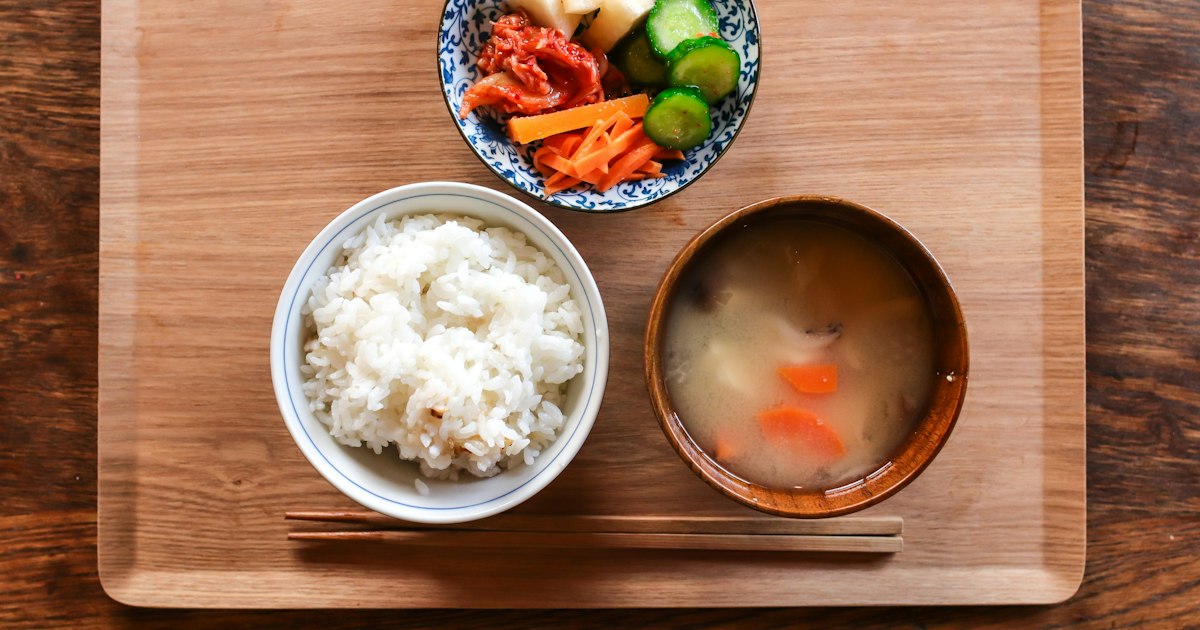
Photo by Takafumi Yamashita on Unsplash
The first time a ryokan attendant sets down a lacquered tray crowded with eight or nine small dishes, most foreign guests freeze. There’s no menu to point at, no obvious “main course,” and at least one item (hello, raw egg or fermented soybeans) that looks nothing like breakfast back home. The traditional Japanese breakfast, or washoku no asagohan, isn’t actually complicated once you know what you’re looking at — it’s just built on a different logic than a Western plate. Here’s how to read the tray, eat it in the right order, and avoid the small mistakes that make staff quietly wince.
What’s Actually on the Tray
A standard ryokan breakfast is modeled on ichiju-sansai — “one soup, three sides” — built around rice, with everything else there to balance it. On a typical tray you’ll find:
- Grilled fish — usually salted mackerel, salmon, or horse mackerel (aji), sometimes hokke in Hokkaido or Tohoku. Eat it with chopsticks, not your hands; the skin is meant to be eaten too.
- Tamagoyaki or a raw egg — rolled sweet omelet, or a raw egg meant to be cracked over hot rice (tamago kake gohan). If a small bottle of soy sauce sits next to it, that’s the hint.
- Rice and miso soup — rice is almost always served last-minute so it’s hot; miso soup varies by region (red, white, or a mix).
- Tsukemono — pickled vegetables, usually 2-3 kinds, meant to be eaten throughout the meal, not as a side salad at the end.
- Nori — dried seaweed sheets for wrapping bites of rice.
- Natto (optional, often on request) — fermented soybeans, stirred vigorously with its packet of mustard and sauce before eating.
- A small simmered or tofu dish — things like hijiki seaweed, boiled vegetables, or chilled tofu with ginger and green onion.
- A regional specialty — this is where ryokan breakfasts differ most. A Hokkaido inn might serve ikura (salmon roe) or a small hot pot; a Kyoto ryokan might include yuba (tofu skin); a coastal inn might add fresh shellfish.
At many ryokan, breakfast is cooked to order at a tabletop burner — a small pot of rice, soup, or a tofu hot pot simmers in front of you and is ready in 5-10 minutes. Don’t poke at it immediately; wait for staff to tell you it’s done, or watch the lid.
The Right Order to Eat (and Why Rice Comes Last)
There’s no strict rule, but the natural rhythm is: take a sip of miso soup first, then alternate small bites — a bit of fish, a bite of rice, a pickle, back to soup. This is called sankan shiho (eating in a triangle) — rice, soup, and a side, cycling through rather than finishing one dish before starting the next. It keeps the rice from being eaten plain and makes the saltier dishes (fish, pickles) taste balanced rather than overwhelming.
A few etiquette basics that matter at a ryokan specifically: don’t pour soy sauce directly onto your rice (pour a little into the small dish provided and dip), don’t stick chopsticks upright in your rice bowl, and if a lid is on a soup bowl, lift it toward you and set it face-up beside the bowl rather than flipping it over.
Common Mistakes Foreign Guests Make
- Treating it like a buffet. Most ryokan breakfasts are plated and brought to your room or a dining hall at a fixed time — there’s usually no second helping of fish, though rice and miso soup are often refillable on request.
- Skipping natto because of the smell, then feeling obligated to finish it anyway. You can simply leave it untouched; staff won’t be offended. It’s normal to ask in advance (“natto nashi de” — without natto) when booking.
- Showing up to the dining hall in a yukata with the wrong wrap. The yukata should always cross left-over-right (right side closest to your body); right-over-left is how bodies are dressed for funerals in Japan. It’s a small detail, but staff do notice.
- Wearing the wrong slippers into the dining area. Ryokan corridors often have one pair of slippers for general use and a separate, usually patterned, pair reserved only for the toilet — swapping them is one of the most common visitor mix-ups, covered in detail in our guide to toire surippa.
- Running late. Breakfast at ryokan is typically served in a narrow window, often 7:00-9:00 or 7:30-9:30, sometimes with two seatings you choose at check-in. Arriving after your assigned time can mean a cold tray or no tabletop cooking.
Timing, Booking, and What If You’re Not a Morning Person
Breakfast is almost always included in the room rate at traditional ryokan (unlike many Western hotels where it’s an add-on), bundled together with dinner in a plan called ichi shoku ni haku (two meals, one night). At check-in or in your reservation confirmation, you’ll usually be asked to pick a breakfast time slot — don’t skip this, since kitchens cook rice and grill fish to order in batches.
If you’re traveling during Japan’s busiest stretch, note that ryokan in popular areas book out breakfast slots (and rooms generally) well in advance around Obon in mid-August; see our guide to traveling during Obon for how far ahead to plan. The same applies to New Year and Golden Week.
Budget, Mid-Range, and Splurge Breakfasts
You don’t need to book a full ryokan stay to try this style of meal:
- Budget (¥800-¥1,500): Business hotels and some capsule hotels offer a simplified “Japanese breakfast set” in their restaurant — grilled fish, rice, miso soup, and a couple of sides, no tabletop cooking.
- Mid-range (¥2,000-¥5,000): Day-use or standalone breakfast experiences at city ryokan and inns near train stations, often bookable without an overnight stay. Expect 6-8 dishes and a hot pot or tabletop course.
- Splurge (¥8,000-¥20,000+ as part of a stay): Ryokan in onsen towns or rural areas built around regional ingredients — fresh seafood near the coast, wagyu or Hida beef in Takayama and Gifu, or wild vegetables (sansai) in mountain regions. This is where the breakfast becomes a genuine culinary highlight rather than a formality.
Best Season and Where to Experience It
Ryokan breakfasts don’t have a single “best” season — the tray changes with what’s regionally in season, which is part of the appeal. Winter brings hot pot-style tabletop dishes and heartier miso; spring and autumn bring seasonal vegetables and fish at their peak; summer inns in mountain or coastal areas lean into lighter, chilled tofu dishes to counter the heat. Onsen towns near natural attractions are a good pairing — if you’re already visiting a shrine-and-waterfall destination like Nachi Falls and Kumano Nachi Taisha, the nearby ryokan in the Kumano region serve breakfasts built around local citrus and seafood. Snow-country inns near ski areas like Gala Yuzawa often serve a wintertime breakfast with simmered root vegetables and a tabletop hot pot — a good reward after a morning on the slopes.
Whatever the region, the tray is designed to be eaten slowly, in small bites, with nothing left to chance — right down to the order the dishes arrive. Once you know what’s in front of you, it stops being a puzzle and starts being one of the better reasons to choose a ryokan over a hotel in the first place.