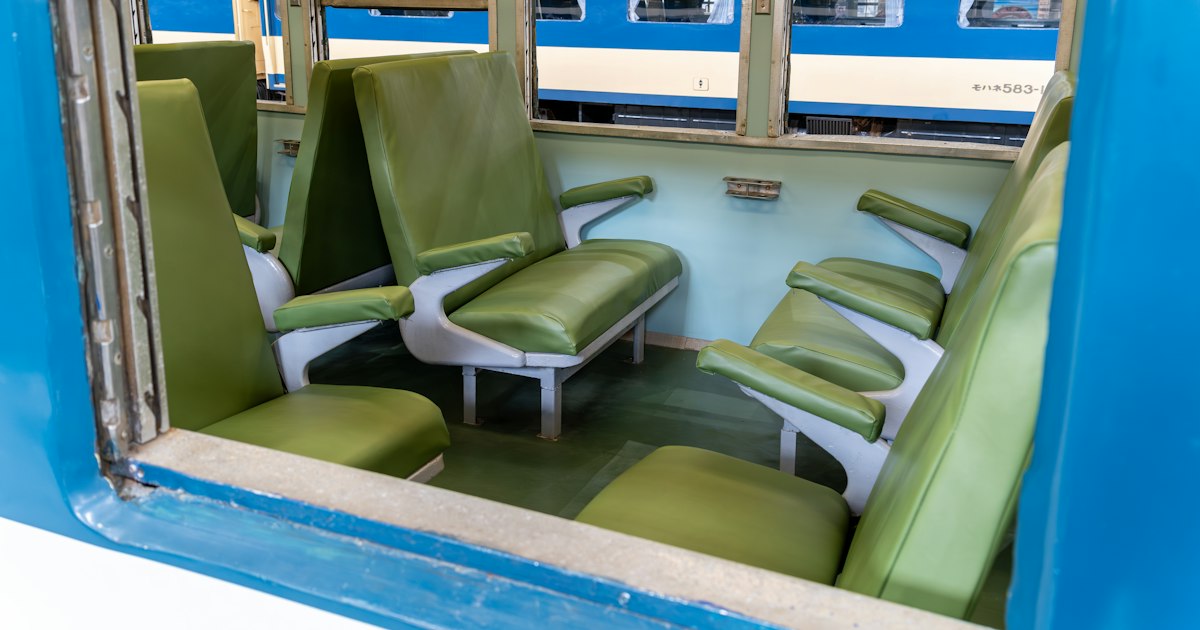
Photo by Winston Chen on Unsplash
Your phone is at 12% somewhere around Nagoya, your laptop needs to survive the whole ride to Osaka, and the seat you picked at random turns out to have no outlet within reach. Shinkansen power sockets aren’t evenly distributed — they follow a predictable pattern based on seat position and, just as importantly, which generation of train you’re on. Once you know the pattern, you can pick a seat that guarantees power every time, without relying on luck.
The Rule That Actually Matters: Window and Wall, Not Aisle
On most Shinkansen rolling stock still in service — the Tokaido/Sanyo Line’s N700A, the Kyushu Shinkansen’s 800/N700-8000 series, and similar older sets — power outlets are installed in two places in Ordinary (standard) class: at every window seat, and at every seat in a row that backs onto a wall, regardless of whether that seat is by the window or the aisle.
In the common 2+3 Ordinary class layout (seats A-B on one side of the aisle, C-D-E on the other), that means seats A and E have power at your feet, while B, C, and D usually don’t — unless their row happens to be a bulkhead row. Bulkhead rows are the first or last row in a car, and any row sitting next to a multipurpose room, storage area, or the connecting deck between cars. Those rows get outlets across the entire row, aisle seats included, because the wall behind them has room to run wiring without threading it under every seat in the car.
This is why two people sitting three rows apart, both in a “D” seat, can have completely different charging luck.
N700S Changes the Math Entirely
If you’re on the Tokaido or Sanyo Shinkansen (Nozomi, Hikari, or Kodama) and your train is an N700S — the newest generation, in service since mid-2020 and now running a large share of Nozomi services between Tokyo and Shin-Osaka — forget everything above. Every single seat in every car, aisle and middle seats included, has its own outlet. This was one of the N700S’s headline upgrades over the N700A, and it’s the single easiest way to guarantee power regardless of where you end up sitting.
The catch is you can’t always tell which generation you’ll get just from the train name, since N700A and N700S run side by side on the same Nozomi/Hikari timetables. The fix is simple: when booking through Smart EX or the EX-IC app (or JR’s ticket machines), the seat map displays a small plug icon next to any seat with an outlet. If you see plug icons on every seat in the map, you’ve got an N700S; if only the window column lights up, it’s an older set. Check that icon before you lock in a seat rather than guessing from the train’s nickname.
Green Car and Gran Class: A Non-Issue
If you’ve upgraded to a Green car (Tokaido/Sanyo, Tohoku, Hokuriku lines) or Gran Class (Tohoku/Hokkaido Shinkansen), outlet access has been standard at every seat for years regardless of train generation. It’s one of the few things you don’t need to double-check. The seats are also wider and reserved by nature, so this is the reliable option if you absolutely need power for a work call or a long editing session and don’t want to think about seat letters at all. Expect to pay several thousand yen more each way than Ordinary class — exact Green car surcharges vary by route length, so check the fare shown at booking rather than assuming a flat number.
Tohoku, Hokkaido, and Hokuriku Lines
The E5/H5 series (Hayabusa, running Tokyo–Aomori/Hakodate) and the E6 series (Komachi, running Tokyo–Akita) follow the same window-and-bulkhead logic as the older Tokaido sets in Ordinary class, with full outlet coverage in Green Car and Gran Class. The Hokuriku Shinkansen’s E7/W7 series (Kagayaki, Hakutaka, Tsurugi, connecting Tokyo to Kanazawa and Tsuruga) has a reputation for more generous outlet placement than the Tokaido fleet, but coverage still isn’t guaranteed at every single seat on every car — the seat-map plug icon is your most reliable source, since fleet refurbishments change these details over time.
If you’re connecting between the Tokaido and Sanyo lines, or correcting a mis-booked transfer, it’s worth reading our platform-by-platform guide to the Shin-Osaka transfer — it’s the one station where getting the wrong platform costs you the most time.
How to Check Before You Book
Don’t rely on memory of “which seat had power last time” — rolling stock is swapped between routes and refurbished on a schedule you can’t predict. Instead:
- Book through Smart EX (for Tokaido/Sanyo/Kyushu) or the JR East/JR West apps, and look for the plug icon on the seat selection map before confirming.
- Reserved seating opens exactly one month ahead at 10:00am — if a specific bulkhead or N700S car matters to you, book that morning rather than a few days out, especially around Golden Week (early May), Obon (mid-August), and New Year, when trains fill fast.
- In unreserved (jiyuseki) cars, you can’t pick a specific seat, so the pattern still applies but you’re gambling on availability — arrive at the platform early and board toward the front of the queue for your car.
Common Mistakes
The biggest one is assuming a middle or aisle seat on an older N700A will have power because the window seat next to it does — it won’t, unless that row is a bulkhead row. The second is forgetting that Shinkansen outlets are two-pin AC sockets (Japan’s standard Type A, 100V) with no built-in USB port on most trains, even the newest ones — bring your own USB wall charger or car-style adapter rather than assuming a bare USB cable will work. If you land in a powerless seat anyway, convenience-store and station-concourse battery rental kiosks (ChargeSPOT is the most common brand) let you borrow a portable charger for roughly ¥300–¥600 a day and return it at any participating kiosk nationwide, including ones at your destination station.
One more thing worth knowing if you’re traveling with an infant and need a calm spot to feed and recharge both the baby and your phone before boarding: the nursing lounges inside Akachan Honpo stores near major stations are an underused option. And if a bulkhead seat’s extra floor space is tempting because you’re hauling ski gear or oversized luggage rather than a laptop, our guide to shipping skis and suitcases ahead via takkyubin counters covers the alternative to wrestling it onto the train at all.
The Short Version
On older trains, go for window seats (A or E in a 2+3 layout) or any bulkhead row for guaranteed power. On an N700S, every seat works — check the plug icon when booking to know which generation you’ve got. And if you need certainty over savings, Green car and Gran Class remove the guesswork entirely.