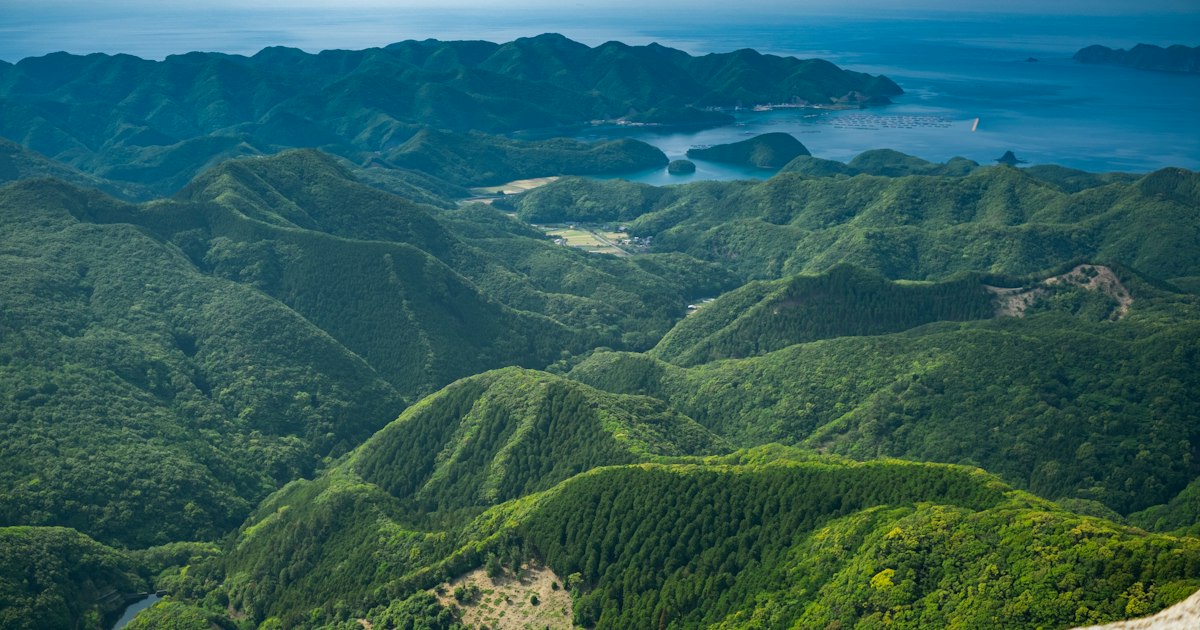
Photo by Nichika Sakurai on Unsplash
Tsushima sits in the strait between Kyushu and the Korean Peninsula, closer to Busan (about 50 km) than to mainland Japan (over 130 km). It’s a ragged, heavily forested island of deep inlets, ancient shrines, and more deer than people in some villages — plus one of the rarest cats on earth hiding in its hills. Few foreign visitors make it out here, which is exactly the appeal: you get a genuinely remote corner of Japan that’s also, on a clear day, a place to literally see another country.
Where Tsushima Is and Why It’s Worth the Trip
Administratively part of Nagasaki Prefecture, Tsushima is really two linked islands (Upper and Lower Tsushima) split by the deeply indented Aso Bay, which looks like a fjord more than a typical Japanese coastline. The main town, Izuhara, sits in the south; Hitakatsu, the north’s gateway port facing Korea, is where ferries from Busan dock. Historically Tsushima made its living as a trading post between Japan and the Korean kingdoms — you’ll see that history at Kaneda Castle’s seventh-century stone ramparts and at Watatsumi Shrine, whose torii gates stand half in the sea.
Getting There: Ferry or Flight from Fukuoka
Most travelers come via Hakata Port in Fukuoka. Kyushu Ferry runs a slower car ferry to Izuhara and Hitakatsu (roughly 4.5–5 hours, from around ¥7,500 one-way in 2nd class), while the Venus high-speed jetfoil cuts that to about 2–2.5 hours for roughly ¥14,000 one-way. Both can be cancelled in rough seas without much warning, especially in winter, so build in a buffer day if you have an onward international flight — don’t book a same-day connection.
Flying is the other option: Tsushima Yamaneko Airport (TSJ) near Izuhara has short hops (about 35 minutes) from Fukuoka and Nagasaki operated by Oriental Air Bridge, usually ¥10,000–¥20,000 one-way depending on how early you book. There’s also a direct international ferry from Busan to Hitakatsu (around 1–2 hours), which is why Hitakatsu’s signage, restaurants, and convenience stores are often as much in Korean as Japanese. If you’re entering Japan this way rather than through a major airport, it’s worth pre-registering your customs and immigration details through Visit Japan Web beforehand so the border check is quick.
Meeting the Deer — and the Island’s Famous Wildcat
Sika deer are everywhere on Tsushima, particularly in the north around Kamitsushima, where overpopulation has become a real agricultural problem — don’t be surprised to see them grazing roadside shoulders at dusk or crossing in front of your rental car. Resist feeding them; this isn’t a tame deer park like Nara.
The island’s true celebrity is the Tsushima leopard cat (Tsushima yamaneko), a critically endangered wild subspecies found nowhere else, with an estimated population in the low hundreds. Realistically you will not see one in the wild — they’re nocturnal and skittish. Instead, visit the Tsushima Wildlife Conservation Center in Kamitsushima, which has rescued cats in large naturalistic enclosures, exhibits on the conservation program, and (depending on the day) a chance to see one through the viewing windows. It’s closed Mondays, entry is free or a token fee, and it’s a 10–15 minute drive from the northern ferry port — easy to combine with a Korea-viewing stop on the same day. Night driving anywhere on the island warrants caution for both deer and the occasional wildcat crossing signs you’ll pass.
Catching a Glimpse of Korea
This is Tsushima’s signature experience. On a clear day — most reliably in winter when the air is driest, but also possible on crisp autumn mornings — you can see the outline of Busan’s coastline and mountains from the island’s northern tip. The purpose-built Korea Observatory (Kankoku Tenboujo) near Kamitsushima has telescopes and panel displays explaining exactly what you’re looking at, while the Eboshidake Observatory above Hitakatsu gives a wider sweeping view over Aso Bay with Korea visible beyond on good days. Bring your own binoculars if you have them; the coin-operated telescopes have limits on how long you get. Humid summer haze usually blocks the view entirely, so don’t plan a trip around this alone if you’re visiting June–August.
Getting Around Once You’re There
Public buses exist but run only a handful of times a day and don’t cover most of the scenic coastal roads, and taxis are scarce outside Izuhara and thin out completely after dark. A rental car is close to mandatory — book one at the airport or ferry terminal in Izuhara or Hitakatsu through the usual agencies (Toyota Rent-a-Car, Nissan, ORIX all have counters). If you’re already touring Kyushu in a rented vehicle and considering something like a camper van, note that rental agreements almost always prohibit taking the vehicle across on a ferry — plan to rent locally on Tsushima instead and treat the island as its own separate leg. Roads are narrow and winding around Aso Bay, so budget more driving time than the map distance suggests; a loop that looks like an hour can easily take two.
Best Season and Common Mistakes
Spring (April–May) brings mild weather and fewer ferry cancellations; autumn (October–November) offers the clearest skies for Korea-viewing and comfortable hiking temperatures. Summer is hot, humid, and carries typhoon risk from August into September, which is when ferries and flights get cancelled most often. Winter is cold and rough-sea cancellations spike, but it’s also when the air is clearest for spotting Korea.
- Trying to day-trip from Fukuoka: the jetfoil alone eats 4–5 hours round trip; plan at least one overnight.
- Mixing up Izuhara and Hitakatsu: they’re over an hour apart by car. Book accommodation in the port matching your ferry/flight, not the other one.
- Assuming cards work everywhere: many small restaurants and guesthouses outside Izuhara are cash-only. Bring enough yen.
- Expecting a wild leopard cat sighting: go in with the conservation center as your realistic goal, not a roadside encounter.
- No weather buffer: don’t schedule an international flight out of Fukuoka or Busan for the same day you leave Tsushima.
Where to Eat and Stay
Tsushima soba — made with a distinctive rotary stone-milling method some claim is the origin point of Japanese soba — is worth seeking out in small Izuhara noodle shops, often for ¥700–¥1,000 a bowl. The surrounding waters are known for squid (ika) and other fresh seafood; look for set lunches at harborside restaurants in Izuhara or Hitakatsu for roughly ¥1,200–¥2,000. For a souvenir with more shelf life, Tsushima’s small-scale Japanese honeybee honey makes a distinctive, harder-to-find pick than the usual regional snacks.
Budget travelers can find simple business hotels in Izuhara from around ¥6,000–¥9,000 a night, with minshuku guesthouses offering home-cooked meals for a similar range. Mid-range options are a step up in comfort near the Izuhara waterfront; there’s no large luxury resort on the island, so “splurge” here mostly means a nicer ocean-view room or a private onsen-style bath at one of the better guesthouses rather than a five-star property. Camping near Aso Bay is also an option in warmer months if you want to wake up on the water rather than drive to it.