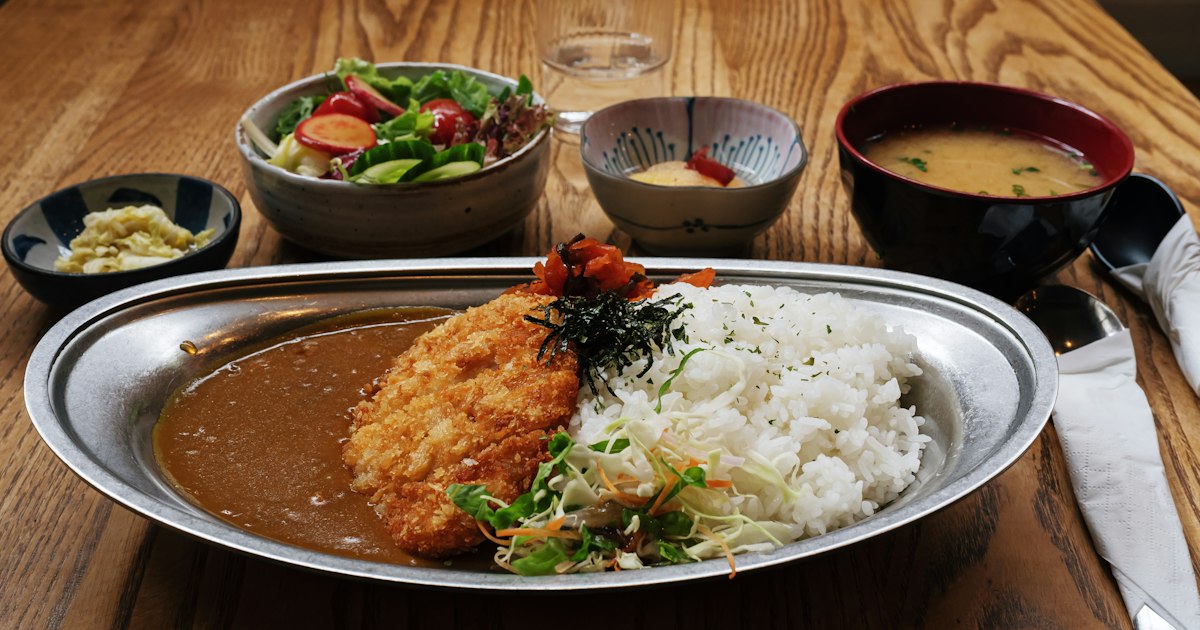
Photo by Kelsey He on Unsplash
Bright yellow signage, a menu thick with photos, and a waiter asking you three questions you weren’t expecting — that’s the CoCo Ichibanya experience for most first-timers. Known in Japan as Koko Ichibanya (ココイチ) and officially CoCo壱番屋, this is the country’s largest curry chain, with well over 1,200 locations from Hokkaido to Okinawa and a build-your-own system that rewards a little preparation. Here’s exactly how to navigate the menu, what things cost, and the mistakes that trip up most visitors.
What Makes CoCo Ichibanya Different
Most Japanese curry shops serve one fixed plate. CoCo Ichibanya instead treats curry rice as a build-your-own bowl: you pick a base curry, choose how much rice you want, set a spice level from a wide range, and add toppings on top. The curry itself is a thick, slightly sweet Japanese-style roux (closer to a mild beef stew than Indian or Thai curry), poured over white rice with a small mound of pickles — usually fukujinzuke (sweet pickled vegetables) and rakkyo (pickled scallions) — on the side. Those pickles are there to cut the richness, not as a garnish to skip.
The chain is famous for two axes of customization that don’t exist at most restaurants: rice quantity and spice level, both chosen independently of each other and independently of your toppings.
How to Order: Rice, Spice Level, and Toppings
At most locations a staff member takes your order at the table rather than you filling out a slip, though some branches use a touchscreen or QR-code menu. You’ll be asked to specify, in order:
- Rice amount (ライス量): Standard is 300g. You can usually go down to 200g or up to 400g, 500g, 600g, or more, often at no extra charge up to a certain weight and a small surcharge beyond that (roughly ¥50–¥150 for very large portions). If you’re not a big eater, ask for “sukuname” (少なめ, a bit less) or specify 200g.
- Spice level (辛さ): This is CoCo Ichibanya’s signature feature — a scale typically running from 0 (karakuchi/mild, sometimes labeled “0”) up through level 10, sometimes higher at special “extreme spice” tiers. Levels 1 through 4 or 5 are usually included in the base price; levels above that (6, 7, 8+) add roughly ¥100–¥300 because the chain uses pricier spice blends at the top end. Level 5 is already noticeably hot by most Western palates; level 10 is a genuine endurance challenge, not a flavor upgrade.
- Toppings (トッピング): Chosen from a laminated photo menu — this is where the fun (and the bill) adds up.
Reading the Menu and Prices
The base dish is usually “pork curry” (ポークカレー), running around ¥580–¥700 depending on rice size and location. From there, toppings are priced individually and stack freely:
- Budget (¥100–¥250 add-on): cheese, extra pickles, a soft-boiled or fried egg, vegetable toppings like eggplant or okra.
- Mid-range (¥250–¥450 add-on): chicken katsu, croquette (korokke), minced cutlet, sausage, shrimp.
- Splurge (¥450–¥700+ add-on): pork cutlet (tonkatsu), hamburger steak, a combination of two or three toppings on one plate, or the seasonal “grand menu” specials that rotate a few times a year.
A realistic total for a satisfying meal — base curry, medium rice, one topping, and a drink — lands around ¥900–�¥1,300, which is solid value for a sit-down meal in Japan. Most locations accept cash and increasingly take IC transit cards (Suica, PASMO, ICOCA) and credit cards, but it’s worth having ¥1,000–¥2,000 in cash as backup at smaller branches.
Step-by-Step: A Typical Order
Here’s what the exchange sounds like in practice, even if your Japanese is minimal:
- Sit down (no reservations needed; it’s fast-casual, usually counter or table seating).
- Point to a photo on the menu for your base curry and topping.
- When asked about rice, hold up fingers or point to the size chart — most menus show grams next to small illustrations.
- When asked about spice, point to a number 1 through 10 on the chart; staff are used to tourists choosing a cautious level 2 or 3.
- Water and the pickle condiments usually arrive automatically or are self-serve from a station near the register.
- Pay at the register on your way out, not at the table, at most branches.
If you want something simpler, just say “kono menu to, rice futsuu, karasa ni” (this menu, normal rice, spice level two) while pointing — staff are well practiced at helping non-Japanese speakers through the process.
Common Mistakes First-Timers Make
A few things catch visitors off guard every time:
- Ordering too much rice. 300g is already a generous portion by Western standards; 400g-plus is a lot of plain rice to finish, especially with a heavy topping on top.
- Treating spice levels like restaurant “mild/medium/hot.” The gap between level 4 and level 7 is much bigger than it looks on the chart. If you’re unsure, order one level lower than you think you want — you can always add the table hot sauce, but you can’t remove spice once it’s cooked in.
- Forgetting toppings are priced separately. The photo menu shows the finished combo plate, but the price listed is often for curry-plus-topping as a set; double-check whether a topping is “included” in a combo price or an add-on, since menu layouts vary by branch.
- Assuming it’s spicy like Thai or Indian curry. Japanese curry roux is built on a sweeter, flour-thickened base. Even high spice levels taste different from chili heat — more of a dry, building burn than a sharp one.
Best Season and Timing to Visit
CoCo Ichibanya has no strong seasonal angle — it’s a reliable year-round option, which is exactly its appeal when you need a filling, fast, English-menu-friendly meal between sightseeing stops. It’s especially useful on cold-weather trips (similar logic to grabbing a nikuman at a convenience store in winter) since the hot, thick curry warms you up fast. Most branches open around 11:00 and run through 22:00 or 23:00, with some near stations and highways open even later, making it a solid late-dinner fallback when other kitchens have closed. Locations cluster around train stations, shopping malls, and roadside strips — a quick map search for “CoCo壱番屋” or “CoCo Ichibanya” near your hotel will usually turn up several options within walking distance.
If you enjoy the idea of a build-your-own, highly customizable rice bowl, it’s worth comparing the experience to other Japanese chain classics like tendon, or to retro comfort food like napolitan at an old-school kissaten — both represent the same category of fast, satisfying, distinctly Japanese comfort meals that reward knowing how to order before you sit down.