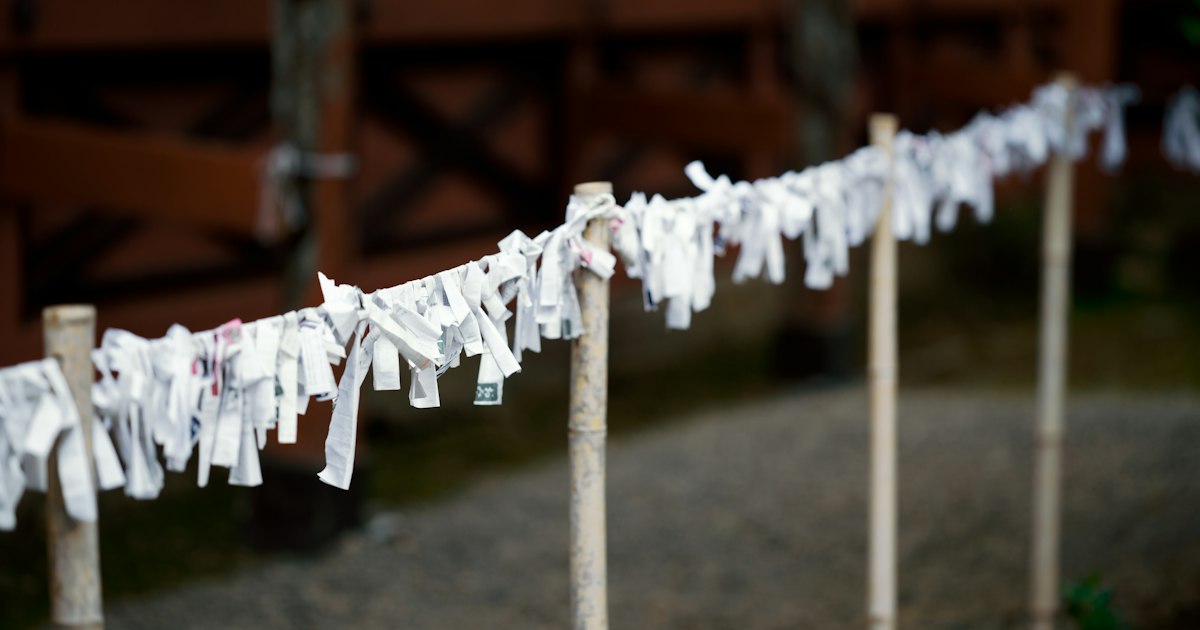
Photo by Heng Chiu on Unsplash
At almost every Shinto shrine and Buddhist temple in Japan, you’ll spot a wall or rack fluttering with thin white paper strips tied in neat rows. These are omikuji (おみくじ), random fortune slips that visitors draw for a small fee, and they’re one of the easiest, cheapest rituals a traveler can take part in without any special knowledge of Japanese. Here’s how they work, what your result actually means, and how to do it right.
What Exactly Is an Omikuji?
Omikuji are paper fortunes that forecast your luck in general life as well as specific categories — love, health, work, money, travel, and sometimes study or childbirth. They date back centuries as a way of consulting the gods (kami) or Buddha for guidance, and today they function as a light-hearted but genuinely respected part of a shrine visit, especially around New Year. Unlike a horoscope you read passively, omikuji are interactive: you physically shake a box, extract a numbered stick, and trade it for the matching paper slip at the counter.
The cost is almost always coins — typically ¥100 at Senso-ji in Asakusa, and ¥200–300 at most other shrines and temples nationwide. Many smaller or rural shrines run on an honor system: a wooden box of slips sits unattended with a small payment slot, and you leave your coin before taking one.
How to Draw Your Fortune, Step by Step
- Pay first. Drop your coin into the box or hand it to the shrine attendant.
- Shake the container. It’s usually a hexagonal wooden box with a small hole, filled with thin numbered sticks. Shake it (don’t dump it) until one stick slides out of the hole.
- Read the number on the stick, usually in kanji numerals.
- Find the matching drawer in the cabinet of small numbered boxes nearby and take one folded paper slip from it.
- Return the stick to its original container so the next visitor can draw.
Some busier spots, including sections of Senso-ji and Fushimi Inari Taisha in Kyoto, simplify this with a self-service shaking cylinder that drops a numbered ball directly, or with coin-operated omikuji vending machines. Either way, the whole process takes under a minute and needs zero Japanese ability.
Reading the Ranking: From Daikichi to Daikyo
Near the top of your slip is a ranking word in bold kanji — this is the headline result. Rankings vary slightly by shrine, but the common scale runs roughly:
- Dai-kichi (大吉) — great blessing, the best outcome
- Chu-kichi (中吉) — middle blessing
- Sho-kichi (小吉) — small blessing
- Kichi (吉) — blessing
- Han-kichi / Sue-kichi (半吉・末吉) — half blessing / future blessing
- Kyo (凶) — bad luck
- Dai-kyo (大凶) — great bad luck, rare
Below the ranking, the slip breaks things down by category with short poetic verses — these are the genuinely useful part, offering specific advice like “a journey now is favorable” or “wait before starting new business.” Many temples popular with foreign tourists, including Senso-ji, Fushimi Inari Taisha, and Kiyomizu-dera, print bilingual or fully English versions specifically for overseas visitors, so you don’t need to rely on a translation app to get the nuance.
What to Do With a Good (or Bad) Fortune
If you draw a good result, it’s common to fold the slip and tuck it into your wallet, bag, or phone case as a small good-luck charm to carry home. If you draw kyo or dai-kyo, the traditional response isn’t to panic — it’s to tie the paper onto the designated metal rack or wire frame set up near the drawing spot. The idea is that leaving the bad fortune at the shrine allows it to be “neutralized” or corrected by the deity rather than following you out the gate. You’re welcome to tie up a good fortune too if you’d rather leave it as an offering; neither choice is wrong.
One etiquette note: tie slips only to the provided racks or wire frames, not to living trees or shrubs, even if you see older, informal photos showing trees covered in paper. Most shrines have moved drawing points away from trees specifically to protect them, and staff will quietly untie anything attached to plants.
Best Times and Places to Draw Omikuji
Omikuji can be drawn year-round, but the single most popular window is hatsumode, the first shrine or temple visit of the new year, typically January 1–3, when millions of people across Japan line up specifically to draw their first fortune of the year. If you’re visiting then, expect long queues at famous sites and bring extra ¥100 and ¥500 coins, since lines move faster with exact change.
Outside New Year, reception desks at major sites generally operate during daylight hours — Senso-ji’s main hall area runs roughly 6:00–17:00 depending on season, and most shrines close their omikuji counters by early evening even if the grounds stay open later. If you’re building a shrine-heavy itinerary, sites with a strong spiritual pilgrimage tradition, like the Dewa Sanzan sacred mountains in Yamagata, are worth pairing with an omikuji stop, since drawing a fortune fits naturally into the same contemplative mindset as the hike itself.
Omikuji Souvenirs Worth Buying
Beyond the plain paper slip, many shrines sell novelty omikuji holders that double as souvenirs — small ceramic or wooden figurines (animals, Daruma dolls, deer at Nara-area shrines) that come pre-loaded with a tiny rolled fortune inside, priced around ¥300–600. These make better take-home mementos than a folded paper slip, since you keep the whole object rather than just the reading. If you enjoy collecting folk-craft items tied to regional culture, this pairs well with browsing seasonal and folklore-driven souvenirs, similar in spirit to the demon costumes and masks sold around the Namahage folklore festival in Akita.
Common Mistakes to Avoid
- Treating a bad result as a bad omen for your whole trip. Locals generally see kyo as a prompt for caution in a specific area, not a curse — don’t let it color your mood for the rest of the day.
- Drawing twice to “fix” a bad result immediately. It’s considered poor form to pay again right away hoping for a better slip; if you want to try again, wait for a different visit or shrine.
- Losing the translation. If your slip isn’t in English, take a photo and ask your hotel staff or a translation app to help later — the specific advice lines are often more interesting than the headline ranking.
- Forgetting coins. Many smaller shrines have no card payment option at all for omikuji, so carry ¥100 and ¥500 coins, the same habit worth keeping if you’re road-tripping between rural shrines where cashless payment is rare.
Omikuji cost less than a vending-machine drink and take seconds to draw, but they’re a genuinely memorable way to slow down during a shrine visit and engage with a tradition that’s still very much alive for Japanese visitors, not just performed for tourists. Keep a coin ready at your next torii gate and give it a try.