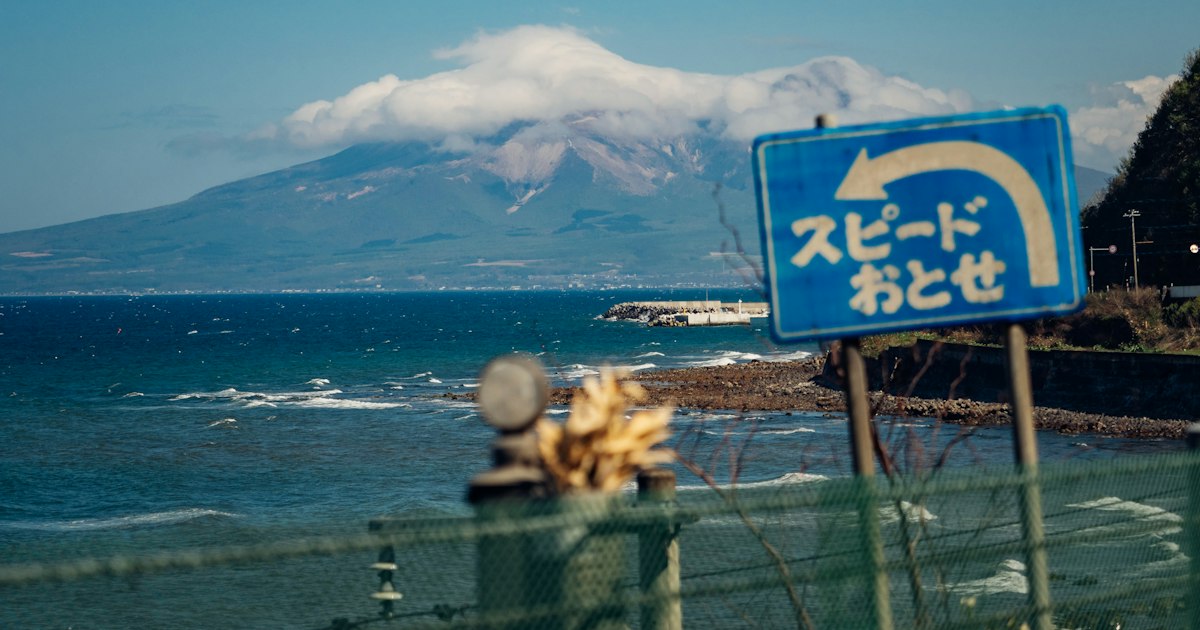
Less than two hours from central Tokyo by jetfoil sits an island with a smoking volcano, a desert of black lava sand, and — for about two months every winter — one of the largest camellia collections in Japan. Izu Oshima is the largest of the Izu Islands but gets a fraction of the visitors that flock to Hakone or Nikko, which means you can walk a live volcanic crater rim on a weekday and barely see another hiker. Here’s how to plan the trip.
Why Izu Oshima Is Worth the Trip
Izu Oshima is a volcanic island roughly 9km across, administratively part of Tokyo, built almost entirely around Mount Mihara (三原山), an active stratovolcano that last erupted in 1986 — an eruption dramatic enough that the entire island population of around 10,000 people was evacuated by boat in a single night. That eruption is also why the island’s interior looks the way it does: a stark, black lava-sand plain nicknamed “Urasabaku” (裏砂漠), one of the only desert-like landscapes in Japan, sits in the volcano’s rain shadow. Beyond the volcano, the island is known for camellias (tsubaki), the traditional red-and-white checked “anko” clothing once worn by island women, and shima-zushi, a vinegar-light, soy-marinated nigiri style that predates mainland Edo-style sushi.
Getting There from Tokyo
You have three realistic options from Tokyo:
- Jetfoil (high-speed ferry): Tokai Kisen runs jetfoils from Takeshiba Pier (near Hamamatsucho) to Oshima’s Motomachi or Okada port in about 1 hour 45 minutes. One-way fares run roughly ¥9,000–10,000. This is the standard day-trip option — book ahead in camellia season and around Golden Week, since sailings can be cancelled in rough seas.
- Overnight large ferry: The same company runs a large ship departing Takeshiba around 22:00–23:00, arriving Oshima early the next morning (roughly 6 hours). Second-class fares start around ¥5,000–6,000 — cheaper, but you lose a travel day unless you sleep on board and start hiking at dawn.
- Flight: New Central Aviation operates small propeller flights from Chofu Airport (in western Tokyo, reachable by train/bus from Shinjuku) to Oshima Airport in about 25 minutes, with fares generally in the ¥16,000–19,000 one-way range. It’s the fastest option and worth it if you’re short on time or prone to seasickness.
If you’re coming from the Izu Peninsula side instead, high-speed boats connect Oshima with Atami and Ito in under an hour, which makes a Tokyo–Izu Peninsula–Oshima loop possible without backtracking. If your trip starts or ends at Haneda, see our guide to Haneda Airport Terminal 3 for what to do with a spare hour before an international flight.
Getting Around the Island
Oshima is too spread out to walk between sights. Local buses run from Motomachi and Okada ports up to the Mihara crater area, but schedules are thin — often just four to six buses a day, fewer in winter — so check return times before you set off. Taxis exist but are expensive for a full loop. The easiest way to see the volcano, the camellia garden, and the coastline in one day is renting a car at the port; our guide to renting a kei car in Japan covers exactly this kind of narrow-road, small-island driving. Scooter and bicycle rentals are also available near Motomachi port for a slower pace.
Climbing Mount Mihara
The main hike is the “Ohachi Meguri” (お鉢巡り), a loop around the crater rim itself. Most visitors start by bus or car at the Mihara-Sanrin parking area, where the Oshima Volcano Museum sits, then walk a paved path up to the rim — about 30–40 minutes of steady but non-technical climbing. Once on top, the full crater loop is roughly 2.5km and takes 1 to 1.5 hours at an easy pace, with views down into the vent and across the black lava fields below. There’s no shade and little shelter, so bring water, sun protection, and a windbreaker — it’s noticeably windier and cooler on the rim than at sea level even in summer.
Two things to know before you go:
- The crater area is sometimes closed to visitors when volcanic activity ticks up, even slightly. Check the current access status at the tourist information center at the port before heading up — don’t assume the trail is open just because it was last time.
- The last bus down is often mid-afternoon. Hikers who linger on the rim for sunset photos regularly get stuck needing a taxi or a long walk back to port.
For a shorter detour, the Urasabaku desert area nearby is reachable on foot from the same parking area and makes for a striking 20-minute side trip across black volcanic sand dunes.
The Camellia Season
Oshima’s other headline attraction is at Tokyo Metropolitan Oshima Park’s Camellia Garden (都立大島公園椿園), a free, year-round public garden holding roughly 20,000 camellia trees across 800-plus varieties — one of the largest camellia collections in Japan. The Oshima Camellia Festival (Oshima Tsubaki Matsuri) runs from late January to late March, with peak bloom typically in February, and includes anko-costume parades and folk dance performances near Motomachi. Outside festival dates the garden is open and free to wander, just quieter. If you’re planning around blooms, note this is the opposite season from cherry blossoms, which makes a late-winter Oshima trip a good way to extend a Japan visit beyond the typical spring window.
Best Time to Visit and Common Mistakes
Late January through March is ideal if camellias are the draw; the volcano hike is doable year-round but best from spring through autumn, since winter rim winds can be severe. Summer brings warm-water diving and snorkeling off the island’s rocky coast but also typhoon risk, which can cancel ferries with little notice — always build in a buffer day if you’re not flying. The most common mistake visitors make is treating this as a rigid day trip: ferry schedules, bus frequency, and occasional crater closures mean a tight one-day itinerary can fall apart if any single link is delayed. An overnight stay, even in a basic minshuku near Motomachi, removes most of that risk and lets you catch sunrise over the crater, which the day-trip crowd never sees.
If you enjoy this kind of low-key island escape from Tokyo, Oshima’s southern neighbor Hachijojima offers a subtropical, double-volcano version of the same idea, and pairs well with Oshima on a longer Izu Islands itinerary via the same Tokai Kisen ferry network.