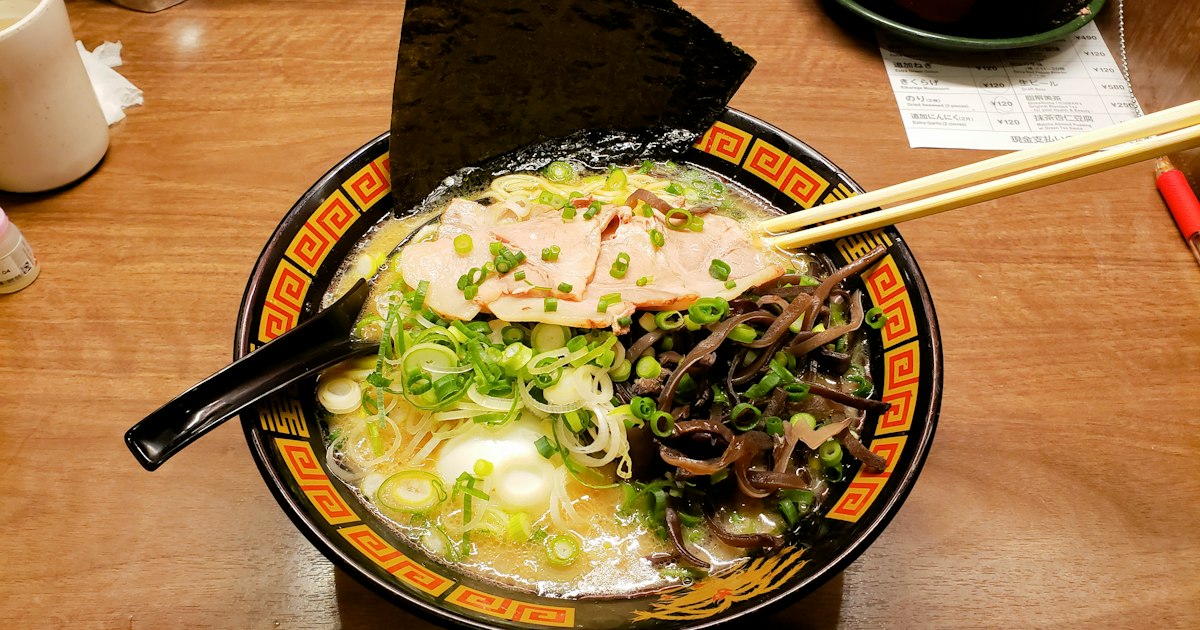
Photo by Crystal Jo on Unsplash
If you’ve seen a photo of someone eating ramen alone in a wooden cubicle, facing a curtain, with no visible staff in sight — that’s almost certainly Ichiran. The Fukuoka-born tonkotsu ramen chain has built a cult following not just for its rich pork-bone broth but for its “flavor concentration booths” (味集中カウンター, ajiwai shūchū kaunta), a system designed so every customer can tune their bowl exactly to taste without ever having to talk to anyone. It sounds intimidating on paper, but it’s one of the easiest meals in Japan to order once you know the routine — and genuinely useful for solo travelers who’d rather not navigate a crowded counter in a language they don’t speak.
What Makes Ichiran Different
Ichiran serves exactly one dish: a bowl of tonkotsu (pork bone) ramen, built around a broth the chain has refined since its first Hakata-area shop opened in the 1960s. The gimmick isn’t the ramen itself but how you order it. Instead of calling out customizations to a cook, you fill in a paper order form covering five variables — broth richness, garlic, spiciness, green onion type, and noodle firmness — then hand it to staff through a small gap at your booth. You eat facing a wooden partition, often with a bamboo blind or curtain pulled down in front of you once your bowl arrives, so there’s zero small talk and zero pressure to finish quickly. It was originally designed to let customers focus entirely on the flavor without distraction; it has the side effect of being extremely comfortable for solo diners, including people eating out alone for the first time in Japan.
How the Order Form Works: Reading the Flavor Chart
When you’re seated, you’ll get a form (usually with English available) with checkboxes for:
- Flavor richness — from light to rich (the broth’s intensity)
- Garlic — none to a generous amount; note that raw garlic is used, which matters if you have evening plans involving other people
- Spiciness (the red sauce) — a chili-based paste, adjustable from none to very spicy
- Green onion — white (Tokyo-style) or green (Hakata-style), sometimes both
- Noodle firmness — from very soft to very firm; first-timers often do well with “normal” or “slightly firm”
- Extra toppings — a boiled egg, extra chashu (pork), kikurage mushroom, or nori, each checked separately and added to the bill
You also mark how many servings of noodles you want and can order a kaedama (replacement noodles added to your remaining broth) separately once you’re nearly done. Some locations now use touchscreen ticket machines at the entrance instead of paper forms, but the categories are the same. Either way, there’s no verbal ordering required, which is part of why the system works so well for travelers who are self-conscious about restaurant Japanese.
Inside the Booth: What to Expect
Booths are narrow — built for one — with a tap for water, a call button, and a small sliding panel in front of you. After you submit your form, a staff member’s hands appear through the panel to confirm your order and later deliver the bowl; the panel or curtain closes again as you eat. It’s less “restaurant” and more “sensory-deprivation ramen,” in a good way: no eye contact, no rush, no judgment about slurping loudly, which is normal ramen etiquette here anyway. Some shops have communal tables too if you’re traveling as a group and want to sit together, but the individual booths are the signature experience worth seeking out at least once.
Prices and What to Order
A classic bowl of Ichiran tonkotsu ramen runs roughly ¥890–¥1,000 depending on location, with Tokyo shops generally at the higher end. Add-ons are itemized separately: a flavored soft-boiled egg is typically around ¥150–¥190, extra chashu around ¥250–¥350, and a kaedama noodle refill around ¥190–¥260. A fully loaded bowl with egg, extra pork, and a noodle refill usually lands you around ¥1,400–¥1,600 — still reasonable for a filling meal. Budget travelers can stick to the base bowl with one topping; if you want to splurge, the “tokusei” (special) ramen bundles several extras for a set price and is the closest thing to a deluxe option on the menu. Payment is by cash or card depending on branch, and increasingly by ticket machine at the door, so you often pay before you even sit down.
Best Locations and Timing
Ichiran has dozens of locations across Japan, with its roots and flagship shops in Fukuoka’s Hakata district. In Tokyo, convenient branches include Shibuya, Shinjuku, Ikebukuro, and Asakusa, several of which run 24 hours — useful after a late flight or a night out. Lines are shortest right at opening or in the mid-afternoon lull between lunch and dinner (roughly 2–4pm); avoid the 12–1pm and 7–9pm windows if you want to skip queuing. Unlike many sit-down restaurants in Japan, Ichiran doesn’t take reservations, so if you’re used to booking ahead via Tabelog or an app, this is one meal where you simply show up and wait — our guide to restaurant reservations in Japan is worth reading for everywhere else on your itinerary, but Ichiran is strictly walk-in. If you’re based near Tokyo Station, the underground Ramen Street inside the Gransta/Yaesu ekinaka station mall is also a reliable spot to find quality tonkotsu-style shops if the nearest Ichiran has a long line.
Common Mistakes First-Timers Make
- Over-ordering spice or garlic on the first visit. The scales are wider than most visitors expect — “medium” garlic is already noticeable, and raw garlic lingers.
- Forgetting the kaedama has to be ordered while broth remains. Once your broth is gone, there’s nothing to refill the noodles into, so request it a bit before you finish.
- Assuming you can split a bill easily. Each booth and form is individual, so groups should sort out payment before ordering, not after.
- Showing up during peak lunch or dinner hours and being surprised by the line. Popular branches like Shibuya can have 20–30 minute waits at peak times even though turnover is fast.
- Treating it as a sit-and-chat meal. The booths are built for quiet, quick, solo dining — great for a fast, satisfying meal between sightseeing stops, less ideal if you wanted a long group dinner.
Is It Worth the Hype?
For a one-dish, highly specialized chain, yes — Ichiran delivers a consistent, genuinely good bowl of tonkotsu ramen with a novelty ordering system that’s actually practical, not just gimmicky. If you want to compare it against other noodle styles while you’re exploring Japan’s ramen and noodle culture, it’s worth also trying curry udon or Nagoya’s Taiwan mazesoba for contrast, and ramen fans with kids (or anyone curious about how instant ramen is made) should pair an Ichiran visit with the hands-on Cup Noodles Museum in Osaka or Yokohama.