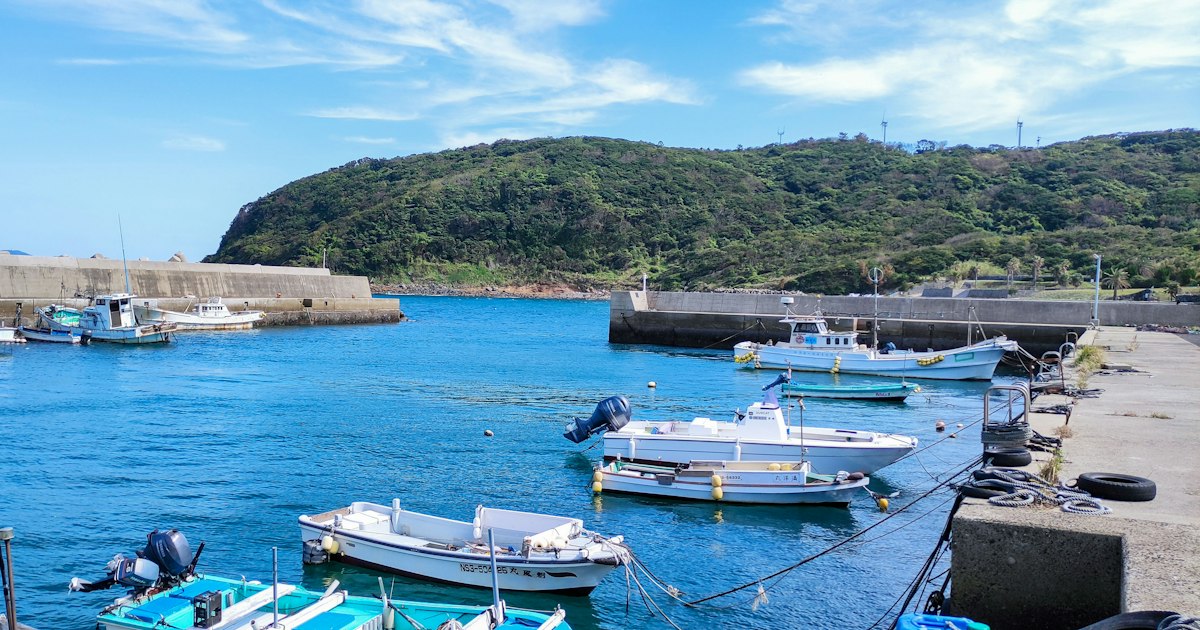
Photo by Keisuke Kuribara on Unsplash
Most visitors to Japan see the ocean from a train window or a ferry deck, but chartering a local fishing boat puts you on the water with someone who actually knows where the fish are. It’s one of the few travel experiences in Japan that’s both genuinely local and surprisingly easy to book, even with no Japanese and no fishing experience. Here’s how half-day charters actually work, what they cost, and the mistakes that trip up first-timers.
What a “half-day charter” actually means
In Japanese, this kind of trip is usually advertised as chibune (小舟, small boat) or yagyu-sen fishing charters, though you’ll most often find them listed simply as “釣り船” (tsuribune, fishing boat) on booking sites. A half-day trip typically runs 4-5 hours, split into morning (asa-mawari, roughly 6:00-11:00) and afternoon (hiru-mawari, roughly 12:00-17:00) slots, depending on tides and the port. Full-day trips exist too, but half-day is the sweet spot for tourists — long enough to actually catch something, short enough to leave you an afternoon or morning free for everything else on your itinerary.
Boats fall into two categories: group charters (noriai), where you join other anglers on a shared boat for a fixed per-person price, and private charters (kashikiri), where you book the whole boat for your group. Group charters are cheaper but less flexible on timing; private charters cost more but the captain will often tailor the trip to what you want to catch.
How much it costs
Prices vary by region and target fish, but as a rule of thumb:
- Budget (¥8,000-12,000 per person): Group charter targeting easy species like aji (horse mackerel), kisu (sillago), or squid, departing from a smaller regional port. Rod rental and bait usually add ¥1,000-2,000.
- Mid-range (¥15,000-25,000 per person): Group or small private charter for tai (sea bream), kawahagi (filefish), or light jigging trips near Tokyo Bay, Sagami Bay, or the Seto Inland Sea.
- Splurge (¥60,000-120,000 for the whole boat, 2-6 people): Private charter for offshore jigging, tuna, or kingfish, often including all gear, ice, and sometimes a crew member who fillets your catch at the dock.
Rod and reel rental (rentaru tackle) generally runs ¥1,500-3,000 for a half-day set. Life jackets are mandatory and almost always included free. Bait (esa) is often a separate small charge, ¥500-1,500, paid in cash at the shop before boarding.
Booking as a non-Japanese speaker
This is the part that scares people off unnecessarily. Most working fishing ports have at least one or two shops with online booking, and increasingly these support English:
- Umitsuri Goo (uotsuri.net) and Tsuribune.net are Japanese-language aggregators, but you can plug a port name into Google Translate’s camera mode to navigate them, or just call and say “English OK?” — many captains who work near resort towns (Izu, Kamakura, Okinawa) have fielded tourist calls before.
- In tourist-heavy areas like Okinawa, Izu, and Kanazawa, English-language charter operators cater specifically to foreign visitors and list directly on their own sites or through activity marketplaces.
- Hotel concierges in coastal towns can often call and book on your behalf — this is genuinely one of the most reliable methods, and worth trying even at a mid-range business hotel.
- If you’re already using YAMAP for hiking, note it doesn’t cover marine activities, but the same instinct — searching for activity-specific Japanese apps rather than English ones — applies here too.
Whichever route you use, book at least 3-5 days ahead in peak season (July-September) and 1-2 weeks ahead for popular tuna or kingfish charters, which fill up with repeat local customers.
Best season and timing
Japan’s coastal fishing calendar varies by species and region, but general patterns hold:
- Spring (March-May): Sea bream (tai) and squid season around Honshu’s Pacific coast; mild seas, good for beginners.
- Summer (June-August): Aji, kisu, and light jigging for bonito; hot but calm mornings. Avoid booking during Obon week in mid-August, when both boats and lodging near ports get booked solid by domestic travelers.
- Autumn (September-November): Widely considered peak season for flavor and variety — kawahagi, tachiuo (needlefish), and the start of winter tai runs.
- Winter (December-February): Rougher seas on the Pacific side but excellent on the sheltered Seto Inland Sea and in Kyushu; this is prime season for amberjack and buri.
Morning departures almost always outperform afternoon ones for both weather and fish activity. If you’re prone to seasickness, ask specifically whether the trip stays in a bay (wan-nai) versus open water (gaiyo) — bay trips are calmer and better for a first charter.
What to bring and what mistakes to avoid
- Don’t skip seasickness medicine. Take it the night before and again an hour before departure, even if you’ve never been seasick — small fishing boats pitch far more than ferries.
- Don’t wear street shoes. Boat decks get wet and fishy; non-slip deck shoes or old sneakers are expected, and some boats have a no-shoes, provided-slippers policy similar to the indoor rule covered in our toire surippa guide — ask before boarding rather than assuming.
- Don’t forget cash. Many smaller port shops still don’t take cards; bring enough for the charter fee, rental, bait, and ice for your catch.
- Don’t assume you keep everything you catch. Some charters expect you to release undersized fish per local regulations, and a few deduct a small cleaning/bagging fee if you want your catch filleted at the dock.
- Do confirm the pickup point. “The harbor” can mean several different piers; captains usually text or call the morning of to confirm, so make sure you’ve given a number that works in Japan or arranged Wi-Fi calling.
- Pack light outerwear even in summer — it’s noticeably colder and windier on open water than on land, similar to how packing for thin-walled ryokan rooms (see our guide on sleep masks and earplugs for hotel rooms) is about preparing for conditions you don’t expect from a glossy brochure.
Where to base yourself
You don’t need to be near a major city to find a good charter — in fact, smaller ports often have more availability and lower prices. Good regions to center a trip around include Izu Peninsula and Sagami Bay (easy day trip from Tokyo), the Seto Inland Sea around Hiroshima and Matsuyama, Okinawa’s reef-fishing charters, and Kyushu’s coast near Fukuoka or Nagasaki. If you’re already routing through Kyushu by rail, it’s worth grabbing supplies before boarding — our rundown of JR Kyushu station snacks covers easy options for an early departure when port-side shops aren’t open yet.
A half-day charter won’t fit every itinerary, but if you’ve got a free morning near any coastal town, it’s a low-risk way to spend a few hours with a local captain, come back with dinner, and see a side of Japan that most tourist itineraries never touch.