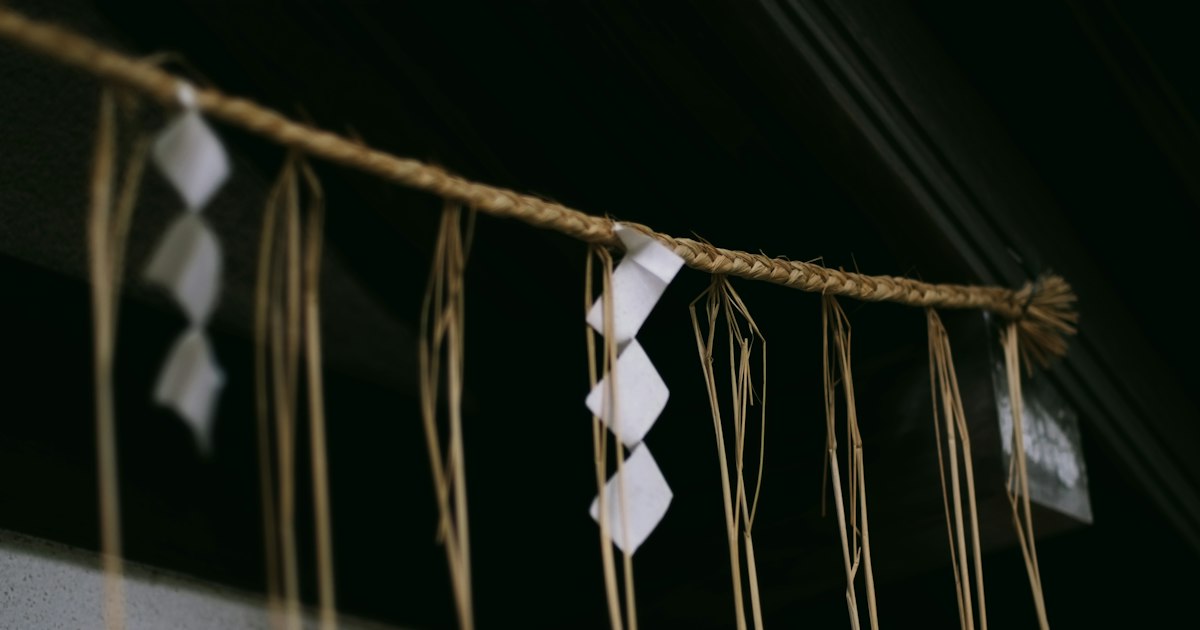
Photo by Chatathorn Wechkunanukool on Unsplash
Walk up to almost any Shinto shrine gate in Japan and you’ll see it before you see anything else: a thick, twisted rope of rice straw strung across the entrance, with jagged white paper strips hanging from it. That’s a shimenawa, and it marks the boundary between ordinary space and sacred space. Many visitors who set up a small home kamidana (household Shinto altar) want one of their own, but buying a shimenawa isn’t quite like buying a souvenir fridge magnet — there’s etiquette, seasonal timing, and a real range of quality to know about before you hand over any yen.
What a Shimenawa Actually Does
A shimenawa marks a space as purified and off-limits to impurity (kegare). On a torii gate it announces the shrine grounds. On a home kamidana, a smaller version does the same job on a tiny scale, framing the shelf where you place your o-fuda (protective talismans) and offerings. The rope itself is almost always rice straw, twisted so it gets thicker toward one end, with shide — the white zigzag paper strips — tucked in at intervals. Some also carry a small orange (daidai) or pine sprig for New Year displays.
For a home kamidana you don’t need the massive entrance-gate version — you want a scaled-down shimenawa, typically 20–50cm long, sized to fit across the front of your shelf.
Reading Quality and Price Before You Buy
Shimenawa for home use fall into three rough tiers:
- Budget (¥100–¥1,000): Machine-made or lightly hand-finished straw rope, sold at 100-yen shops like Daiso and at general home centers. Perfectly legitimate for a first kamidana, though the straw is often thinner and the shide paper simpler.
- Mid-range (¥2,000–¥8,000): Hand-twisted rope with proper shide folding, sold by shrine shops and Shinto ritual-goods specialists. This is the standard choice most Japanese households actually buy.
- Splurge (¥10,000–¥30,000+): Thick, artisan-twisted rope with full ornamental shide, often custom-ordered through a shrine priest or a specialist ritual-goods maker, aimed at larger kamidana or business altars.
There’s no shame in starting budget — what matters more than price is buying new and replacing it annually, which is covered below.
Where to Buy One
Your most reliable source is the shop or office window at any Shinto shrine — most sell small kamidana-sized shimenawa alongside o-fuda and omamori, usually during normal shrine hours (roughly 9:00–17:00 daily), and stock swells heavily from early-to-mid December through New Year. If you’re near Tokyo, shrines that run their own ritual-goods counters year-round, such as those featured in our piece on Kanda Myojin and Sanno Matsuri’s shrines, are worth a stop even outside festival season.
Outside shrines, large home-improvement and lifestyle stores (Cainz, Kahma, Joyful Honda, Tokyu Hands, Loft) carry seasonal New Year corners from early December with kadomatsu, shimekazari, and kamidana-size shimenawa bundled together, generally during normal store hours of 9:00/10:00–20:00/21:00.
For something more distinctive, Ise is the place to go. The region around Ise Jingu has a unique custom of displaying shimenawa-based decorations (shimekazari) at entrances year-round, not just at New Year, and the shops along Okage Yokocho — the pedestrian street leading to the Naiku’s Uji Bridge — sell well-made versions as a local specialty all year. It’s about a 5-minute walk from the Naiku entrance, reachable by Kintetsu or JR to Ise-shi Station and then a bus or taxi to the shrine.
Buying Online or Secondhand
Rakuten Ichiba and Amazon Japan both carry kamidana-size shimenawa from specialist sellers, with photos detailed enough to judge straw thickness and shide quality before ordering — useful if you’re shipping one home rather than buying in person. What you shouldn’t do is buy a used shimenawa itself: because the rope exists to mark purified space, it’s meant to be fresh each time, not inherited. That said, the wooden kamidana shelf itself is a different story — secondhand kamidana in good condition turn up regularly on apps covered in our Rakuma vs Mercari guide, and pairing a secondhand shelf with a brand-new shimenawa is completely normal practice.
Best Timing: Why December Matters
Most households put up a new shimenawa for the New Year (shogatsu), which is also why stock and selection peak in early-to-mid December. If you’re shopping during this window, keep in mind that many ordinary shops — not shrine shops — close for several days around New Year itself, a pattern explained in our guide to Japan’s New Year closures. Buy before December 28 if you want decent selection and want to avoid the last-minute rush.
Tradition also says to avoid putting up a new shimenawa on December 29 (the number 9 reads like “suffering”) or on December 31 itself (a one-night decoration is considered disrespectful). December 27–28 or the early 30th is the conventional sweet spot. Decorations typically come down around January 7 (some regions wait until January 15) and are returned to a shrine for the dondo-yaki bonfire rather than thrown in household trash.
Common Mistakes to Avoid
- Reusing last year’s rope. A shimenawa is meant to be renewed annually — treat it as consumable, not decor.
- Getting the orientation backward. Facing the shimenawa, the thicker end conventionally sits on your right — Izumo Taisha and a few regional shrines reverse this, so if you bought one modeled on a specific shrine’s style, ask the seller which convention it follows.
- Buying a torii-gate-scale rope for a tabletop kamidana. Measure your shelf width first; 20–50cm covers nearly all home kamidana.
- Disposing of it in regular trash. Bring it back to a shrine for dondo-yaki burning, or at minimum wrap it with a pinch of salt before disposal, out of respect for what it represented.
If you’re building out a home kamidana setup in general — not just the shimenawa — a shrine shop clerk will usually walk you through what else belongs on the shelf if you ask, and the quiet, attentive way they do it is a good example of the small service habits described in our piece on omotenashi in practice. Buying a shimenawa is a small purchase, but getting it right — fresh rope, right size, bought with enough lead time — makes the difference between a kamidana that feels authentic and one that just looks the part.