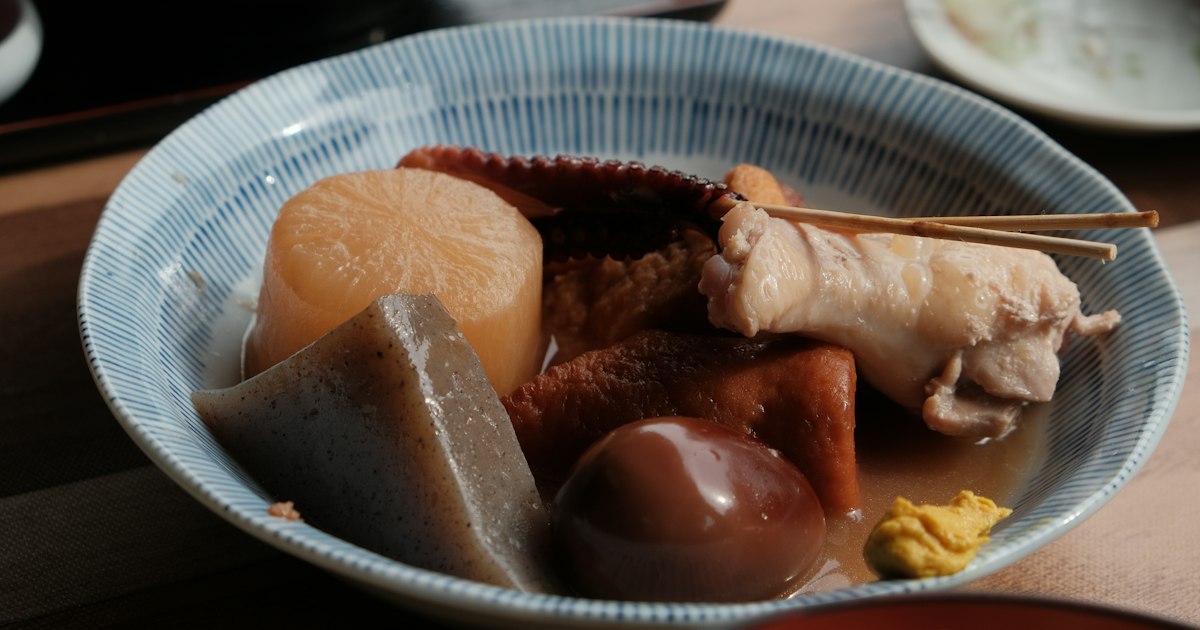
Photo by Nicholas Ng on Unsplash
If you’ve peered into a bubbling pot of oden at a convenience store counter or poked through the chilled section of a Japanese supermarket, you’ve probably seen chikuwa without knowing its name: a pale, ridged tube of fish paste, hollow in the middle, usually sold in packs of four or five. It’s one of Japan’s most practical foods — cheap, pre-cooked, and endlessly adaptable — yet most visitors walk past it because nothing about its appearance explains what it is or how to eat it. This guide covers where chikuwa comes from, the dishes it shows up in, and how to buy and cook it yourself.
What Chikuwa Actually Is
Chikuwa (竹輪, literally “bamboo ring”) is a type of kamaboko — steamed or grilled surimi (white fish paste, traditionally from pollock or shark) formed around a stick and cooked until the outside browns slightly. The stick is pulled out afterward, leaving the characteristic tube shape with a hollow center. The name refers to the original method: the paste was wrapped around a length of bamboo before cooking, and cross-sections of the finished product resembled bamboo rings.
Texture-wise, it’s springy and mild, closer to a very dense fish sausage than to sashimi or tempura. On its own it tastes faintly of fish and a bit sweet; it’s designed to absorb the flavor of whatever broth or sauce it’s cooked in, which is why it turns up in so many different dishes rather than being eaten plain very often.
Where You’ll Encounter It While Traveling
The most common place visitors run into chikuwa is oden, the simmered-in-dashi hot pot sold at convenience stores (Lawson, FamilyMart, 7-Eleven) every winter, usually from around October through March. Look for a steaming metal case near the register with skewered or loose ingredients floating in broth — chikuwa is almost always in the mix alongside daikon, boiled eggs, and konnyaku. A piece typically costs 100–150 JPY, and the clerk will fish out whatever you point to and bag it in a paper cup with broth. If you’re also curious about decoding other convenience-store food while you’re standing at that counter, the same logic applies to rice balls — see Onigiri Fillings Decoded for reading labels when kanji isn’t an option.
Outside convenience stores, chikuwa shows up sliced into udon and soba as a cheap protein topping, battered and deep-fried as “chikuwa tempura” at izakaya, stuffed with cheese or mayo-mentaiko (chikuwa’s most popular home-cooking trick — you pipe the filling straight into the hollow center), and cut into rings as a bento box filler. At izakaya it’s a classic alongside grilled skewer snacks; if you’re already planning a night of ordering skewers, chikuwa tempura pairs naturally with something like tsukune on the same menu.
Regional Specialties Worth Seeking Out
Standard chikuwa is made from a blend of whitefish, but regional versions use a single prized fish and are sold as souvenirs. Odawara, in Kanagawa Prefecture, is historically famous for chikuwa made with flying fish or shark meat, sold fresh at shops near Odawara Station — a reasonable stop if you’re passing through on the way to Hakone. Aomori and parts of Hokkaido produce versions with higher fish content and a firmer, more pronounced fish flavor, usually priced higher (400–800 JPY for a small pack) than the mass-market kind. If you happen to be food-touring the San’in coast for something like nodoguro, it’s worth checking local fish-paste shops (kamaboko-ya) in the same towns — many produce their own chikuwa alongside other surimi products, and it’s a lighter, cheaper souvenir than fresh fish.
Buying It to Cook at Home
Every Japanese supermarket sells chikuwa in the refrigerated section near tofu and other processed fish products (look for きす, 焼ちくわ, or just ちくわ on the label). A standard pack of 4–5 tubes runs 100–250 JPY; it’s already fully cooked, so you can eat it cold straight from the pack, slice it into salads, or heat it in soup. It keeps for about a week unopened in the fridge and doesn’t freeze well — the texture turns rubbery and starts to separate.
A few ways to cook it that don’t require any special technique:
- Chikuwa tempura — slice lengthwise or leave whole, coat in tempura batter, deep-fry 2–3 minutes until golden.
- Cheese-stuffed chikuwa — push a stick of string cheese or a strip of processed cheese into the hollow center, slice into coins; no cooking needed, though a quick pan-fry browns the outside nicely.
- Kinpira-style stir-fry — slice into rings, stir-fry with julienned carrot and burdock root in soy sauce, mirin, and a little sugar.
- Miso soup addition — thin slices dropped into miso soup in the last minute of cooking soak up broth without falling apart.
Common Mistakes Visitors Make
The most frequent misstep is treating chikuwa like fresh fish and expecting a strong seafood taste — it’s mild, slightly sweet, and meant to carry other flavors, so eating it plain and judging it that way undersells it. The second is overcooking it in soup or oden broth for too long; chikuwa is pre-cooked, so it only needs a few minutes to warm through and absorb flavor — simmering it for the hour-plus that daikon needs will make it mushy at the edges. Third, if you buy chikuwa as a souvenir, check the packaging for refrigeration requirements before putting it in a suitcase — most non-regional chikuwa is chilled, not shelf-stable, and won’t survive a long flight unless it’s a vacuum-sealed, room-temperature specialty version explicitly marked for travel (these exist at airport souvenir shops but cost more, around 500–900 JPY).
Budget, Mid-Range, and Splurge Options
At the budget end, a single oden skewer piece from a convenience store (100–150 JPY) or a 150 JPY supermarket pack is as cheap as Japanese food gets while traveling. Mid-range means ordering chikuwa tempura or a cheese-stuffed version at an izakaya (300–500 JPY per plate) as a side dish while you work through a drinks menu. For a splurge, seek out artisanal regional chikuwa from a dedicated kamaboko shop — places in Odawara or coastal Tohoku towns sell hand-formed, higher-fish-content versions in gift boxes (1,000–2,500 JPY), often vacuum-packed well enough to survive the trip home as a edible souvenir that’s lighter and less fragile than ceramics or lacquerware.