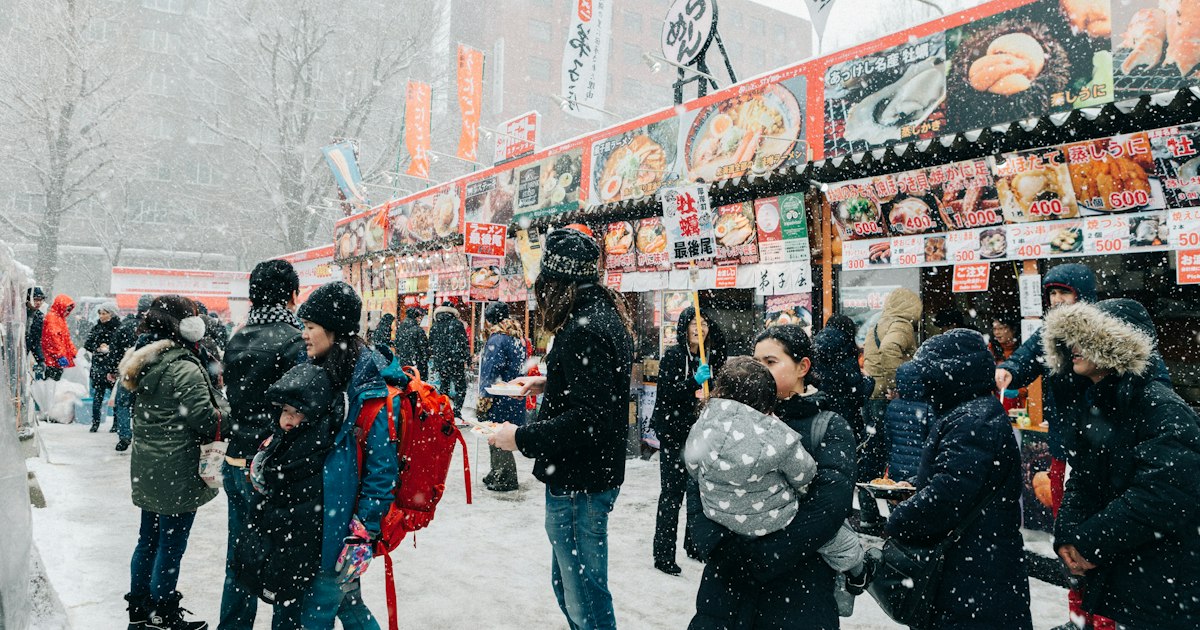
Photo by Denny Ryanto on Unsplash
Ask most visitors to name a Hokkaido ramen style and they’ll say “miso,” thinking of Sapporo. A smaller number will say “salt,” thinking of Hakodate’s clear shio broth by the harbor. Almost nobody mentions Asahikawa — which is a shame, because the city’s soy-sauce ramen, finished with a thin, glossy layer of melted pork lard, is arguably the most technically interesting of Hokkaido’s three major styles, and it’s an easy detour if you’re already heading north toward Daisetsuzan or the Furano area.
What Makes Asahikawa Ramen Different
Asahikawa’s base is a double soup (w-soup): a pork-and-chicken bone stock blended with a seafood dashi, usually built on dried sardines, kelp, or flying fish. It’s seasoned with a dark, slightly sweet shoyu rather than the fermented miso Sapporo is known for or the pale salt broth of Hakodate.
The signature move is the lard. Asahikawa’s winters regularly drop below -15°C, and broth cools fast in an unheated bowl walking from kitchen to table. Shops counter this by ladling a spoonful of melted pork back fat onto the surface, where it forms a thin, clear film that traps heat underneath — not a heavy, cloudy tonkotsu fat, just enough to keep the soup hot until the last noodle. The noodles themselves are thin, tightly curled, and low-moisture, designed to hold their bite without turning mushy as they absorb the hot broth.
Where to Eat It
Three names come up constantly:
- Aoba Honten (青葉本店) — the shop most locals credit with codifying the style, in the Heiwa-dori shopping arcade a few minutes’ walk from JR Asahikawa Station. Expect a short line at lunch.
- Baikohken (梅光軒) — known for a more seafood-forward double soup; the original shop is near the station, and it’s become well-known enough to have opened branches in Tokyo.
- Santouka (山頭火) — now a global chain, but the honten (original location) is here in Asahikawa, and it’s worth comparing against the Tokyo branches you may already know.
- Asahikawa Ramen Village (あさひかわラーメン村) — a purpose-built complex in the Nagayama district housing eight competing ramen shops under one roof, with shared parking. It’s touristy by local standards, but it’s the single most efficient way to sample several shops’ takes on the style in one visit.
Ramen Village is roughly a 15–20 minute taxi ride from JR Asahikawa Station (expect around ¥2,000–3,000 one way), or reachable by local bus with a bit more walking. Shops there generally run from around 11:00 to 19:00 or 20:00, though hours and weekly closing days vary by shop and change with the seasons — check current hours on Google Maps the day you go rather than planning around a fixed schedule, since several shops close on different weekdays and some take a break between lunch and dinner service.
Getting to Asahikawa
Asahikawa sits about 1.5 hours north of Sapporo. By train, the JR limited express Kamui or Lilac services run between Sapporo and Asahikawa Station roughly every 30–60 minutes, taking about 1 hour 25 minutes to 1 hour 40 minutes, with an unreserved one-way fare around ¥4,900–5,000.
By car, it’s about 1.5–2 hours via the Doo Expressway from New Chitose Airport or central Sapporo. If you’re renting, double-check how your rental agency’s excess waiver actually works before you drive in winter conditions — see this breakdown of the NOC insurance excess waiver for what’s actually covered if you hit black ice.
From Tokyo, you can also fly directly into Asahikawa Airport (AKJ) in about 1 hour 45 minutes; an airport bus into the city center takes roughly 35–40 minutes and costs around ¥600–700.
What to Order and What It Costs
Default to the standard shoyu ramen (正油ラーメン or 醤油ラーメン) — that’s the dish the lard-topping technique is built for. A basic bowl typically runs ¥750–950. Add a seasoned soft-boiled egg (味付け玉子, roughly ¥100–150) and extra chashu pork for a more filling ¥1,000–1,300 bowl if you want to splurge slightly. Portions are noodle-forward rather than toppings-forward compared to Tokyo-style ramen, so don’t expect a mountain of chashu.
Most shops are cash-friendly as a baseline; a growing number now take IC cards or credit cards, but carrying a few thousand yen in cash is still the safer bet, especially at smaller, older shops in the Heiwa-dori arcade.
Best Time to Visit
Winter is when the lard trick actually matters and the dish makes the most sense — walking in from -15°C air into a steaming bowl with a lid of hot fat on top is the whole point of the style. Early February also brings the Asahikawa Winter Festival, with large-scale snow sculptures downtown, and the Sounkyo Icefall Festival happens around the same time in nearby Daisetsuzan National Park, making a combined trip logical. If you’re underpacked for that kind of cold, Hokkaido’s big-box sporting goods stores are a reasonable last-minute fix — see this guide to Alpen and Sports Depo for grabbing thermal layers or proper gloves before you head further north.
That said, the ramen is good year-round. Summer (July–August) is comfortable for walking the arcade and Ramen Village without battling snow, and lines tend to be shorter outside the winter tourist season.
Common Mistakes
- Assuming it’s miso ramen. Travelers who only know “Hokkaido ramen” from Sapporo often order expecting a thick miso broth and are surprised by the clear-ish soy base. They’re genuinely different dishes.
- Eating too slowly. Asahikawa’s thin noodles are built to be eaten fast, while still firm. Linger and they’ll soften in the hot broth faster than thicker noodle styles tolerate.
- Treating the lard layer as heavy or greasy. It’s a thin, functional film for heat retention, not a rich fatty broth — don’t skip the dish expecting something as dense as tonkotsu.
- Not checking shop hours before the trip. Many Asahikawa ramen shops, including some in Ramen Village, close on inconsistent weekdays or take a mid-afternoon break — confirm the specific shop’s hours the same day.
- Only visiting one shop. Because the style’s signature techniques (lard sealing, double soup ratios, noodle thickness) vary shop to shop, a single bowl won’t tell you much about the style as a whole — Ramen Village exists specifically to solve this.
Pairing the Trip
Asahikawa functions well as a gateway stop rather than a final destination. It sits close to Daisetsuzan National Park, Hokkaido’s largest wilderness area, so a day of ramen-hopping pairs naturally with a hike, a soak at one of the park’s onsen towns, or the winter icefall festival at Sounkyo. Build it as a two- or three-day loop out of Sapporo: train up, eat your way through Ramen Village and the Heiwa-dori shops, then push on to Daisetsuzan before heading back south.