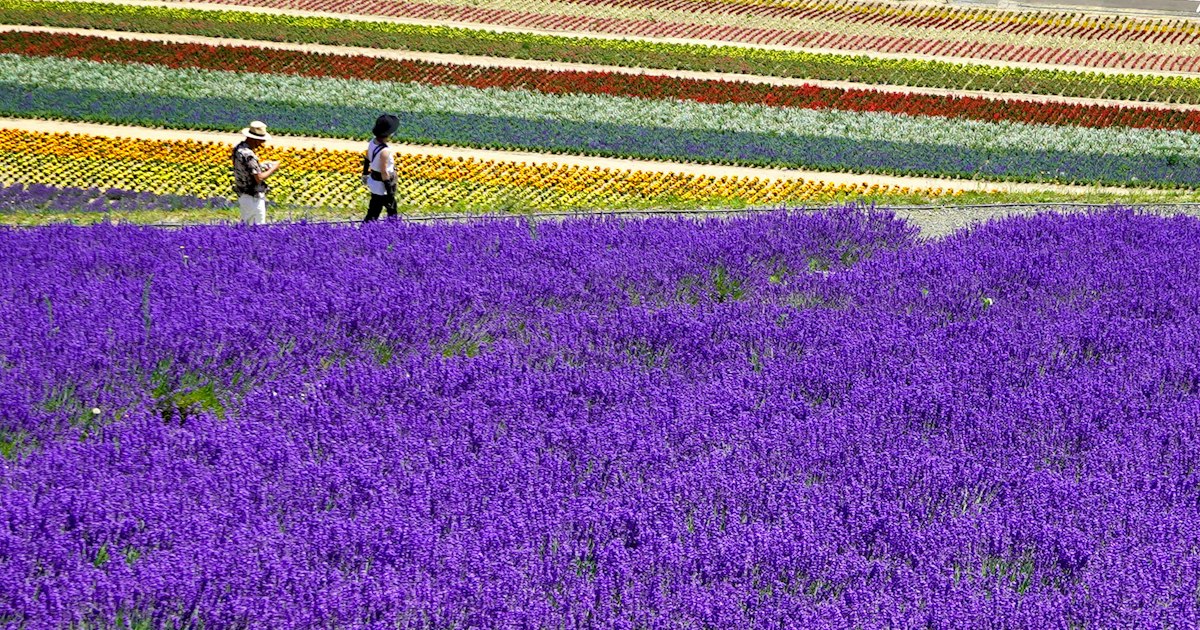
Photo by Cindy Bissig on Unsplash
Every July, the rolling farmland of central Hokkaido turns into stripes of purple, yellow, and green, and photos of it end up on half the “best of Japan” lists on the internet. But Furano and Biei are two distinct towns with different rhythms — one built around lavender, the other around a patchwork of crop fields that changes color through the seasons. Here’s how to actually plan the trip, not just admire it on a screen.
When to Go: Lavender Season vs. Patchwork Views
Lavender has a short, specific window. Farm Tomita’s fields are usually at their best from mid-July to early August, with the single deepest-purple week typically falling around July 20–31. Arrive in June or September expecting the postcard shot and you’ll see mostly green. Biei’s “patchwork hills,” by contrast, are a slower show — potato, wheat, beet, and corn fields ripen and get harvested on staggered schedules from May through October, so the color combinations shift week to week rather than peaking once. Winter (roughly December to March) is its own separate attraction: the same hills under snow, with bare trees like the famous Ken and Mary’s Tree standing alone in white, draw photographers even though nothing is blooming.
If lavender is the priority, book a July trip. If you just want the classic rolling-hills scenery with fewer crowds, late May to June or September are easier and cheaper.
Farm Tomita and Furano’s Lavender Fields
Farm Tomita in Nakafurano is the original and still the most-visited lavender farm — admission is free, and it stays open year-round, though hours shrink outside summer (roughly 8:30am–6pm in July–August, closer to 9am–5pm in shoulder months, and reduced hours through winter when the fields are dormant). Besides the lavender field itself, there’s a lavender-scented soft-serve stand, a dried-flower distillery you can peek into, and several other flower fields (poppies, marigolds) blooming alongside it in summer.
The nearest regular train stop is Nakafurano Station, about a 25-minute walk away. In lavender season, JR also opens a seasonal flag-stop called Lavender Batake Station right next to the farm — trains only call there roughly mid-June through early September, so check current JR Hokkaido timetables before relying on it. If you’re traveling by rail, an ekiben (station lunch box) makes the ride more pleasant than searching for food once you arrive; our guide to Japan’s bento box culture covers how to pick a good one.
Biei’s Patchwork Hills and the Blue Pond
Biei has no single “main gate” — its appeal is a network of viewpoints scattered across farmland, connected by roads with names like Patchwork Road and Panorama Road. Highlights include the solitary Ken and Mary’s Tree (named after a 1970s car commercial), the Seven Star Tree, and the hill once nicknamed “Mild Seven Hill” after the cigarette ad it appeared in. All of these are free to view from the roadside, but they sit on private farmland — stay on the road and don’t walk into the crops. Local farmers have put up “please do not enter” signs after years of tourists trampling fields for photos, and it’s a real source of friction with the community.
The other must-see is Blue Pond (Aoi Ike), about 3km from Biei Station — free, strikingly blue-turquoise from dissolved minerals, and best photographed in the still air of early morning. Shikisai no Oka, a private flower farm on the hills, charges an entrance fee (around ¥500 for adults in peak season, free in winter) and adds buggy and horseback rides as paid extras.
Getting There and Getting Around
From Sapporo, take a JR limited express (Lilac or Kamui) to Asahikawa — about 1 hour 25 minutes, roughly ¥4,700–5,000 unreserved. From Asahikawa, the local JR Furano Line continues to Biei (about 30 minutes) and on to Furano (another hour or so). If you’re traveling in comfort, some limited expresses on this route offer Green Car seating; see our guide to Green Car and Gran Class if the extra legroom and quieter car appeal to you for the ride out.
In summer (roughly late June to early September, weekends and holidays), JR runs the Furano Biei Norokko-go, a slow open-window sightseeing train between Asahikawa, Biei, and Furano that stops at Lavender Batake Station — it needs a small seat reservation fee on top of the base fare and is worth it for the views alone.
The catch: Biei’s hill viewpoints are not walkable from the station and barely served by regular buses. Renting a car is the easiest way to see them. If you’re not driving, rental bicycles (including e-bikes) are available near Biei Station for around ¥1,500–2,000 a day — fine for the Blue Pond, harder for the hillier Patchwork Road loop. A seasonal sightseeing bus (the “Twinkle Bus,” running roughly late April to early November) loops past the main viewpoints for about ¥500–800 per ride or a day pass around ¥1,500, and is the best car-free option for the patchwork hills.
Where to Eat and What to Buy
Furano is Hokkaido’s melon country — roadside stands and Furano Marche sell whole Furano melons from around ¥1,500 to ¥3,000 depending on size and grade, plus melon soft-serve for a few hundred yen. The Furano Cheese Factory and neighboring Wine Factory both offer free tastings and tours, and make an easy stop between the train station and Farm Tomita. Biei is known for its potatoes and corn, sold grilled or as chips at farm stands in summer; if you want to keep hunting for Hokkaido-specific snack flavors after you leave, our guide to Calbee’s regional potato chip flavors is a good next stop, since Hokkaido gets several exclusive varieties.
Common Mistakes to Avoid
- Coming for lavender outside July. Fields bloom for roughly three to four weeks; the rest of the year they’re green stubble.
- Assuming trains cover everything. The JR line connects the towns, but most of Biei’s iconic viewpoints require a car, bike, or the seasonal bus.
- Walking into the fields for photos. These are working farms, not gardens — stepping into crops for a shot is a genuine problem for local farmers.
- Booking accommodation last-minute in July. Both towns are small with limited hotel and ryokan capacity, and rooms sell out weeks ahead during peak lavender season.
- Skipping a rain-day plan. Hokkaido summers can be humid and showery; the Furano Wine and Cheese Factories, plus Biei’s small galleries, are good indoor fallbacks.
Budget, Mid-Range, and Splurge Options
On a budget, a day trip from Asahikawa or even Sapporo by regular JR trains, free lavender viewing at Farm Tomita, and a melon soft-serve for a few hundred yen can cover the essentials for well under ¥10,000 all in, including train fare. Mid-range travelers should consider staying one night in Furano or Biei (guesthouses and business hotels generally run ¥8,000–15,000 for a double) and renting a car for a full day (roughly ¥6,000–9,000 plus fuel) to properly cover Biei’s scattered viewpoints. For a splurge, Furano has a handful of resort hotels with private onsen baths and hill views, and a private guided car tour with a local driver-guide (often ¥25,000–40,000 for a half day) takes the guesswork out of finding the best-lit patchwork angles at the right time of day.