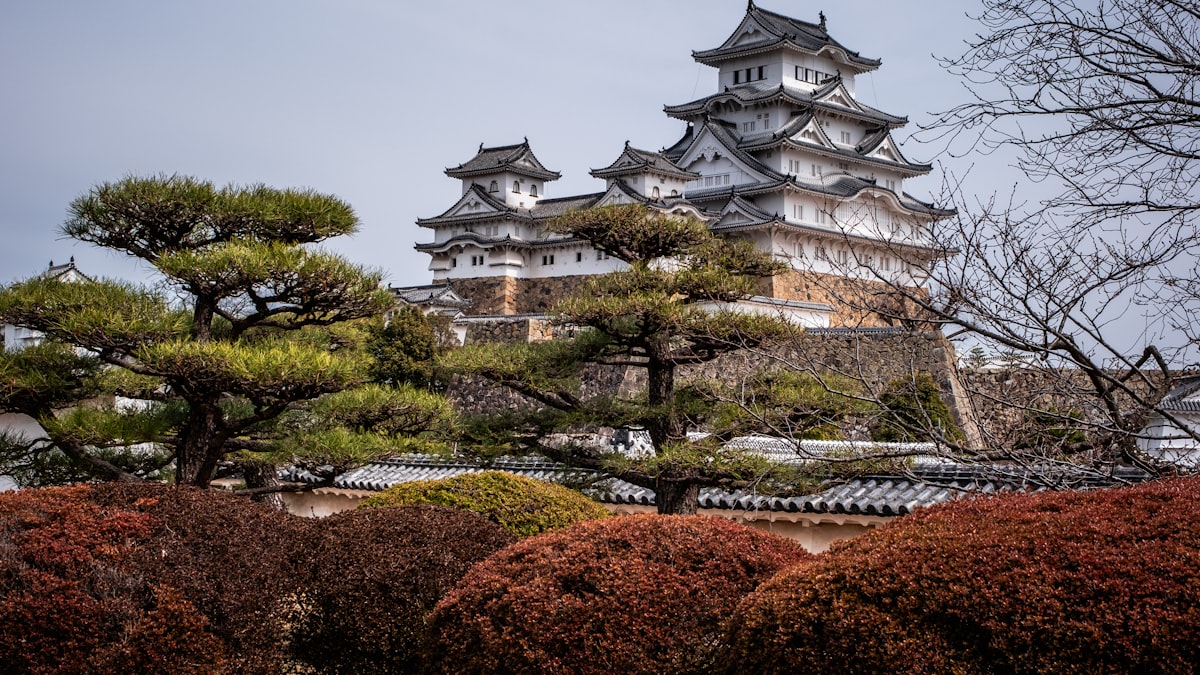
Japan’s castles are striking reminders of the samurai era — soaring white keeps, stone walls, and moats. Here’s a guide to the best to visit and how to tell an original from a reconstruction.
The “original twelve”
Only twelve castles keep their original wooden keeps (donjon); the rest are post-war concrete reconstructions (still worth visiting for the grounds and views). The originals feel authentically old — steep stairs, dark timber, and history.
The best castles to visit
- Himeji Castle — the magnificent “White Heron,” Japan’s finest surviving castle (near Kobe/Osaka).
- Matsumoto Castle — a striking black-and-white original in the Nagano Alps.
- Hikone & Inuyama — beautiful original keeps.
- Nijo Castle (Kyoto) — famous “nightingale” floors; see our Kyoto guide.
- Osaka & Nagoya Castles — grand reconstructions with great museums; see our Nagoya guide.
What to look for
- Defensive design — narrow windows, drop chutes, maze-like approaches.
- Stone walls & moats — often the most impressive original parts.
- Cherry blossoms — castles are prime hanami spots; see our cherry blossom guide.
Tips
- Original keeps have steep, ladder-like stairs — wear easy-off shoes (you go barefoot inside).
- Go early at Himeji to beat crowds.
- Pair castles with nearby shrines and temples and gardens.
Typical costs & hours
- Himeji Castle entry is JPY 1,000; most other major castles run JPY 500-1,000, with combined tickets sometimes available for the castle plus an adjoining garden (Himeji’s Koko-en garden adds JPY 300 as a combo).
- Standard hours run roughly 9am to 5pm (last entry around 4:30pm), with reduced winter hours at some sites — check specific dates around New Year, when several castles close briefly.
- Original keeps like Himeji and Matsumoto take 1-1.5 hours to fully climb and explore due to narrow original staircases that create bottlenecks; reconstructed castles with elevators (Osaka, Nagoya) move faster.
Common mistakes to avoid
- Wearing boots or shoes with buckles to an original keep — you’ll remove them at the entrance and carry them in a provided bag up steep stairs, so slip-on shoes save real hassle.
- Assuming every castle you see is original — most of Japan’s famous castle skylines (Osaka, Nagoya, Wakayama) are 20th-century concrete reconstructions with modern elevators and museum interiors, which is worth knowing before setting an expectation of centuries-old timber.
- Visiting Himeji at midday in cherry blossom season without a plan — it’s one of the most popular hanami spots in the Kansai region and gets very crowded.
Combining castles with a wider day
Himeji works well as a stop between Kyoto/Osaka and Hiroshima if you’re taking the shinkansen that direction anyway, since the castle sits a short walk from Himeji Station. Matsumoto pairs naturally with a Japan Alps route through Kamikochi and Takayama.
A castle-and-garden combo day
Many castle grounds double as some of Japan’s best cherry blossom and autumn leaf viewing spots, since moats and stone walls photograph beautifully against seasonal color — pairing a morning castle visit with an afternoon at a nearby traditional garden makes efficient use of a single day without feeling repetitive.