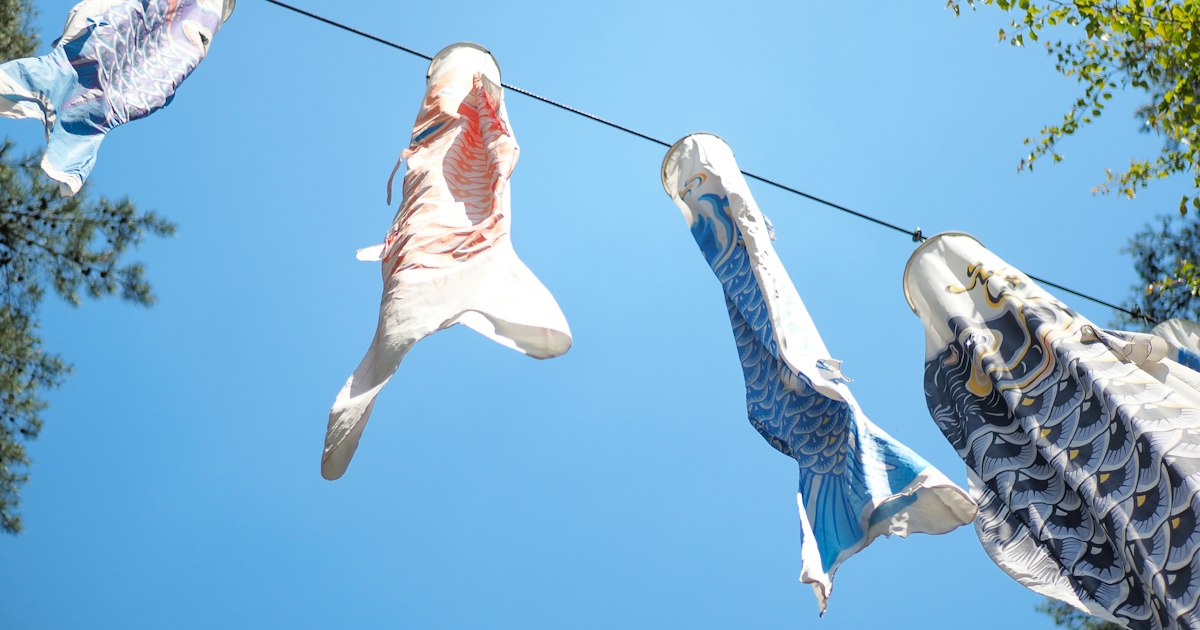
Photo by Yuika Takamura on Unsplash
Koinobori — the wind-filled carp streamers flown for Children’s Day on May 5th — are one of the few Japanese seasonal decorations that actually photograph as well in your living room as they do over a Japanese river. But buying a real set is more complicated than grabbing a fridge magnet: there are half a dozen sizes, several fabric grades, and a genuine logistics problem once you realize a traditional pole set is taller than most hotel room ceilings. Here’s where to actually buy one, what it costs, and how to get it home in one piece.
When Koinobori Are Actually in Stores
Koinobori go on display in shops from around late February through Golden Week (the holiday stretch that ends on May 5th, Children’s Day itself). Selection is best in March and early April, before the best sizes and designs sell out. If you’re traveling in that window, you’ll see koinobori hanging in department stores, specialty doll shops, and even supermarkets. Shop after May 5th and you’ll find 30–50% clearance discounts, but the selection thins out fast to whatever didn’t sell — fine if you just want something decorative, less fine if you wanted a specific size or colorway.
Know Your Set Before You Shop
Koinobori aren’t sold as a single object — you’re buying a system, and the type matters more than the brand:
- Garden pole sets — a freestanding aluminum pole (typically 3m to 7m) with a weighted base, topped with spinning arrow-wheels (yaguruma) and a rotating ball, from which the carp streamers hang. These need an actual yard or wide balcony and run roughly ¥40,000–¥150,000 for mid-range nylon sets, climbing past ¥300,000 for hand-painted silk carp from established makers.
- Veranda/balcony sets — a shorter pole (1.2m–2.5m) that clamps to a railing instead of needing ground anchoring. This is what most urban Japanese families actually buy now. Expect ¥15,000–¥50,000 depending on the number of carp and fabric quality.
- Tabletop sets — a small stand, usually 30cm–80cm tall, with miniature carp and sometimes a samurai helmet (kabuto) alongside. These run ¥5,000–¥20,000 and are the only realistic option if you’re flying home with checked luggage rather than freight.
A standard set includes a large black carp (magoi, representing the father), a red carp (higoi, the mother), and one or more smaller colored carp for each child. Nylon and polyester are durable and rain-resistant — fine for actual outdoor flying. Silk sets are for display only and are priced accordingly.
Tokyo’s Doll District: Asakusabashi
The single best place to see and buy serious koinobori in Tokyo is Asakusabashi, a neighborhood between Akihabara and Ryogoku that has been Tokyo’s wholesale doll and seasonal-goods district since the Edo period. Two long-established shops anchor it: Kyugetsu and Yoshitoku, both specialists in hina dolls (for Girls’ Day) and gogatsu ningyo — the samurai helmets, armor stands, and koinobori sold for Boys’/Children’s Day. Both are a short walk from Asakusabashi Station (JR Sobu Line and Toei Asakusa Line) and typically open around 10:00, closing around 18:00, with occasional irregular closures — check the specific week if visiting in off-season, since staff hours shrink outside the February–May selling period.
These shops carry the full range from modest veranda sets to museum-grade silk koinobori, and staff are used to explaining fabric grades and set sizes to customers who’ve never bought one before. Prices are clearly tagged, and because this is a specialist district rather than a tourist strip, you won’t pay an inflated “souvenir shop” markup.
The Production Towns: Kazo and Tatebayashi
If you want to see koinobori made, not just sold, two towns are worth building a day trip around. Kazo City in Saitama Prefecture has been a center of koinobori manufacturing for over 150 years, with several family workshops still hand-painting and dyeing carp using traditional methods; the town also raises a famous giant koinobori (previously Guinness-recognized for length) during its spring festival, usually held in late April or around Golden Week in a riverside park. Tatebayashi, in neighboring Gunma Prefecture, hosts the Watarase River koinobori display, where thousands of streamers are strung across the river from late March into early May — genuinely one of the better spring day trips from Tokyo if your visit lines up with the season. Workshop stores in both towns sell direct, often at prices below what you’d pay at a department store, though English support is limited, so having set sizes and a budget written down (or on your phone) in Japanese helps.
Budget and Convenience Options
Not everyone needs an heirloom-grade set. Daiso and other ¥100-shops stock small decorative koinobori — miniature standing sets or simple fabric streamers on a dowel — for anywhere from ¥110 to around ¥1,100, seasonally from February through May. Stock and selection vary a lot by store size, so if you want options beyond a single rack, it’s worth reading up on how flagship Daiso branches differ from neighborhood ones before assuming your local store will have what you saw online. Department stores like Takashimaya and Isetan also run seasonal gogatsu ningyo floors in spring, with mid-range sets and attentive staff, at prices roughly between the specialist shops and the production-town workshops.
Shipping a Full-Size Set Home
This is where most travelers get stuck. A garden or veranda pole, even disassembled, is usually too long for a suitcase and often too long for standard parcel services without special oversized handling. Your realistic options are: ask the shop about international shipping (larger shops like Kyugetsu and Yoshitoku have experience boxing sets for overseas customers, though it’s worth confirming cost and timeline before you buy); use Japan Post’s EMS service, which handles oversized boxes and gives you tracking; or, if you’re buying mid-trip and need to get a bulky box to your hotel or the airport without hauling it around, Japan’s domestic takuhai courier network is worth knowing — the same system covered in this guide to hotel-to-hotel luggage forwarding can also move an awkward box between your hotel and a shipping point. If you don’t want to deal with any of this on the ground, note that some department stores and specialty retailers run mail-order catalogs you can order from after you’re home — a pattern similar to Japan’s broader mail-order catalog culture, though koinobori-specific overseas mail order is less common than for smaller goods, so confirm shipping coverage before relying on it.
Common Mistakes to Avoid
The biggest mistake is buying a garden pole set without a garden — these require either a concrete-anchored base or a sandbag-weighted stand, and they’re genuinely heavy. If you live in an apartment, buy a veranda/balcony set instead; it’s designed for exactly that constraint. The second mistake is assuming checked luggage will fit a pole — it won’t, so decide on shipping before you buy, not after. The third is shopping only in Tokyo: production-town prices in Kazo are often meaningfully lower than Tokyo retail for equivalent quality, so if your itinerary allows a day trip, it’s worth the detour even accounting for travel cost. Finally, don’t wait until May 5th itself to shop — by then the good sizes are gone and you’re choosing from clearance leftovers.