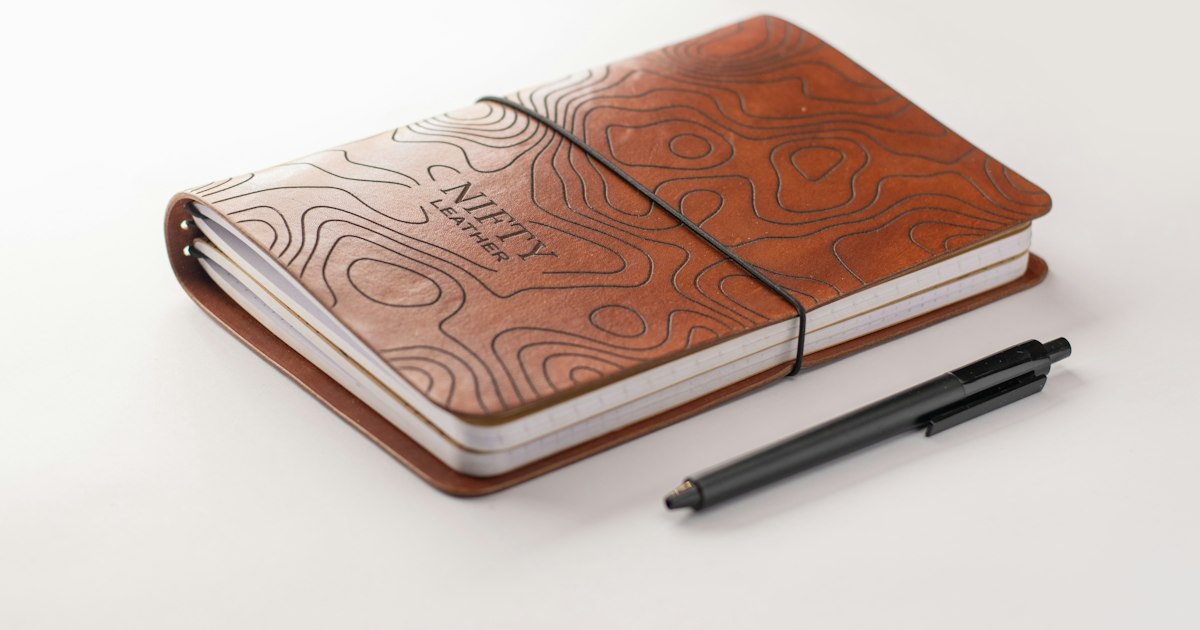
Photo by Nifty Leather on Unsplash
If you’ve ever seen a battered leather notebook stuffed with train tickets, stamps, and washi tape peeking out of someone’s bag, there’s a good chance it was a Midori TRAVELER’S notebook. What started as a simple leather cover and a few paper inserts in 2006 has turned into one of Japan’s most devoted stationery cults, with collectors tracking down discontinued refill colors the way sneakerheads chase limited drops. If you’re heading to Japan and want to start — or restock — your own system, here’s what’s actually worth knowing before you shop.
What Makes Traveler’s Notebook a Cult Object
The brand is made by TRAVELER’S COMPANY, a label under Designphil Inc. (part of the Kokuyo stationery group), and it was originally sold simply as “Midori Traveler’s Notebook” before the rebrand in 2016 — you’ll still hear longtime fans call it “Midori” out of habit. The core idea is deliberately low-tech: a single leather cover, held together with an elastic cord, into which you slot thin paper refills. There’s no binding, no mechanism, nothing to break. The leather is undyed and untreated, so it darkens and creases with use, which is the whole appeal — your notebook is supposed to look like it’s been somewhere.
That simplicity is also why it has spawned such a deep accessory ecosystem: refill inserts, connecting bands, pen holders, zipper pockets, sticker-release paper, even brass clips and charms. Collectors who enjoy this kind of hunt-the-accessory culture tend to also like Japan’s other niche hobby scenes — if that’s you, it’s worth reading about vintage film camera hunting in Japan or the collectible figure shops run by Kaiyodo, Figma and Good Smile Company, which attract a very similar completionist mindset.
Regular vs Passport Size: Which to Buy First
There are two standard sizes, and they are not interchangeable — this trips up almost every first-time buyer.
- Regular size — roughly 110mm x 210mm, closer to a slim A5. Good if you want more writing space and plan to use it as a planner or sketchbook. Leather covers run approximately ¥5,500–6,000.
- Passport size — sized to match an actual passport, around 90mm x 125mm. More pocketable, popular for travel logs and stamp/ticket collecting. Leather covers run approximately ¥4,500–5,000.
Refills are sized specifically for one or the other, so decide before you buy inserts. Leather colors to know: camel, brown, black, and blue are the standard lineup; olive, pink, and other seasonal colors rotate in and out and are usually what collectors are hunting for.
Understanding the Refill System
Each refill is a thin paper booklet, numbered rather than named, and the numbering differs between Regular and Passport size — refill 001 in Regular size is lined paper, but 001 in Passport size is also lined paper, while the numbers diverge further up the range (grid, blank/”free diary,” weekly, kraft-paper folder, zipper pouch, sticker paper, and so on). Regular-size refills go up into the 020s; Passport-size refills top out lower, around 017. A single refill typically costs somewhere in the ¥400–550 range, and most people run through one in a few months depending on how much they write or paste into it.
The cover itself ships completely empty — no refill included — so budget for at least one insert on top of the leather price. You’ll also likely want a connecting band or two (small elastic loops, a few hundred yen) if you want to run multiple refills side by side in one cover, which is how most long-term users expand their system over time.
Where to Buy in Japan: Budget to Splurge
Budget / easiest: Loft and Hands (formerly Tokyu Hands) stores in any major city stock the core leather colors and the most common refill numbers (lined, grid, blank, kraft folder). This is the fastest option if you just want to get started and don’t need rare colors — look in the stationery floor, usually grouped with other Japanese paper goods.
Mid-range / bigger selection: Itoya in Ginza, Tokyo (the multi-floor flagship stationery department store, commonly called G. Itoya) carries a much deeper range of refills and accessories than a typical Loft, plus other Japanese paper and pen brands worth browsing while you’re there. Sekaido in Shinjuku is another solid stop with a large stationery floor.
Splurge / full experience: TRAVELER’S FACTORY runs its own concept stores — the original and most famous is near Nakameguro Station in Tokyo, set in a converted warehouse space with the full catalog, store-exclusive stamps you can ink directly onto your notebook, and limited-edition covers not sold elsewhere. There are sister TRAVELER’S FACTORY locations in Kyoto and Osaka as well. These stores are destinations in their own right for fans — budget at least 30–45 minutes to browse properly, and expect to pay a premium for store-exclusive leather colors or collaboration items versus the standard lineup at Loft.
If you’re routing a Japan itinerary around Tokyo, Kyoto, and Osaka anyway, working a TRAVELER’S FACTORY stop into a shinkansen day is easy — see our guide to choosing between Nozomi, Hikari, and Kodama trains for getting between those cities efficiently.
Best Time to Visit, and Timing Tips
There’s no real seasonal rush for Traveler’s Notebook the way there is for, say, cherry blossom goods, but two things are worth planning around. First, flagship stores get noticeably busier on weekends and around Japanese holiday weeks, so a weekday morning visit gets you more counter time with staff and less competition for display-only exclusive stock. Second, limited-color leather covers and collaboration refills sell out fast and are rarely restocked — if you see a color you like at a TRAVELER’S FACTORY store, buy it there rather than assuming you’ll find it later at a regular Loft, where selection is much more limited.
Common Mistakes First-Time Buyers Make
- Buying refills in the wrong size. A Passport-size refill will not fit a Regular-size cover and vice versa — double-check the packaging before you leave the store.
- Forgetting the cover ships empty. New buyers sometimes walk out with just a leather cover and nothing to write on.
- Assuming all stores carry everything. A standard Loft or Hands branch stocks maybe a dozen of the most popular refill numbers — for the full range or discontinued colors, you need Itoya Ginza or a TRAVELER’S FACTORY store specifically.
- Not checking leather care needs. The undyed leather marks easily from water and oil; it’s part of the charm, but don’t be surprised the first time a rain drop leaves a permanent spot.
Prices and stock listed here are approximate and can shift with exchange rates and seasonal releases, so treat the figures as a planning baseline rather than a guarantee. Beyond that, the system rewards patience — buy one cover, one refill, and let the accessory hunt happen naturally on future trips.