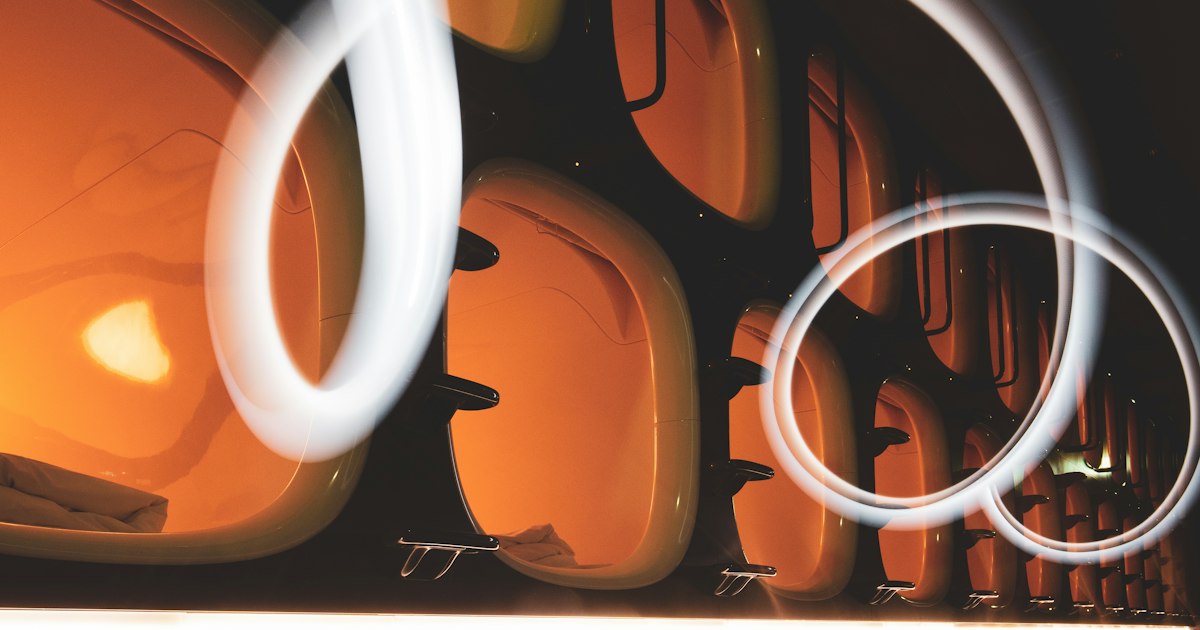
Photo by Denys Nevozhai on Unsplash
Capsule hotels have evolved a long way from the cramped overnight-sauna pods built for salarymen who missed the last train. Today, two chains dominate the modern capsule scene for travelers: First Cabin, with its airplane-cabin-inspired rooms, and Nine Hours, the minimalist pod design you’ve probably seen in magazine spreads. Both are clean, affordable, and far more comfortable than their name suggests — but they’re built on different ideas of what a capsule hotel should be. Here’s how to pick the right one.
What “Capsule Hotel” Actually Means in 2026
Neither First Cabin nor Nine Hours is a true windowless box anymore. Both separate sleeping areas from bathing facilities — you get a private sleeping space (a “cabin” or “pod”) plus shared showers, toilets, and a lounge or vending area down the hall. Nothing is en-suite, so pack a small toiletry kit and don’t expect a bathroom door in your room. Shoes come off at the entrance and go into a locker; you’ll be given a key, wristband, or PIN code for your personal locker where luggage is stored during the day.
First Cabin: Airplane-Style Comfort
First Cabin’s whole concept is built around the idea of an airline cabin — “First Class” cabins are roughly 5 square meters with a sliding door, a real mattress, a flat-screen TV, and enough headroom to sit up comfortably, while “Business Class” rooms are smaller, closed off with a roll-down shutter instead of a door, and sized closer to a single bed with a shelf. Expect to pay roughly ¥6,000–¥9,000 a night for a First Class cabin and ¥4,500–¥6,500 for Business Class, depending on the city and season.
Locations include Tsukiji, Akasaka, and Haneda Airport in Tokyo, plus Kyoto, Osaka (Shinsaibashi and Namba), Kobe, Nagoya, and Fukuoka. Several properties — notably the Kyoto and Kobe branches — are built inside restored or heritage-style buildings, so the lobby and common bath areas often have more personality than a typical business hotel. Check-in is usually from 16:00–17:00 and checkout around 10:00, with luggage storage available if you arrive early or need to linger after checkout.
Nine Hours: Minimalist Efficiency
Nine Hours takes its name from a simple formula: 1 hour to shower, 7 hours to sleep, 1 hour to get ready. The pods themselves are compact fiberglass capsules — just enough room to sit up and stretch out, with a light and sound-dimming interior, a reading light, and an alarm you set from inside. There’s no TV and no desk; this is a sleep-focused design, not a lounge-around-your-room one. Rates typically run ¥4,000–¥5,800 a night, making it one of the cheapest clean, private-sleep options in any major Japanese city.
You’ll find Nine Hours locations in Kyoto (steps from Kyoto Station), Kanda and Akasaka in Tokyo, Narita Airport’s Terminal 2, Namba in Osaka, Sapporo, Fukuoka, and Sendai. Floors are strictly separated by gender, with separate locker rooms, showers, and pod floors for men and women — mixed-gender couples or friends will check in together but sleep on different floors. Check-in generally opens at 17:00, and checkout is 10:00, both enforced fairly strictly since pods are cleaned and reset between guests.
Price, Amenities, and Comfort Compared
- Cheapest overall: Nine Hours, especially for solo travelers who don’t need a TV or extra space.
- Most “room-like” feel: First Cabin’s First Class cabins, which are the closest thing to a tiny private hotel room you’ll find in this price bracket.
- Design and photogenic factor: Nine Hours wins for the sleek, almost futuristic pod aesthetic; First Cabin wins for cabins with actual doors and a bit more individuality between locations.
- Baths: Some First Cabin locations (Kyoto, Kobe) have larger communal bath areas worth lingering in; Nine Hours sticks to efficient individual shower stalls.
- Luggage: Both offer lockers sized for a carry-on, but neither easily fits a large suitcase — if you’re traveling with big luggage, plan to use station lockers or a forwarding service instead.
Who Should Choose Which
Budget solo travelers and backpackers will usually be happiest at Nine Hours — it’s cheaper, the design is genuinely restful, and the stations they’re built near (Kyoto Station, Narita, Kanda) make early flights or trains painless. Travelers who want a bit more room to unpack, charge devices at a desk, or watch Japanese TV before bed will prefer First Cabin’s First Class tier. Couples or friends traveling together should know that both chains separate guests by gender once you’re past the lobby — if you want to actually share a room, look at a capsule hotel elsewhere or a standard business hotel instead.
Either chain is also a smart pick on a night when you’ve stayed out later than planned. If you’re out drinking and tracking the clock, it helps to understand how izakaya tabs and nomihodai deals work before you order, and to know how shuden (last train) times work — both First Cabin and Nine Hours have locations near major stations that are built exactly for travelers who cut it close.
Booking Tips and Common Mistakes
- Book directly or through major OTAs well ahead for weekend stays. Both chains’ city-center locations (Kyoto especially) sell out fast during cherry blossom season (late March–early April) and autumn foliage (mid-November), and school trip season in Kyoto and Nara can also tighten up availability at nearby budget stays.
- Don’t assume you can check in early. Both chains are strict about the 16:00–17:00 check-in window; arriving earlier usually just means dropping bags at the front desk, not getting into your cabin.
- Bring your own basic toiletries if you’re picky about brands — amenities are provided, but they’re the standard small-bottle variety. If you’re also stocking up on Japanese skincare while you’re here, it’s worth understanding why Japanese skincare routines lean so heavily on toner and lotion before you buy a full routine’s worth to pack home.
- Snoring and noise carry. Pods and cabins reduce light and sound but aren’t soundproof booths — light sleepers should pack earplugs regardless of which chain they choose.
- Settle your IC card balance before you leave the country. If your stay is near the end of your trip, it’s a good moment to handle getting your Suica or Pasmo deposit refunded rather than leaving it for a rushed airport departure.
The Bottom Line
Nine Hours and First Cabin solve the same problem — affordable, clean, private sleep in expensive Japanese city centers — with two different philosophies. Nine Hours is the cheaper, more minimalist, airport-friendly option; First Cabin is the slightly pricier, more room-like experience with a bit more character between locations. Neither is a downgrade from a hotel so much as a different kind of stay, and either one is a perfectly comfortable base for a night or two between the places you’re actually there to see.