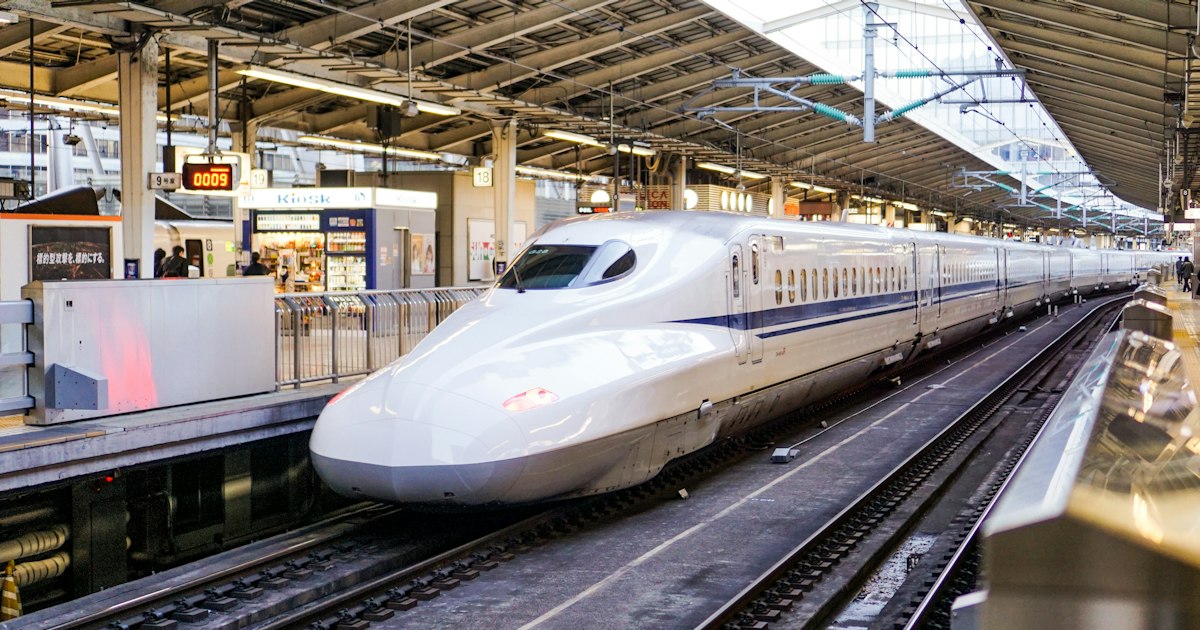
Photo by Fikri Rasyid on Unsplash
If you’re riding the Tokaido Shinkansen between Tokyo, Nagoya, Kyoto, and Osaka, the first decision you’ll face isn’t which seat to pick — it’s which of the three train types to board. Nozomi, Hikari, and Kodama run the exact same route on the exact same tracks, but they stop at different stations, take wildly different amounts of time, and — crucially for JR Pass holders — have different rules about who can ride them. Pick the wrong one and you could add an hour to a trip that should take 90 minutes, or accidentally board a train your pass doesn’t cover.
The Basic Difference: Speed vs. Stops
All three trains are the same sleek white-and-blue Shinkansen, running on the same Tokaido Line between Tokyo and Shin-Osaka (with many continuing onward as Sanyo Shinkansen services to Hakata). The difference is simply how many stations they skip:
- Nozomi (“hope”) is the fastest, stopping only at major hubs: Tokyo, Shinagawa, Shin-Yokohama, Nagoya, Kyoto, and Shin-Osaka. Tokyo to Shin-Osaka takes about 2 hours 22 minutes.
- Hikari (“light”) makes a few more stops — places like Odawara, Shizuoka, or Maibara depending on the service — and takes roughly 2 hours 40 minutes to 3 hours for the same route.
- Kodama (“echo”) stops at every single station, including small ones like Mishima, Kakegawa, and Gifu-Hashima. Tokyo to Shin-Osaka takes around 4 hours.
For a one-way Tokyo–Kyoto trip, that’s the difference between a 2-hour-15-minute Nozomi ride and a 3.5-hour-plus Kodama slog. If your only goal is getting from A to B quickly, Nozomi almost always wins.
The JR Pass Catch: Nozomi Is Off-Limits
Here’s the detail that trips up more travelers than anything else: the ordinary Japan Rail Pass (and the regional JR Pass variants that cover the Tokaido line) does not cover Nozomi or the related Mizuho services on the Kyushu Shinkansen. Pass holders must ride Hikari or Kodama instead. If you tap into a Nozomi platform or try to board with just your pass, station staff will stop you at the gate — you can’t pay a top-up fee on the spot in all cases, so it’s better to know this before you’re standing on the platform with luggage and a train departing in two minutes.
This isn’t a huge sacrifice. Since Hikari skips most minor stations, the time difference versus Nozomi over a Tokyo–Kyoto run is usually only 15–20 minutes. Kodama is the one to avoid for pass holders doing long hauls, since it adds well over an hour.
If you’re weighing whether a JR Pass is worth buying at all for your itinerary, remember the pass only pays for itself on longer multi-city loops — for a single round trip between Tokyo and Osaka, individual tickets are often cheaper. Whichever way you travel, don’t forget to budget for Japan’s 1,000 yen departure tax when you eventually fly home.
Prices Without a Pass
If you’re buying individual tickets, prices are nearly identical across all three train types — you pay the same base fare plus a limited express surcharge regardless of whether you ride Nozomi, Hikari, or Kodama. For Tokyo to Shin-Osaka in an unreserved ordinary car, expect around 13,870 yen one-way (fare plus limited express charge combined). Reserved seats add roughly 200–720 yen depending on season and car. Green Car (first class) seats run about 18,380 yen one-way from Tokyo to Shin-Osaka.
Shorter hops cost proportionally less: Tokyo to Nagoya is about 11,300 yen, and Nagoya to Kyoto is about 6,030 yen. Since the fare is the same no matter which train you choose, there’s rarely a financial reason to pick Kodama over Nozomi if you’re paying out of pocket — speed comes free.
Tickets can be bought at JR ticket offices (midori-no-madoguchi), station ticket machines, or online via the SmartEX or Japan Rail Pass apps, which let you reserve seats and receive a QR code for the gates instead of a paper ticket.
When Kodama Actually Makes Sense
Kodama isn’t just the slow option — it has two genuine uses. First, if you’re hopping just one or two stops (say, Odawara to Atami, or Gifu-Hashima to Nagoya), Kodama is often the only train that stops there at all, since Nozomi and many Hikari services blow straight through smaller stations. Second, Kodama trains are consistently the least crowded of the three, especially in unreserved cars, which makes them a good fallback during peak travel windows like Golden Week (late April–early May), Obon (mid-August), and New Year’s, when Nozomi unreserved cars can fill up entirely and leave standing passengers for the first hour.
There’s also a niche discount product called the “Kodama Economy Pass” sold as part of some travel packages, bundling a Kodama seat with a hotel stay at a lower combined price than booking separately — worth a glance if your schedule is flexible and you’re not in a hurry.
Seasonal Timing and Crowding
Weekday mornings and evenings on the Tokyo–Nagoya–Kyoto–Osaka corridor carry heavy business commuter traffic, and Nozomi reserved cars for popular departure times can sell out a day or more in advance during peak holiday weeks. Cherry blossom season (late March–early April) and autumn foliage season (mid-November) in Kyoto push leisure demand up sharply on top of the usual business travel, so reserving seats a few days ahead — rather than relying on unreserved cars — is the safer bet in those windows. Outside of peak weeks, unreserved cars (usually cars 1–3 on most Tokaido trains) are reliably easy to board even with no advance booking.
Common Mistakes to Avoid
- Boarding a Nozomi with a JR Pass. Double-check the train name on the departure board, not just the time — Nozomi, Hikari, and Kodama often depart from the same platform within minutes of each other.
- Assuming Hikari stops everywhere between major cities. Hikari skips plenty of stations too; if your destination is a smaller stop, check the specific service’s stop pattern on the timetable, since not all Hikari trains stop at the same places.
- Standing in the unreserved line during peak weeks. If you haven’t reserved a seat for a Golden Week or Obon departure, you may be standing for the whole trip — reserve ahead or take an earlier/later Kodama instead.
- Not confirming the final destination of connecting services. Some Hikari and all Mizuho/Sakura trains continue past Shin-Osaka onto the Sanyo Shinkansen toward Hiroshima and Hakata — useful to know if you’re continuing west, confusing if you’re not.
Once you’ve got the Nozomi/Hikari/Kodama distinction straight, the rest of Shinkansen travel is refreshingly simple: show up a few minutes early, find your car number painted on the platform, and the train will be within arm’s length of being dead on time. If language on signage or with station staff is a worry, a translation gadget like those covered in this guide to Pocketalk and other translation tools can smooth over last-minute platform confusion. And if your Shinkansen trip connects to a bus leg on either end, it’s worth knowing your way around a major terminal like Basta Shinjuku before you arrive.