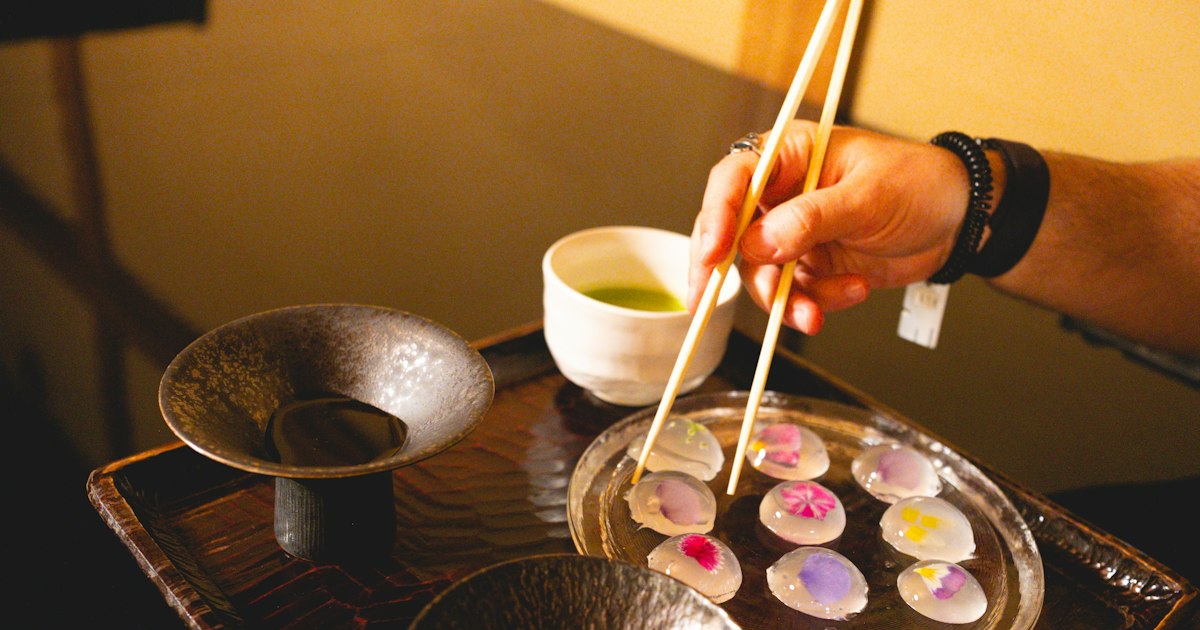
Photo by Igal Ness on Unsplash
Most souvenir sweets in Japan are made to be eaten within the week. Toraya’s are made to be understood as craft first, sweet second — the company has been making wagashi (traditional Japanese confectionery) since before Japan had a unified capital at Edo, and it still supplies sweets to the Imperial Household. If you only know wagashi as “the weird jelly thing next to the mochi,” a stop at Toraya is the fastest way to see what the fuss is about, and it’s also one of the few places where you can buy a genuinely old-world souvenir that survives the flight home.
A 500-Year House: From Kyoto’s Imperial Court to Modern Tokyo
Toraya traces its founding to Kyoto in the early 1500s, during the late Muromachi period, where it supplied wagashi to the Imperial court. When the capital and Imperial household moved to Tokyo in 1869, Toraya followed, opening what’s now its Tokyo headquarters store in Akasaka while keeping its original Kyoto shop running near the old Imperial Palace grounds. That dual identity — Kyoto roots, Tokyo headquarters — is still the core of the business today, eighteen generations and five centuries later. The company also quietly runs a shop in Paris, opened in 1980, which says something about how it has positioned itself: not as a nostalgia act, but as a living confectionery house that still trains new craftspeople in a very old method.
What Makes Wagashi — and Toraya Specifically — Different
Wagashi is built around anko (sweetened azuki bean paste), agar, rice flour, and sugar rather than butter, cream, or chocolate, and the best pieces are designed to represent a season, a poem, or a specific moment rather than just “chocolate cake, but Japanese.” Toraya’s signature product is yokan — a firm, sliceable block of sweetened bean paste set with agar — which it has been refining since the 17th century. Alongside yokan, Toraya makes nerikiri (soft, hand-shaped seasonal sweets meant to look like flowers, leaves, or seasonal motifs), dorayaki (two small pancakes sandwiching anko), and monaka (thin wafer sandwiches). If you’ve read about Japan’s obsession with Mont Blanc or tried warabimochi, Toraya sits at the more formal, old-school end of that same spectrum — this is the wagashi served at tea ceremonies, not the stuff sold from a festival stall.
Where to Visit
Toraya Akasaka (Tokyo headquarters store): 4-9-22 Akasaka, Minato-ku, Tokyo. It’s about a 5-7 minute walk from Akasaka Station (Chiyoda Line) or Akasaka-mitsuke Station (Ginza/Marunouchi Lines), tucked into a quiet, more residential stretch of Akasaka away from the nightlife strip. The shop sells the full product range and typically opens around 9:00 and closes by 18:00, though hours shift around New Year and can vary by season, so it’s worth confirming the day you plan to go. Attached to the store is the small, free Toraya Gallery, which rotates exhibits on wagashi history, tools, and Imperial-era documents — a 15-20 minute stop, not a full museum visit.
Toraya Kyoto (Gosho honten): near the Kyoto Imperial Palace (Kyoto Gosho), on Karasuma-dori close to Ichijo. This is the shop closest to Toraya’s actual origins, and it’s a reasonable add-on if you’re already walking the palace grounds.
TORAYA CAFE and AN STAND: Toraya also runs more casual, modern offshoots — TORAYA CAFE locations (such as in Tokyo Midtown and Omotesando) serve matcha-and-wagashi sets for roughly ¥1,200-1,500, while the AN STAND concept sells anko-based snacks like anko toast or anko soft-serve for about ¥500-800. These are a good lower-commitment way to try the flavor without buying a full box, especially if you’re not sure wagashi is for you yet.
What to Buy, and What It Costs
- Classic yokan bar (single serving): around ¥400-450. This is the easiest entry point and the best souvenir — more on why below.
- Mini yokan assortment box (5 pieces): roughly ¥1,600-2,200. Good for sharing or for bringing home multiple flavors at once.
- Gift boxes (mixed yokan, dorayaki, monaka): ¥3,000-10,000+ depending on size — this is the standard “bring something back for the office” tier.
- Dorayaki: about ¥260-320 each, best eaten within a couple of days.
- Seasonal nerikiri (fresh, hand-shaped sweets): roughly ¥500-600 each, sold individually or in small boxes. These are the most beautiful items in the shop and the most fragile — they’re a same-day or next-day treat, not a souvenir.
- Splurge option: large formal gift sets in wooden presentation boxes, sometimes ¥10,000 and up, aimed at the Japanese tradition of omiyage for a boss or in-law, not casual self-buying.
The single most useful thing to know before you buy: Toraya’s sealed, firm-set yokan (the kind sold in individually wrapped bars or wooden boxes, not the fresh nerikiri) is shelf-stable and doesn’t need refrigeration — some varieties keep for close to a year unopened. That makes it one of the rare Japanese sweets that genuinely survives a long flight and weeks in a suitcase, which is why it’s been a standard diplomatic and Imperial gift for centuries. Fresh nerikiri, by contrast, is meant to be eaten within a day or two and will not travel well at all.
Best Season and Timing
Toraya changes its nerikiri lineup roughly monthly to match the 24 micro-seasons of the traditional Japanese calendar — cherry blossom motifs in spring, cool water and ayu-fish shapes in summer, chestnut and maple leaves in autumn, plum blossoms in winter. If a specific seasonal design matters to you, check that it’s currently in rotation before building a trip around it, since last month’s shape won’t be sitting in the case. For the shelf-stable yokan and gift boxes, timing barely matters — they’re sold year-round. New Year’s week is worth avoiding for store visits generally, as hours shrink and lines for seasonal gift boxes build up domestically.
Common Mistakes
- Buying fresh nerikiri as a take-home souvenir. It looks like the showpiece item, but it’s a same-day food. Buy it to eat in Japan; buy sealed yokan to take home.
- Confusing this Toraya with unrelated businesses of the same name. There are other shops and restaurants in Japan called “Toraya” (including at least one well-known ramen/gyoza chain) that have no connection to the wagashi maker — double-check you’re at 虎屋, the confectioner, if you’re navigating by name alone rather than address.
- Assuming it’s duty-free or needs special customs handling. It doesn’t — it’s a normal packaged food souvenir. If you’re stocking up on several boxes along with other Japanese snacks and goods, it’s worth skimming what you can actually bring back under your home country’s duty-free allowance before you over-buy.
- Treating the Akasaka store as a quick grab-and-go. It’s a quiet, formal shop, closer in feel to a jeweler than a convenience store — budget a little time to look at the gallery and ask staff about current seasonal flavors rather than rushing in and out.
If you’re building out a broader list of traditional, well-made Japanese things to bring home rather than mass-produced souvenirs, Toraya’s yokan pairs naturally with other small-format collectibles like hashioki chopstick rests — both are inexpensive enough to buy several, both hold up in a suitcase, and both give a Japanese host or dinner-table gift a little more weight than a keychain.