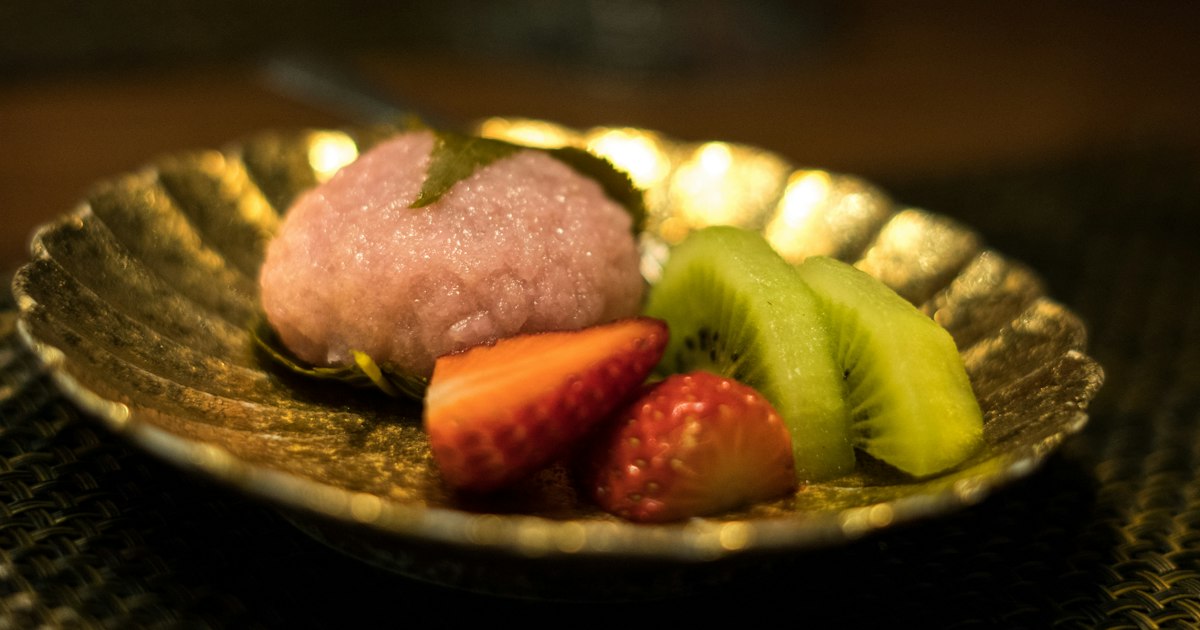
Photo by Antonio Araujo on Unsplash
If you’ve seen a Japanese dessert that looks like translucent amber cubes trembling on a plate, dusted in pale yellow powder and drizzled with dark syrup, you’ve met warabimochi. It’s one of Japan’s oldest confections, and despite the name, it has almost nothing in common with the chewy rice mochi most visitors already know. Here’s what it actually is, why the “real” version is surprisingly hard to find, and where to track one down.
What Warabimochi Actually Is
Warabimochi (蕨餅) is made by heating warabiko — starch extracted from the root of bracken fern — with water and sugar until it thickens into a soft, quivering gel. It’s then cut into bite-sized cubes, coated in kinako (roasted soybean flour) and often finished with a drizzle of kuromitsu (dark brown sugar syrup). Unlike mochi, which is pounded glutinous rice and has a stretchy, dense chew, warabimochi barely holds its shape — it jiggles on the spoon and dissolves almost instantly in the mouth. If you’ve tried daifuku, think of warabimochi as its opposite in texture: cool, slippery, and nearly weightless rather than chewy and sticky. For comparison, our guide to daifuku and ichigo daifuku covers the rice-based side of the mochi world.
Why “Real” Warabimochi Is Rare and Expensive
This is the detail most visitors miss, and it explains the big price gaps you’ll see on menus. Genuine bracken starch is harvested by hand from wild fern roots, and the extraction process is slow and labor-intensive — it can take months to produce a usable batch. As a result, 100% hon-warabiko (true bracken starch) warabimochi is genuinely rare, has a cloudy brownish-grey tint, and costs noticeably more. The vast majority of warabimochi sold in supermarkets, convenience stores, and even some sweets shops is made partly or entirely with substitutes like sweet potato starch, tapioca starch, or kudzu starch, which gel in a similar way but cost a fraction of the price. These versions are usually clearer and whiter. Neither is “fake” exactly — it’s a legitimate, long-standing substitution — but if you want the real thing, look for labels or shop descriptions that specifically say hon-warabimochi or 本わらび粉使用 (uses real bracken starch).
Best Season and Timing to Buy It
Warabimochi is traditionally a summer sweet, classified as suzumi-gashi (a “cooling” confection) meant to feel refreshing in humid weather. You’ll see it everywhere from roughly May through September, with convenience store chains rotating it into their chilled dessert cases specifically for summer. It’s sold year-round at dedicated sweets shops, but summer is when selection and festival-stall versions peak. Freshness matters more here than with almost any other Japanese sweet: real warabimochi starts to firm up and weep liquid within a few hours at room temperature and even faster in the fridge, since refrigeration actually accelerates the starch re-hardening (a process called retrogradation). Buy it the day you plan to eat it, and if a shop offers an eat-in option, take it — that’s the only way to taste it at peak texture.
Where to Buy It: Budget to Splurge
Options range enormously by price and quality:
- Budget (¥150–300): Convenience stores (7-Eleven, Lawson, FamilyMart) stock individually packaged warabimochi cups in the chilled dessert section during warmer months. These use starch substitutes but are a perfectly good, cheap introduction, and the kinako packet is usually separate so you can shake it fresh.
- Mid-range (¥400–1,200): Specialty sweets shops and depachika (department store basement food halls) sell small boxed sets of 6–8 pieces, often with a small bottle of kuromitsu on the side. Kyoto and Nara stations both have shops selling tourist-friendly boxed versions that travel reasonably well if eaten within the day.
- Splurge (¥1,600–4,000+): Historic teahouses serving warabimochi made fresh to order with real bracken starch, eaten on the spot with matcha. Kagizen Yoshifusa, a long-established confectionery in Kyoto’s Gion district, is one of the most famous destinations for this — its warabimochi set (served with tea) typically runs in the ¥1,600–2,000 range when eaten in the tea room, and the portion is smaller than a convenience-store cup, which reflects the cost of real bracken starch rather than any attempt to overcharge tourists.
Kyoto and Nara: The Classic Hunting Grounds
Kansai is the undisputed home turf for warabimochi, partly thanks to a long confectionery tradition and partly because Kyoto’s humid summers made cooling sweets especially popular historically. In Kyoto, beyond Kagizen Yoshifusa in Gion (easily reached on foot from Gion-Shijo Station), several matcha-focused tea shops around Uji — famous for matcha more broadly — serve warabimochi as part of parfaits or set menus, usually open from around 10am to 5 or 6pm, with last orders often earlier. In Nara, shops near Nara Park sell warabimochi alongside the more famous mochi-pounding demonstrations, making it an easy add-on to a deer park visit. None of these require reservations for a quick takeaway purchase, but eat-in tea room seating can involve a short wait on weekends.
Common Mistakes to Avoid
A few things trip up first-timers:
- Refrigerating it “to keep it fresh.” Do the opposite — keep it at cool room temperature and eat it the same day. The fridge actively ruins the texture.
- Assuming it’s shelf-stable like youkan. It isn’t. If you’re comparing Japanese sweets for souvenir durability, dense sweets like youkan travel far better than warabimochi, which really is a same-day treat.
- Expecting a chewy texture. If you go in expecting mochi-like stretch, the delicate, almost gelatin-like softness can feel underwhelming rather than delightful. Reset your expectations and it becomes one of the more interesting textures in Japanese sweets.
- Skipping the kuromitsu. Plain kinako-only versions are good, but the molasses-like depth of kuromitsu is what makes the dish — don’t be shy about using the whole packet.
Pairing It With the Rest of Your Trip
Warabimochi fits naturally into a hot-weather itinerary alongside other classic Japanese cooling treats — it’s worth trying next to a bottle of Calpis on a sweltering August afternoon, or as a lighter counterpoint after a heavier meal elsewhere in Kansai. Because it’s so time-sensitive, don’t buy it as an early-trip souvenir to save for later — treat it instead as a snack to track down specifically on the day you’re sightseeing in Kyoto, Nara, or Uji, and enjoy it within hours of purchase for the texture it’s actually famous for.