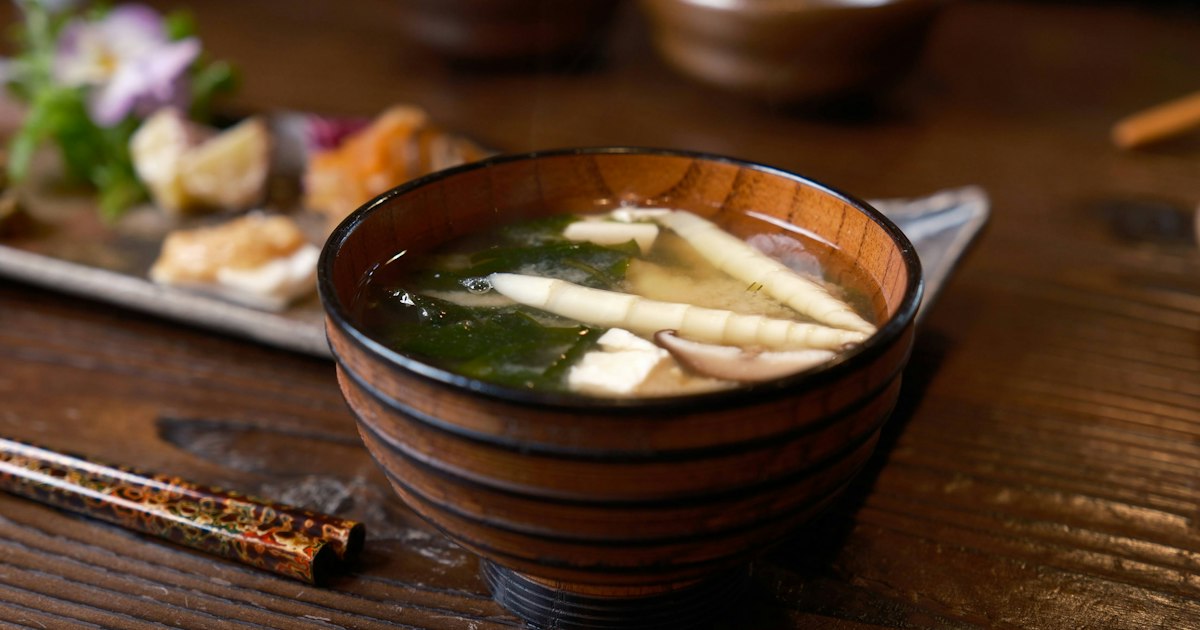
Photo by Seiya Maeda on Unsplash
If you’re in Japan over New Year’s and a host offers you a bowl of soup with a piece of mochi floating in it, you’ve just been handed ozoni (お雑煮) — the dish nearly every Japanese household eats on the morning of January 1st. What makes ozoni fascinating for visitors isn’t the dish itself but how differently it’s made depending on where you are: broth, mochi shape, and toppings can change completely within a few hundred kilometers. Here’s what to know if you want to try it, understand it, or even recreate it at home.
What Ozoni Is and Why It’s Eaten at New Year’s
Ozoni is a soup built around mochi (pounded rice cake), eaten as part of osechi ryori, the formal New Year’s meal. The custom dates back to the Muromachi period, when mochi offered to household and harvest gods during New Year’s rituals was later cooked into a soup and shared as a way of receiving that blessing for the coming year. Because the dish evolved independently in farming and fishing communities across the country, there was never a single “correct” recipe — just local ingredients and local dashi traditions layered onto the same basic idea of rice cake plus broth.
Families typically eat ozoni on January 1st, and often continue through January 3rd (the sanganichi, the main three-day New Year’s holiday), sometimes up to January 7th in regions that observe matsu-no-uchi, the traditional end of New Year’s decorations.
The Great Divide: Clear Broth vs. White Miso
The most useful mental map for ozoni is the old Kanto/Kansai split:
- Tokyo and eastern Japan (Kanto): a clear, soy-seasoned dashi broth called sumashijiru, made with katsuobushi (bonito) stock. The mochi is kiri mochi — cut into squares — and lightly grilled before going into the bowl, which gives it a faint char and keeps it from dissolving. Chicken, kamaboko fish cake, mitsuba (Japanese parsley), and spinach or komatsuna round it out.
- Kyoto, Osaka, and much of western Japan (Kansai): a white miso (shiro miso) broth that’s noticeably sweeter and thicker than Kanto’s. The mochi here is round (marumochi) and simply boiled until soft rather than grilled. Daikon and taro (satoimo) are cut into rounds too — a deliberate pun on “roundness” meaning harmony for the year ahead.
If you only remember one thing, remember this: clear and square in the east, white-miso and round in the west. Everything else is a regional variation on that theme.
Six Regional Variations Worth Knowing
Travel outside the two big metro areas and ozoni gets genuinely surprising:
- Kagawa Prefecture (Shikoku): an anmochi version — mochi filled with sweet red bean paste — dropped into a white miso broth. The combination of sweet filling and savory miso is deliberately startling and is one of the most talked-about regional ozoni among Japanese people themselves.
- Hiroshima: a clear broth ozoni with fresh oysters added, reflecting the region’s oyster farming industry in the Seto Inland Sea.
- Niigata and parts of Tohoku: salmon and salmon roe (ikura) go into a soy-based clear broth — a nod to the salmon runs of the region’s rivers.
- Tottori: a sweet azuki bean version closer to zenzai, with whole red beans simmered into the broth around the mochi rather than a savory stock.
- Iwate: mochi is often served separately with kurumi-dare, a sweet walnut dipping sauce, alongside a lighter broth.
- Nara: starts as a white miso ozoni, but diners are expected to lift the mochi out of the broth, dip it in kinako (roasted soybean flour) and sugar, and eat it that way — a two-stage dish rather than a straightforward soup.
Several of these regional dishes sit alongside other distinctly local comfort foods worth seeking out on the same trip — if you’re curious about regional variation in everyday Japanese cooking more broadly, takikomi gohan follows a similar pattern of “same dish, different ingredients by prefecture.”
When and Where Visitors Can Actually Try It
Ozoni is a seasonal dish in the truest sense — outside the New Year’s window it essentially disappears from restaurant menus, so timing matters more than for almost any other dish covered on this site.
- Ryokan and hotel New Year’s breakfasts: if you’re staying at a ryokan or traditional hotel on the night of December 31st into January 1st, ask whether a New Year’s breakfast (osechi or ozoni set) is offered. Many ryokan include it automatically for guests staying through ganjitsu (New Year’s Day); others offer it as an add-on for roughly ¥2,000–¥5,000 per person.
- Department store food halls (depachika): from mid-to-late December, basement food floors at stores like Isetan Shinjuku, Daimaru, and Takashimaya sell takeout osechi boxes that include mochi and sometimes a ready-to-heat ozoni broth packet, typically ¥10,000–¥30,000 for a full osechi set depending on size and how many people it serves.
- Supermarkets and convenience stores: in the days around New Year’s, chains sell individual kiri mochi packs (around ¥300–¥600 for a tray of 8–12 pieces) and instant ozoni broth sachets, which is the easiest way for a visitor with access to a kitchen to try making a bowl themselves.
Year-round, your best bet for tasting a specific regional style is a restaurant specializing in that region’s home cooking (izakaya chains built around Kyoto, Shikoku, or Tohoku cuisine sometimes keep a version on the menu outside New Year’s), but don’t expect to find it on a generic restaurant menu in July.
Buying Ozoni Ingredients to Bring Home
If you want to recreate ozoni after your trip, the shopping list travels well: vacuum-sealed kiri mochi or marumochi (sold shelf-stable, no refrigeration needed until opened), a tub of white miso paste if you want the Kansai style, and a pack of katsuobushi or dashi powder. Nishiki Market in Kyoto and Kuromon Ichiba in Osaka both sell high-quality miso and dashi aimed at home cooks, often in smaller, suitcase-friendly packaging than supermarket versions. Before you buy in bulk, check what’s actually allowed through customs when you land — Japan’s duty-free allowance guide covers the practical limits on food items so you don’t lose anything at the airport.
Common Mistakes Visitors Make
- Confusing mochi textures. Ozoni’s mochi is dense, chewy pounded rice cake, not to be confused with warabimochi, the cold, jiggly bracken-starch sweet served with kinako and syrup — they look vaguely similar in translation but are completely different dishes and seasons.
- Assuming one recipe is “the” recipe. Asking a Kyoto local why their ozoni “isn’t real ozoni” (because you tried the Tokyo version first) is a reliable way to start a good-natured but long conversation about regional pride.
- Underestimating the mochi. Pounded mochi is notoriously sticky and has caused choking deaths in Japan, especially among the elderly, which is why NHK and city governments issue public reminders every New Year’s to cut mochi small and chew thoroughly. Take smaller bites than you think you need to.
- Expecting it outside the season. Unlike other heritage dishes that have specialty restaurants open all year, ozoni’s availability is genuinely tied to the New Year’s calendar — plan your trip timing around late December through early January if trying it is a priority.
Ozoni rewards curiosity more than most Japanese dishes precisely because there’s no “authentic” version to chase — the differences themselves are the point. If you’re traveling during New Year’s week, asking a ryokan host or homestay family how their family makes it is often the most direct way into a conversation about where they’re from.