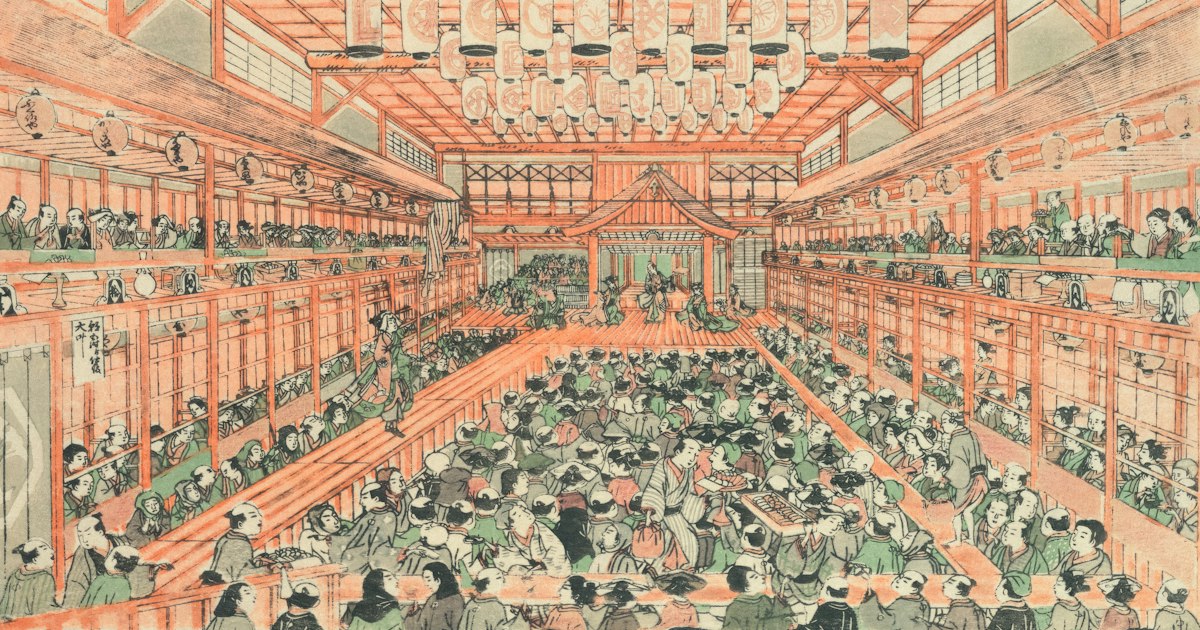
Photo by Art Institute of Chicago on Unsplash
Long before manzai duos and late-night variety shows, Japan had rakugo — a single performer, kneeling on a cushion, who conjures an entire cast of characters using nothing but a folding fan, a small cloth, and impeccable comic timing. It’s one of the oldest living performance arts in the country, and Tokyo still has working theaters where you can watch it almost every single day of the year. You don’t need to understand Japanese fluently to enjoy an afternoon at one — you just need to know which theater to pick and what to expect once you’re inside.
What Is Rakugo, Exactly?
Rakugo (“falling words”) is comic storytelling built around a punchline. A performer called a rakugoka sits on a small platform called a kōza, dressed in kimono, and acts out every character in a story — switching voices, posture, and facial angle to show who’s speaking — using only a hand fan (sensu) and a small cloth (tenugui) as all-purpose props. A fan becomes a chopstick, a pipe, a letter; a cloth becomes a wallet or a book. Stories range from centuries-old classics about foolish merchants and sharp-tongued wives to newly written material about smartphones and tourists. The craft is less about the plot and more about delivery — rhythm, pauses, and a final twist that lands the whole thing.
The Four Classic Yose Theaters in Tokyo
Rakugo is performed in dedicated variety theaters called yose, where a rotating lineup of storytellers, jugglers, magicians, and musicians takes the stage one after another for hours. Tokyo has four historic yose still running full-time:
- Suzumoto Engeijo (鈴本演芸場) — Ueno. The oldest yose in Japan, dating to 1857, a 3-minute walk from JR Ueno Station’s Hirokoji exit. Day session roughly 12:30–16:30, night session 17:00–20:30.
- Shinjuku Suehirotei (新宿末廣亭) — a 5-minute walk from Shinjuku-sanchome Station, near Golden Gai. A beautifully preserved wooden building with box seating on tatami plus regular chairs. Day roughly 12:00–16:30, night 17:00–20:30.
- Asakusa Engei Hall (浅草演芸ホール) — on Asakusa’s old Rokku entertainment strip, 5 minutes from Asakusa Station and an easy pairing with a Senso-ji visit. Runs continuously, roughly noon to 9pm.
- Ikebukuro Engeijo (池袋演芸場) — a small, intimate hall near Ikebukuro Station’s east exit, seating under 100 people.
Expect to pay around ¥3,000 for adults at Suzumoto, Suehirotei, and Asakusa Engei Hall, with discounts of a few hundred yen for seniors and students and roughly ¥1,500 for children; Ikebukuro runs slightly cheaper. Programs change in 10-day blocks (1st–10th, 11th–20th, 21st–end of month), each with a different headline performer, so the same theater can feel completely different a week apart.
What a Night at the Yose Is Actually Like
A full session runs four to five hours and features 10–15 acts: several rakugo storytellers interspersed with “variety” turns — a juggler, a paper-cutting artist, a kamikiri performer, or musicians playing the banjo-like shamisen. No one expects you to sit through the whole thing. Seating is unreserved (unless you buy an advance reserved ticket), and locals routinely slip in and out, grab a bento or a canned beer from a side counter, and chat quietly between acts. If you only have 90 minutes, that’s a completely normal way to experience a yose — just know that the headline act (shin-uchi) usually performs last, so arriving too early and leaving too soon means missing the best storyteller of the day.
Finding an English-Friendly Show
Most yose performances are entirely in Japanese with no subtitles, which is part of the authentic experience but a real barrier if you’re starting from zero. A few workarounds exist. Katsura Sunshine, a Canadian-born rakugoka who trained under a Japanese master, performs English-language rakugo shows in Tokyo and on international tours — his sets translate the wordplay and cultural context as he goes, which makes the jokes land even for first-timers. Smaller English rakugo sessions also pop up at community halls and cultural centers aimed at tourists, often bundled with a short explainer on the art form before the stories begin. These are worth searching for by date rather than venue, since schedules shift month to month. If you go to a standard Japanese-language yose instead, treat it like live jazz: you won’t catch every word, but the physical comedy, voices, and crowd reactions carry a surprising amount of the humor on their own.
Tickets, Timing, and Getting There
Same-day tickets are sold at the theater box office and are usually available right up to showtime — rakugo isn’t a sellout-crowds kind of event, except for a famous shin-uchi’s debut show or a New Year’s program. You can also show up partway through a session and pay a prorated or standard entry fee at the door; ask the staff, as policies vary slightly by theater. There’s no strong “best season” for rakugo since every show is indoors and runs year-round, but December and early January programs tend to be livelier, with special New Year’s lineups and a festive atmosphere. Winter is also a good time to combine a Suzumoto or Asakusa Engei Hall visit with other cold-weather plans — Ueno and Asakusa are full of cozy places to warm up before or after the show.
Etiquette and Common Mistakes
The biggest mistake first-timers make is treating a yose like a quiet kabuki performance — formal, hushed, every seat assigned. It isn’t. Talking during a changeover is fine, eating a snack is fine, and laughing loudly at the punchline is the entire point. What actually matters: no flash photography or video recording during performances, keep your phone silent, and don’t walk directly in front of the stage while a storyteller is mid-story. A fully charged phone matters more than you’d think for a four-hour sit — if your battery’s low before you head out, grabbing a rental from a ChargeSPOT kiosk near the station beforehand is an easy fix. And if you want to dress the part for photos outside a traditional wooden theater like Suehirotei, a kimono paired with proper kanzashi hairpins fits the setting well, though plenty of visitors just come in regular clothes.
Budget vs. Splurge Options
On a budget, a standard yose ticket at Suzumoto or Asakusa Engei Hall is one of Tokyo’s best entertainment deals — around ¥3,000 buys several hours of live performance, no reservation needed. For a mid-range option, look for an English-narrated or English-performed rakugo event, which typically runs a bit higher but removes the language barrier entirely. For a splurge, some cultural tour operators arrange small-group rakugo experiences with a private interpreter and a post-show Q&A with the performer, sometimes paired with a kimono-dressing session or a traditional meal — a good fit if you’re already building a culture-focused day similar to reading your omikuji fortune at a shrine or catching a regional folklore event like Namahage elsewhere in Japan. Whichever route you take, rakugo rewards patience — the funniest line is almost always the one you didn’t see coming.