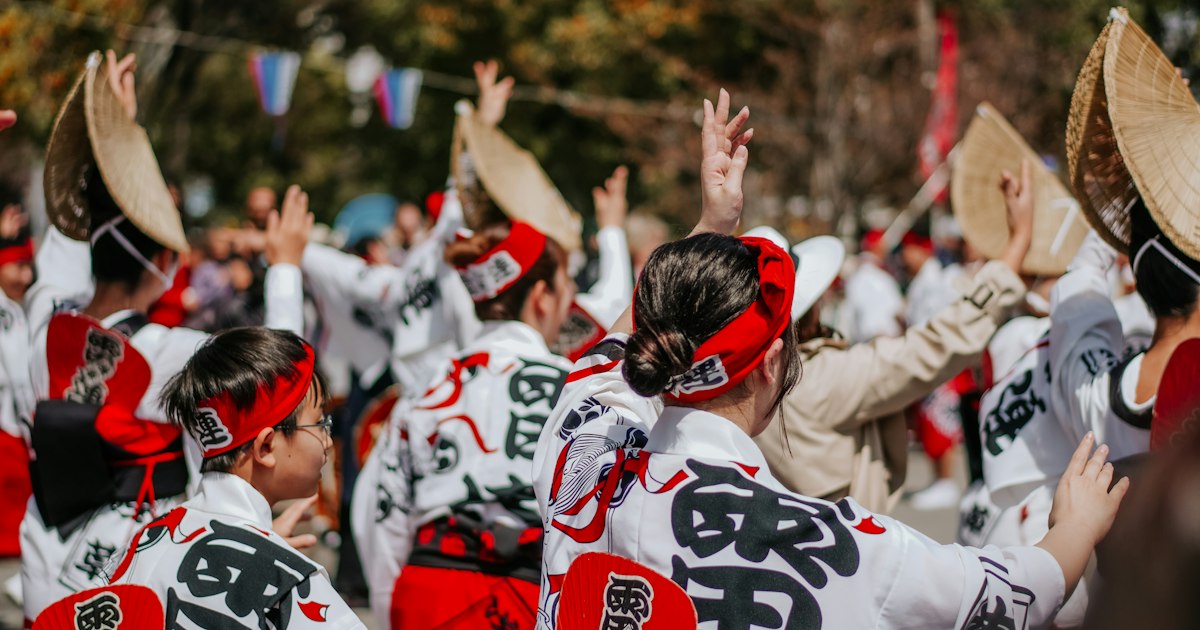
Photo by Ramon Buçard on Unsplash
If you’ve ever seen photos of a Japanese summer matsuri — rows of people hauling a lacquered shrine float through the streets, all wearing matching short cotton jackets with a bold kanji character on the back — that jacket is a happi coat. It’s one of the easiest pieces of real Japanese culture to buy as a souvenir, but also one that’s easy to buy wrong if you don’t know what you’re looking at. Here’s what a happi actually is, when and where to wear one, and exactly where in Japan to buy a good one at whatever budget you’ve got.
What a Happi Coat Actually Is
A happi (法被) is a short, straight-cut cotton coat, open at the front, traditionally worn over regular clothes and tied loosely with a sash. It’s not a kimono and doesn’t fold the same way — there’s no wrapping technique to get wrong, which makes it far more forgiving for a visitor than a yukata. The back and sleeves usually carry a dyed kanji character: the name of a neighborhood, a shop, a festival, or a taiko drumming group. Historically, happi marked which team or guild someone belonged to, the same way a sports jersey does today — firefighters, shop workers, and festival crews all had their own designs.
Don’t confuse it with a haori (a more formal kimono jacket with a lining, worn over a kimono) or a jinbei (a two-piece summer loungewear set). Happi are plain, unlined, and built to be worn hard — sweated in, rained on, and thrown in a bag afterward.
Best Season and Festivals to Wear One
Matsuri season peaks from July through September, with the heaviest concentration around Obon in mid-August. Tokyo’s big ones — Sanja Matsuri in Asakusa (mid-May) and Kanda Matsuri (mid-May, odd years for the main procession) — are actually in spring, so don’t assume all happi-wearing festivals are summer events. If taiko drumming is the draw rather than a street procession, happi show up at performances year-round; see our guide to taiko drums and where to take a lesson for venues where you’ll see the jackets worn on stage.
Shops stock happi for tourists from roughly June through September, timed to the same summer apparel push as yukata and jinbei. Buy in June or early July if you want first pick of sizes and designs — by late August, the cheap seasonal stock at discount stores is often picked over.
Where to Buy One in Tokyo
Asakusa is the single best place to buy a happi as a souvenir. The backstreets around Sensoji — particularly Denboin-dori, just south of the main Nakamise shopping street — have several small shops selling cotton happi printed with a generic “祭” (matsuri) character, priced for tourists rather than festival teams. Most shops open around 10:00am and close by 6:00–7:00pm, and almost none take a weekly closing day, so you can swing by any day of your trip. Get there via Asakusa Station (Tokyo Metro Ginza Line, Toei Asakusa Line, or Tobu Skytree Line) — it’s a 3–5 minute walk to the temple grounds from any exit.
Kappabashi Dougu-gai, Tokyo’s kitchen-supply town, is the under-the-radar option. It exists to outfit restaurants and festival-stall vendors, so several shops here sell plain happi as work uniforms — no tourist markup, often sold by the piece without a minimum order. The catch: many Kappabashi shops close on Sundays and public holidays, so check before you go. It’s about a 7-minute walk north from Tawaramachi Station (Ginza Line), roughly midway between Asakusa and Ueno.
For a zero-effort backup option, Don Quijote stocks seasonal costume-grade happi (thin, often polyester, loose one-size fit) in its party/costume section every summer — fine for a festival photo, not something you’ll want to wear twice.
What to Expect to Pay
- Budget (¥1,000–2,500): Don Quijote or variety-store costume happi — polyester or poly-cotton blend, printed (not dyed) design, one adult size. Good for a single night out.
- Mid-range (¥3,000–6,000): Cotton happi from Asakusa or Kappabashi shops, properly dyed kanji, actual adult sizing (S/M/L). This is the sweet spot for a souvenir you’ll actually keep and wear again.
- Splurge (¥8,000–20,000+): Custom chusen-dyed happi — a traditional hand-dyeing technique where the pattern is dyed through the fabric rather than printed on top, so it doesn’t crack or fade. Some Tokyo dye workshops and online specialty shops will put your name or a design of your choice on one; expect a lead time of two to several weeks since it’s made to order, not stock.
Buying Online or Getting One Custom-Printed
If you don’t make it to Asakusa, Rakuten and Amazon Japan both carry a wide range of mass-produced cotton happi in the ¥2,500–5,000 range, searchable with the term “法被” (happi) or “祭り半纏” (matsuri hanten, a near-synonym). Sizing runs looser than Western clothing — happi are meant to be worn loose and open, so the listed size usually fits one or two sizes up from what you’d normally wear. For a custom name or logo, several Tokyo print and dye shops take mail orders; search for “法被 オリジナル” (happi original/custom) to find current workshops, since specific shops come and go.
Common Mistakes to Avoid
The biggest one: buying or wearing a happi with an actual neighborhood or shrine team’s crest on it. Those designs belong to specific festival associations, and real matsuri participants can tell the difference instantly — showing up in one as an outsider reads as disrespectful, not as a costume choice. Stick to generic “祭” designs, your own name, or a design with no team affiliation, and you’re fine.
Second mistake: assuming all happi are built the same. Costume-grade polyester ones run hot and don’t breathe — rough going on a humid August night hauling through a crowd. If you’re actually going to wear it outdoors for hours, pay the extra couple thousand yen for cotton.
Third: forgetting that matsuri routes are often lined with food stalls but very few places to actually sit and smoke or take a break. If you smoke, Japan’s street-smoking rules are enforced strictly in festival districts; check our guide to designated smoking areas in Japan before you head out, since lighting up mid-crowd can get you fined in some wards.
Finally, don’t skip the stalls themselves — the cheap snacks sold along a matsuri route are part of the experience, and many overlap with the retro candy shops covered in our dagashi guide, worth a browse while you’re wearing your new jacket.
The Takeaway
A happi coat is one of the cheapest, most wearable pieces of Japanese culture you can bring home — unlike a kimono, there’s no technique to learn, and unlike most souvenirs, you’ll actually have an occasion to wear it again. Buy cotton if you can, skip anything with a crest that isn’t yours, and go to Asakusa first; it’s still the most reliable place in the country to walk away with one that fits and looks the part.