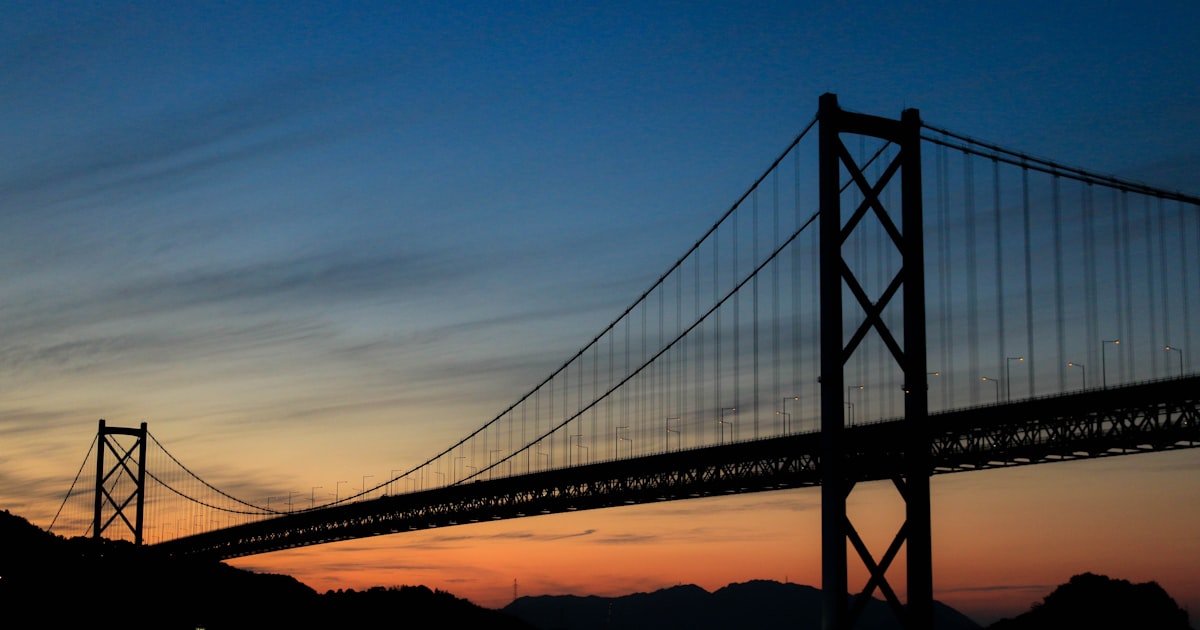
Photo by Ray Waller on Unsplash
The Shimanami Kaido is a roughly 70-kilometer expressway that links Onomichi on the Honshu mainland to Imabari on the island of Shikoku, hopping across six small islands in the Seto Inland Sea via a chain of dramatic suspension and cable-stayed bridges. Unlike most of Japan’s expressways, this one has a dedicated, well-marked cycling lane running its entire length, which is why it’s routinely ranked among the best long-distance bike routes in Asia. You don’t need to be a serious cyclist to do it — the route is flat where it needs to be, the climbs onto the bridges are gentle and gradual, and rental shops make it easy to show up with nothing and leave with everything you need.
Why Cycle the Shimanami Kaido
The appeal is the combination of engineering and scenery: you ride across some of the longest suspension bridges in the world with open sea on both sides, then drop down onto quiet island roads lined with citrus orchards, fishing harbors, and small shrines. The full route (Onomichi to Imabari or the reverse) is well within reach for an average rider in a single long day — most people take 6 to 8 hours including stops — but splitting it into two days with an overnight on one of the islands lets you actually enjoy the temples, cafes, and lookout points instead of racing the clock.
Getting There
Onomichi, the Honshu starting point, is reached via JR Fukuyama Station on the Sanyo Shinkansen line, then a roughly 15-minute ride on the local JR Sanyo Line to Onomichi Station. Imabari, the Shikoku endpoint, is served by limited express trains from Matsuyama and by long-distance and overnight buses from cities including Osaka, Hiroshima, and Tokyo — a budget-friendly option worth considering if you’d rather save shinkansen money for the trip itself; see our guide to overnight buses in Japan for how these work. If you’re combining the ride with a wider loop through Shikoku, our Shikoku travel guide covers onward stops like the Iya Valley and Naruto whirlpools, both reachable from Imabari in a day or two. Regional IC cards work on trains and buses on both ends of the route; if you’re not already carrying one, our guide to IC cards beyond Tokyo explains which one covers this area (ICOCA, on the Honshu side).
The Route: Bridges and Islands
From Onomichi you cross, in order, Mukaishima, Innoshima, Ikuchijima, Omishima, Hakatajima, and Oshima before reaching Imabari — six islands and seven major bridge crossings in total. The cycling course is marked with a continuous blue line painted on the road surface, so navigation is almost foolproof; you simply follow the blue line and the blue-and-white directional signs at every junction. Cyclists currently cross all of the toll bridges for free, a policy the local governments introduced to encourage cycling tourism, so the only costs on the route itself are food, drinks, and any detours you make off the main course. Worth noting: the dedicated bike lane is separate from the car expressway on most bridges, but on a couple of sections cyclists share a narrower path with pedestrians, so keep your speed down near the bridge approaches, especially on Kurushima-Kaikyo Bridge near Imabari, which has its own observation park worth a stop.
Renting a Bike (and Getting It Back)
You don’t need to bring your own bicycle. Sanyo Shimanami Rental Cycle operates around 14 terminals along the route, including at Onomichi and Imabari, and lets you pick up at one terminal and drop off at another — ideal for a one-way ride. Standard city bikes run roughly 2,000 yen per day, cross bikes and road bikes cost more (around 3,000-4,500 yen), and electric-assist bikes are also available at higher-traffic terminals for riders worried about the bridge climbs. You’ll pay a refundable deposit (around 1,000 yen) that’s returned when you drop the bike at any terminal, plus a small one-way return fee if you don’t return to your starting point. Terminals typically operate from around 7:00 or 8:00 AM until 17:00-19:00 depending on the season, and bikes must be returned before closing — plan your day around this if you’re not staying overnight partway.
Best Time to Go
Spring (late March through May) and autumn (October and November) are the sweet spot — mild temperatures, low humidity, and good visibility across the water. Early June through July is the rainy season, and August brings intense heat and humidity that make the exposed bridge sections genuinely tough going; September and early October carry typhoon risk, which can shut down bridge crossings on short notice. Weekday rides are noticeably quieter than weekends, when the route fills with local cycling clubs and tour groups, particularly around Ikuchijima’s Setoda area.
Where to Eat and Sleep Along the Way
Onomichi is known for its soy-based ramen (around 700-900 yen a bowl) — worth trying before you set off. On Ikuchijima, the town of Setoda is the region’s citrus hub, with lemon soft-serve, lemon udon, and other lemon-themed snacks sold near Kosanji Temple, a flamboyant temple complex with a marble sculpture garden (admission around 1,400 yen). Imabari is famous for its yakitori, grilled over charcoal in a distinctive skewer-and-iron-plate style. For accommodation, budget travelers can find cycling-terminal guesthouses and hostels from around 3,000-5,000 yen a night, while business hotels in Onomichi and Imabari run 6,000-9,000 yen. For a splurge, Azumi Setoda in a restored 140-year-old merchant house on Ikuchijima offers high-end kaiseki dinners and private garden onsen from around 35,000-50,000 yen per night — a genuinely memorable way to break up the ride. Whichever route you take, pack a change of clothes for the evening; after a full day of riding you’ll want it, and our guide to doing laundry in Japan is handy if you’re stretching a light packing list over a longer trip.
Common Mistakes to Avoid
Carry cash — island convenience stores and small food stalls between towns don’t always take cards. Don’t underestimate the wind on the bridge sections; even a flat-feeling route can slow you down considerably when crossing open water in a headwind. Book island accommodation ahead during spring and autumn weekends, since options on the smaller islands are limited and fill quickly. Check the rental terminal’s closing time before you set off, factoring in stops for photos and food, since arriving late can mean scrambling for a taxi or an unplanned overnight. And if cycling 70 km in a day doesn’t appeal, it’s entirely possible to drive the route instead — see our guide to renting a car in Japan for licensing rules and costs — or ride only the most scenic middle section, between Ikuchijima and Omishima, and bus back rather than committing to the full crossing.