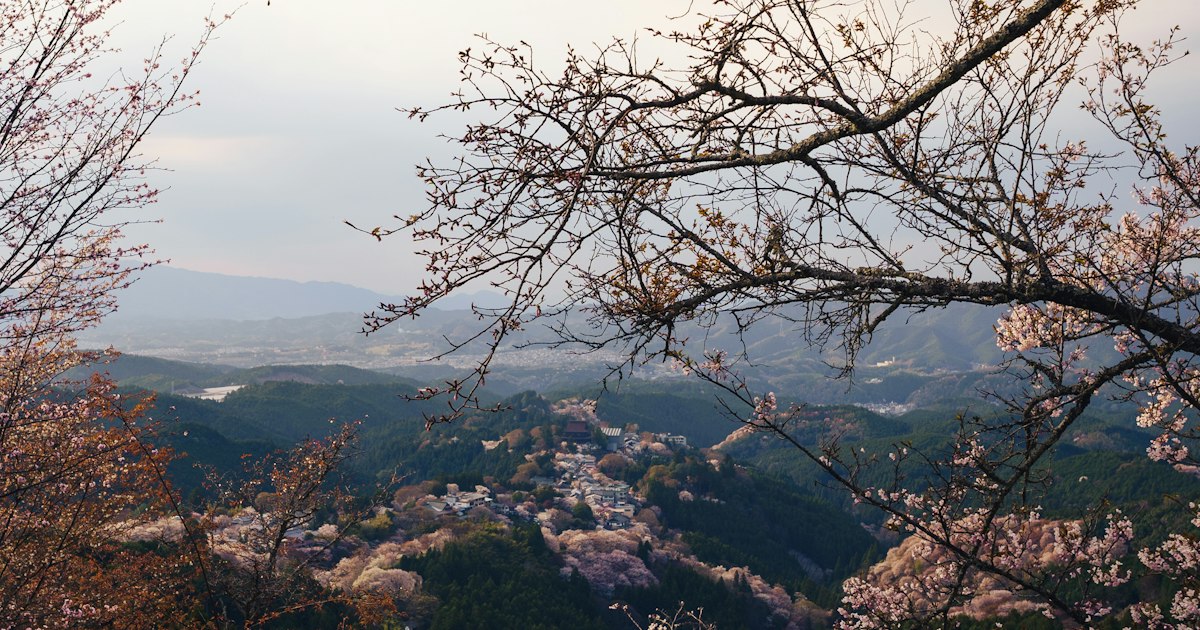
Photo by Red Shuheart on Unsplash
Mount Yoshino in Nara Prefecture is the spot that gave Japan its obsession with cherry blossoms in the first place. For over 1,300 years, people have climbed this single mountain to see roughly 30,000 cherry trees—mostly the pale pink Yamazakura (mountain cherry) variety—blooming in staggered waves from the base to the summit. No other hanami destination in Japan comes close in scale, history, or sheer visual drama. Here’s what you actually need to know to visit it well.
Why Yoshino Is Different From Other Hanami Spots
Most famous cherry blossom spots in Japan—Ueno Park, the Philosopher’s Path in Kyoto, Himeji Castle—are flat, contained, and bloom all at once over a few days. Yoshino is a mountain, divided into four zones at increasing elevation: Shimo Senbon (lower thousand), Naka Senbon (middle thousand), Kami Senbon (upper thousand), and Oku Senbon (inner thousand). Because each zone sits at a different altitude, they bloom in sequence rather than together, stretching the viewing season across roughly two to three weeks instead of a single weekend. Shimo Senbon typically opens first, Naka Senbon and Kami Senbon follow a few days to a week later, and Oku Senbon trails last. This staggered bloom is Yoshino’s single biggest practical advantage: you have more flexibility to time a visit than almost anywhere else in Japan.
When to Go
Peak bloom at Yoshino generally falls in the first two weeks of April, though this shifts year to year with spring temperatures—recent seasons have trended slightly earlier. Naka Senbon, the most photographed section with its famous view of the mountainside painted in pink from the Hanayagura observation deck, usually peaks in early-to-mid April. If you want the classic “mountain covered in cherry blossoms” postcard shot, this is the timing to aim for. Checking a current-year bloom forecast (search “Yoshino sakura bloom forecast” closer to your travel dates) is essential, since the window is narrow and the mountain’s scale makes a mistimed visit obvious—you’ll see mostly green leaves instead of pink flowers if you’re even a week off at a given elevation.
Weekday visits are strongly preferable. On weekends during peak bloom, Yoshino can see well over 100,000 visitors in a single day, and the single main pedestrian street up the mountain becomes a slow shuffle rather than a walk.
How to Get There
Yoshino is accessible by train but requires a transfer, so budget a half-day each way if you’re coming from Osaka or Kyoto. The route is: take the Kintetsu Yoshino Line to Yoshino Station (the terminus). From Kyoto or Namba in Osaka, this usually means a limited express train to Yoshino, which takes about 1 hour 20 minutes to 1 hour 40 minutes depending on your starting point, with a one-way limited express fare typically around 1,000–1,500 JPY on top of the base fare. From Nara city, you’ll generally connect via Kashihara-jingu-mae Station.
From Yoshino Station, most visitors ride the Yoshino Ropeway (a short cable car) up to Senbonguchi Station near the Shimo Senbon area for about 450 JPY one-way, then walk the rest of the mountain on foot. The ropeway has limited capacity and long queues during peak season—during the busiest weekends, waits of 30–60 minutes are common, and it’s entirely possible to walk the same route in about 20–30 minutes instead if you’d rather skip the line.
Walking the Mountain: What to Expect
The main route is a single paved pedestrian street (Yoshino’s “Nanamagari” and the path beyond it) lined with shops, food stalls, and ryokan, climbing gradually from Shimo Senbon through Naka Senbon toward Kami Senbon. This is not a wilderness hike in its lower sections—it’s closer to a steep village high street—but reaching Oku Senbon at the top does involve a longer, more rugged walk past Kinpusenji Temple and further up, and many day-trippers don’t make it that far. Realistically, seeing Shimo and Naka Senbon well takes 3–4 hours round trip at a relaxed pace with stops for photos and food; adding Kami Senbon pushes that closer to 5–6 hours.
If you enjoy a mountain climb paired with a historic religious site, the pacing here will feel familiar if you’ve done Yamadera’s thousand-step climb in Yamagata—steady uphill walking rewarded by views and temple stops along the way, though Yoshino is far less strenuous and spreads the climb over a longer, gentler distance.
Key Sights Along the Way
- Hanayagura Observation Deck (Naka Senbon) — the single most photographed viewpoint on the mountain, looking back over a slope entirely covered in cherry trees. Free to visit, but crowded during peak bloom.
- Kinpusenji Temple — a UNESCO World Heritage site and the spiritual heart of Yoshino, home to the Zao-do Hall, one of the largest wooden buildings in Japan. Entry to the main hall is around 1,000 JPY; the temple grounds themselves are generally open 8:30am–4:00pm.
- Yoshimizu Shrine — a smaller, quieter shrine with one of the best framed views of the Naka Senbon slope, and historically tied to several famous figures in Japanese history.
- Kami Senbon and Oku Senbon — far fewer visitors make it this far up, which means better odds of a quiet, uncrowded view if you’re willing to keep climbing.
Budget, Mid-Range, and Splurge Options
Budget travelers can see Yoshino as a day trip from Kyoto or Osaka for roughly 3,000–4,000 JPY round-trip in train and ropeway fares, grazing on street food (grilled mochi, kakinoha-zushi—persimmon-leaf wrapped sushi, a local specialty—usually 500–800 JPY per portion) along the main street instead of sitting down for a meal.
Mid-range visitors should consider staying one night in a Yoshino ryokan, many of which cost around 15,000–25,000 JPY per person with dinner and breakfast included. Staying overnight means you can see the mountain lit up for yozakura (night cherry blossom illuminations, typically running until around 10pm during peak season) and get an early start the next morning before day-trip crowds arrive by midday.
For a splurge, a handful of ryokan near Yoshimizu Shrine and Naka Senbon offer rooms with direct cherry blossom views from the window or private bath—worth booking many months ahead, as these sell out well before the season even starts.
Common Mistakes to Avoid
The biggest mistake is assuming the whole mountain blooms at once and planning a single-day visit around one date—check which zone is blooming before you commit, since Shimo Senbon fading doesn’t mean Kami Senbon isn’t just starting. The second is underestimating weekend crowding; if your schedule allows any flexibility, go on a weekday, ideally arriving before 9am. Third, many visitors skip lunch planning entirely—restaurants along the main street fill up fast at midday during peak bloom, so either eat early, eat late, or rely on street stalls. Finally, don’t assume you’ll get a same-day ropeway ride without a wait; if you’re short on time, just walk—it’s often faster.
Combined with a stop at a nearby onsen like Yunomine Onsen in Wakayama or a day hike such as Mount Mitake near Tokyo on a different leg of your trip, Yoshino fits naturally into a broader itinerary built around Japan’s mountain villages and seasonal scenery—just build in enough buffer time, since this is one destination where the crowds and the bloom timing both genuinely dictate the pace of your day.