Some links below are affiliate links. If you book through them, Japan Trove may earn a small commission at no extra cost to you.
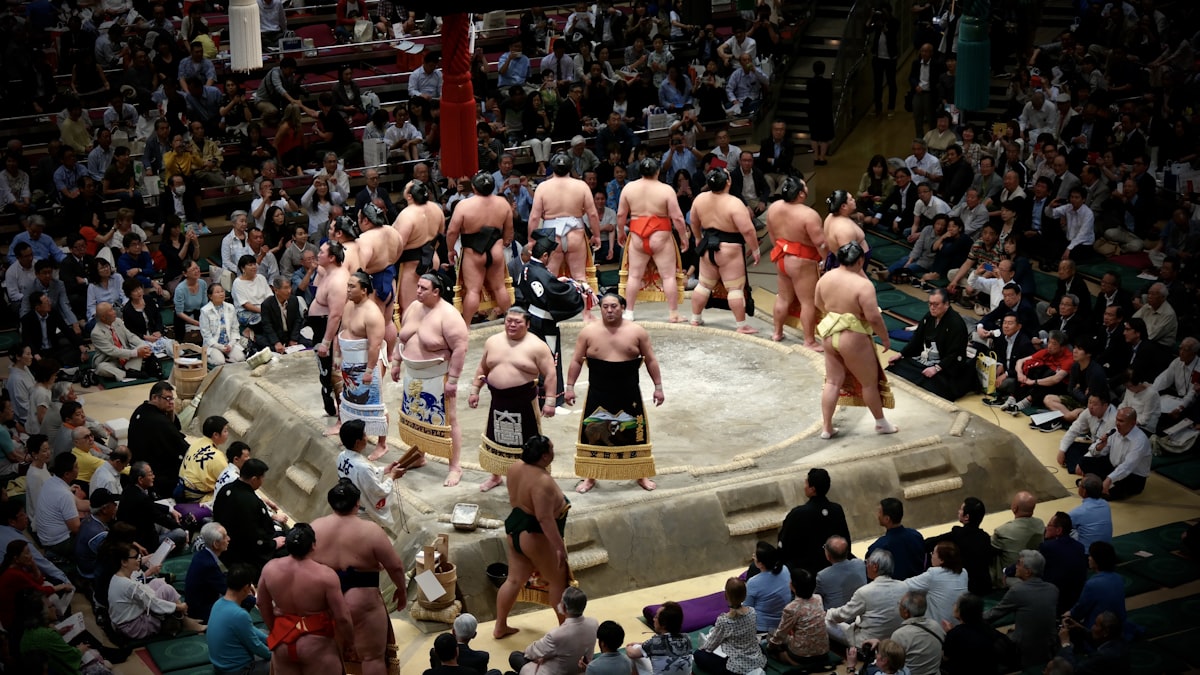
Watching sumo live is one of Japan’s most thrilling cultural experiences — ancient ritual, explosive bouts, and roaring crowds. Here’s how to see it, whether at a tournament or a morning practice.
Grand tournaments (honbasho)
Six 15-day tournaments run each year: Tokyo (Jan, May, Sep), Osaka (Mar), Nagoya (Jul), and Fukuoka (Nov). The top-division bouts run late afternoon and build to the finale.
Getting tickets
- Buy as early as possible — popular tournaments sell out. Tickets go on sale about a month ahead.
- Ringside (expensive, cushions on the floor), box seats (tatami, sold as a set), and arena seats (cheapest, upstairs).
- Compare official and resale options; some tours include tickets on Klook .
No tournament on? See morning practice
Outside tournament days you can watch a morning practice (asageiko) at a sumo stable — usually via a guided tour, with strict etiquette (stay quiet, no eating). A memorable up-close alternative.
What to expect & etiquette
- Arrive later for the top division if you can’t stay all day; the atmosphere peaks near the end.
- Try chanko nabe — the hearty hot pot wrestlers eat.
- Cushion-throwing after an upset is traditional but officially discouraged — follow the crowd’s lead. See our etiquette guide.
Getting there
Tokyo bouts are at Ryogoku Kokugikan — grab an IC card and see our Tokyo guide. Fold it into your itinerary if dates line up.
What sumo tickets cost
- Arena seats (2F): roughly JPY 2,100-3,800 — the cheapest way in and a fine view of the whole ring.
- Box seats (masu-seki): sold as a set of 2-4 people sitting on tatami, roughly JPY 9,000-18,000 for the box depending on proximity to the ring.
- Ringside cushion seats: the most expensive and hardest to get, often JPY 45,000+ and sometimes only available through connections or resale.
- Morning stable practice tours through a licensed operator typically run JPY 8,000-15,000 per person, including guide commentary.
Common mistakes to avoid
- Arriving right at doors-open time expecting top-division action — the marquee wrestlers (makuuchi) fight late afternoon; lower-ranked bouts fill the earlier hours and are far less crowded to watch if you want a quieter warm-up.
- Booking box seats without realizing there are no chairs — you sit on cushions on the tatami floor, which some visitors find uncomfortable for a full multi-hour session; arena seats have normal chairs.
- Skipping tournament months entirely because you assumed sumo isn’t happening — outside the six annual honbasho, stable visits and sumo-themed restaurants (serving chanko nabe) keep the culture accessible year-round.
A typical tournament day
Doors open around 8am, but most visitors arrive by early-to-mid afternoon to catch the ranked divisions build toward the final bouts around 6pm. Wrestlers’ pre-bout rituals — the salt throwing, leg stomping, and staring contests — take up more time than the bouts themselves, which often last only a few seconds; this rhythm is part of what makes a first visit surprising and worth staying for the full session rather than dipping in briefly.